
Pristomyrmex longispinus
- Wetenschappelijke naam
- Pristomyrmex longispinus
- Tribus
- Crematogastrini
- Subfamilie
- Myrmicinae
- Auteur
- Wang, 2003
- Verspreiding
- Gevonden in 1 landen
Introductie
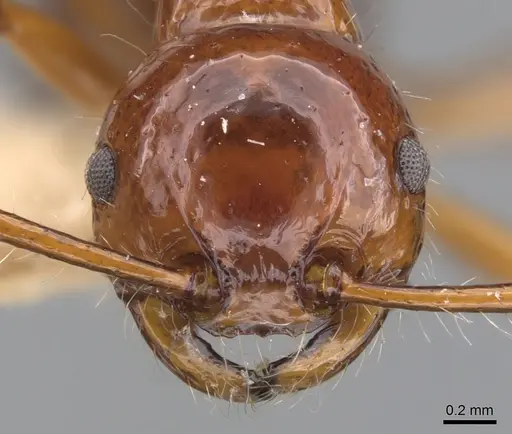
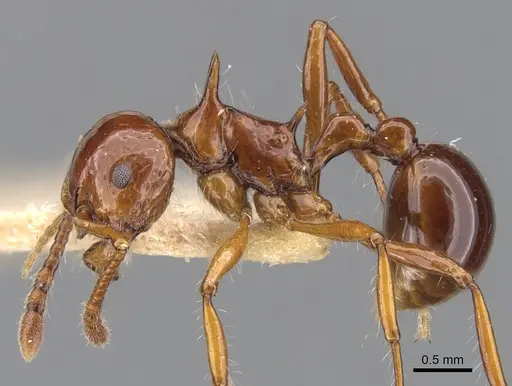
Pristomyrmex longispinus is a small ant species endemic to the Philippines, specifically found in Negros Oriental and possibly Cebu . Workers measure 4.5-5.7 mm in total length and have a distinctive appearance with exceptionally long pronotal spines that are roughly twice the length of their propodeal spines . Their body is reddish-brown, smooth, and shining with sparse punctures on the head . Workers have been observed foraging on leaves, which is rare for Pristomyrmex ants that typically forage on the ground . Queens have never been collected, so colony structure remains unknown .
Quick Summary
- Difficulty: Hard
- Origin & Habitat: Philippines (Negros Oriental, possibly Cebu) in tropical forest habitats [1][2]
- Colony Type: Unconfirmed, queens have never been collected [3]
- Size & Growth:
- Queen: Unknown, queens have not been described [3]
- Worker: 4.5-5.7 mm [1]
- Colony: Unknown, no colony size data available
- Growth: Unknown
- Development: Unknown, no development data exists for this species (Based on related tropical Pristomyrmex species, development may take 4-8 weeks, but this is an estimate with no species-specific confirmation)
- Antkeeping:
- Temperature: Based on tropical Philippine origin, likely comfortable at 22-28°C. Start in this range and observe colony activity [1]
- Humidity: Tropical forest origin suggests moderate humidity. Keep substrate slightly moist but not waterlogged [1]
- Diapause: As a tropical species, they likely do not require diapause [1]
- Nesting: No specific nesting data. Based on genus patterns, they likely nest in soil or rotting wood. Use a test tube setup or Y-tong nest [3]
- Behavior: Workers have been observed foraging on leaves, which is unusual for Pristomyrmex ants [1]. Primary defense is a smear mechanism using a modified stinger, typical of subfamily Myrmicinae, tribe Crematogastrini. Given their small size (under 6 mm), escape prevention should be moderate, standard barriers should suffice.
- Common Issues: wild colonies are the only source since queens have never been collected, making captive breeding impossible [3], no captive keeping experience exists, so care requirements are entirely inferred [3], tropical species may be sensitive to temperature drops below 20°C [1], growth and development timeline unknown makes colony management difficult [3], colony structure unconfirmed due to lack of queen data [3]
Species Overview and Identification
Pristomyrmex longispinus is a Philippine endemic ant species first described by Wang in 2003. Workers are small at 4.5-5.7 mm total length, with a distinctive reddish-brown coloration and smooth, shining body surface [1]. The most striking morphological feature is their exceptionally long pronotal spines, roughly twice as long as their propodeal spines [1]. This gives them a spiny appearance compared to many other Myrmicinae ants.
The species is closely related to Pristomyrmex curvulus and belongs to the Quadridens species group. Key identification features include the petiolar node being indistinguishable from its anterior peduncle in profile, and the first gastral tergite lacking erect hairs [1]. Males have been collected alongside workers, but queens have never been found [3].
Distribution and Habitat
Pristomyrmex longispinus is endemic to the Philippines, specifically found in Negros Oriental and possibly Cebu [1][2]. As a tropical species, it inhabits humid forest environments. Zettel (2006) noted that this species is one of only two Philippine Pristomyrmex species with punctured heads and long pronotal spines [1]. Workers foraging on leaves suggest some arboreal or semi-arboreal behavior, though more observations are needed.
Defense Mechanism
Pristomyrmex longispinus belongs to subfamily Myrmicinae, tribe Crematogastrini, which typically use a smear defense mechanism with a modified stinger. No specific literature exists for this species, so this is based on taxonomic knowledge.
Current Knowledge Gaps
This species has significant knowledge gaps, queens have never been collected, meaning no information on colony structure, founding behavior, or development [3]. This makes captive keeping experimental, as all care must be inferred from genus patterns. Antkeepers should start with standard Myrmicinae protocols and adjust based on colony response.
Inferred Care Recommendations
Since no captive data exists, care is inferred from tropical Philippine origin and genus patterns. Provide a temperature range of 22-28°C as a starting point, warm and stable, typical of tropical species [1]. For humidity, aim for moderate levels with slightly moist substrate [1]. Use a test tube setup for founding colonies or Y-tong nests for established colonies [3]. Feeding should include protein sources like small insects and sugar water, following typical Myrmicinae preferences.
Comparison to Related Species
Pristomyrmex longispinus is closely related to Pristomyrmex curvulus, with workers similar in spine shape, body size, and color [3]. The genus Pristomyrmex contains around 40 species, mostly in Old World tropics, and many lack queen descriptions. For antkeepers, more commonly kept Pristomyrmex species with existing data would be better starting points.
Frequently Asked Questions
Can I keep Pristomyrmex longispinus in captivity?
Keeping them is experimental due to lack of captive data. Queens have never been collected, so wild colonies are the only source [3].
What do Pristomyrmex longispinus ants eat?
Their diet is unconfirmed, but based on genus patterns, they likely accept small insects and sugary liquids. Workers foraging on leaves suggest possible omnivory [1]. Offer small protein sources and sugar water as a starting point.
How big do Pristomyrmex longispinus colonies get?
Colony size is unknown, no data has been published [3].
Do Pristomyrmex longispinus ants sting?
Sting capability is unconfirmed, but most Pristomyrmex species have a functional stinger. Given their small size, any sting would likely be mild.
What temperature do Pristomyrmex longispinus ants need?
Temperature requirements are unconfirmed. As a tropical species, they likely prefer 22-28°C. Start at room temperature and observe colony behavior [1].
Where is Pristomyrmex longispinus found?
This species is endemic to the Philippines, specifically Negros Oriental and possibly Cebu [1][2].
Why have queens never been found for Pristomyrmex longispinus?
Queens have not been collected in any known sampling effort. This is not unusual for Pristomyrmex species, where queen castes remain unknown [3].
Are Pristomyrmex longispinus good for ant-keeping beginners?
No, this species is not recommended for beginners due to lack of captive care protocols and unknown queen status [3].
Do Pristomyrmex longispinus ants need hibernation?
Diapause requirements are unknown, but as a tropical species, they likely do not require hibernation [1].
How long does it take for Pristomyrmex longispinus to develop from egg to worker?
The egg-to-worker timeline is completely unknown. Related tropical species may develop in 4-8 weeks, but this is an estimate with no species-specific confirmation [3].
Report an Issue
The current care sheet is based fully on literature. See inconsistencies, or something that's incorrect? Please , it will be resolved after review from an admin. Contributing to the blogs tab also helps providing information, to make us be able to further improve the caresheets. Thank you for your support!
References

Dit verzorgingsblad is gelicentieerd onder CC BY-SA 4.0 .
Community-blogs
CASENT0901715
Bekijk op AntWeb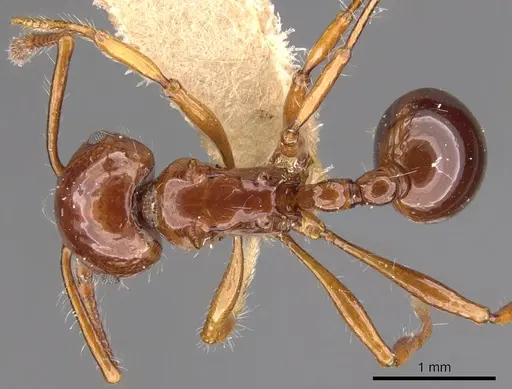
Literatuur
Verspreidingskaart laden...Producten laden...