
Plagiolepis dichroa
- Wetenschappelijke naam
- Plagiolepis dichroa
- Tribus
- Plagiolepidini
- Subfamilie
- Formicinae
- Auteur
- Forel, 1902
- Verspreiding
- Gevonden in 1 landen
Introductie
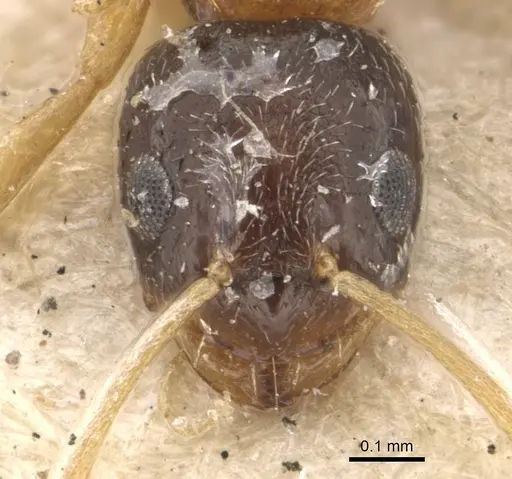
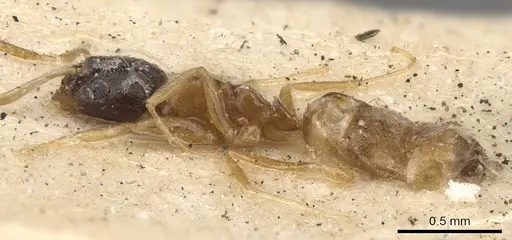
Plagiolepis dichroa is a tiny yellow ant native to India and Bangladesh in the Indomalaya zone . Workers measure just 2mm in length and have a distinctive look – they're yellow with the head shading to light or dark brown, and their body is smooth and shiny with very sparse hair . These ants belong to the Formicinae subfamily and are classified as a cryptic species, meaning they nest in hidden, concealed spots like under stones or in rotting wood . This species is found across much of northern and eastern India, from the Himalayan foothills (up to 1500m elevation) through the Western Ghats and into West Bengal, plus parts of Bangladesh . Their tiny size and secretive habits make them a challenging species for antkeepers who have experience with small, cryptic ants.
Quick Summary
- Difficulty: Hard
- Origin & Habitat: Native to India and Bangladesh in the Indomalaya zone [1]. Recorded from Himachal Pradesh, Jammu & Kashmir, Karnataka, Meghalaya, Sikkim, West Bengal, and Bangladesh [5][1]. Found at elevations up to 1500 meters in the Himalayas [4]. As a cryptic species, they likely nest in hidden microhabitats like under stones, in soil crevices, or within rotting wood in forested areas [3].
- Colony Type: Unconfirmed – no data available on social structure.
- Size & Growth:
- Antkeeping:
- Temperature: Keep at 22-26°C. Being from India with populations up to 1500m elevation, they likely tolerate a range from 20-28°C. A gentle temperature gradient allows ants to self-regulate [4].
- Humidity: Moderate humidity – keep the nest substrate consistently moist but not waterlogged. Their cryptic nature suggests they prefer stable, moderately humid conditions [3].
- Diapause: Probably required. Based on their Himalayan distribution (up to 1500m), they likely experience seasonal cooling. Provide a winter rest period of 2-3 months at 10-15°C [4]. This is an inference – direct confirmation is lacking.
- Nesting: Use small, tight-fitting chambers scaled to their tiny 2mm size [2]. Test tubes work well for founding. For larger colonies, Y-tong (AAC), plaster, or soil nests with narrow passages are suitable. Provide dark, concealed nesting areas – these cryptic ants prefer privacy. Avoid acrylic nests which are not secure for very small ants.
- Behavior: These are tiny, docile ants that are not aggressive. As formicine ants, they have no functional sting – they spray formic acid, but at their size it is harmless to humans. They are cryptic by nature, preferring to stay hidden rather than forage openly. Their tiny 2mm size means they are excellent escape artists – they can squeeze through remarkably small gaps [2]. Foraging style is likely generalist omnivorous, similar to other Plagiolepis species. Activity level is moderate.
- Common Issues: escape prevention is critical – their tiny 2mm size means they can slip through standard barrier setups, use fine mesh and tight-fitting lids, cryptic nesting means they may seem inactive or hidden – don't assume the colony is struggling just because they're not visible, wild-caught colonies may harbor parasites that can devastate captive populations, overfeeding leads to mold in small setups – remove uneaten food promptly, slow colony growth can lead to frustration and neglect – be prepared for a long wait before seeing much activity
Housing and Escape Prevention
Plagiolepis dichroa presents significant housing challenges due to the extremely small worker size of just 2mm [2]. Standard antkeeping equipment often has gaps that these tiny ants can slip through. For founding colonies, use test tubes with cotton plugs packed firmly – the gap between the cotton and the tube wall must be minimal. For larger colonies, Y-tong (AAC) nests work well because the chambers can be scaled to small ants. Plaster or soil nests are also suitable. Do not use acrylic nests, as they are not secure enough for such tiny escape artists.
Escape prevention is essential. Apply Fluon (liquid PTFE) to all rim edges and consider a double barrier system – a moat of water or oil around the outworld, plus fine mesh covering any ventilation holes. Even a 0.5mm gap is enough for these ants to escape. The outworld should be relatively small and enclosed. Place the nest in a dark location – these cryptic ants prefer dim conditions and will be more active when the nest is covered.
Feeding and Diet
Based on genus-level patterns, Plagiolepis ants are generalist omnivores. They likely consume honeydew from aphids and scale insects, small insects, and various sugar sources. In captivity, offer a varied diet: sugar water or honey water (changed every 2-3 days), and small protein sources like fruit flies, tiny crickets, or mealworm pieces.
Feed small amounts initially and observe what the colony accepts. Remove uneaten food within 24-48 hours to prevent mold, which is particularly dangerous in small setups. A feeding schedule of sugar water constantly available plus protein prey once or twice weekly works well for established colonies. During founding, the queen will not eat if founding is claustral (unconfirmed) – she would rely on stored reserves until the first workers emerge. Once workers are present, they will forage for food.
Temperature and Seasonal Care
Plagiolepis dichroa originates from India and Bangladesh, with populations recorded up to 1500m elevation in the Himalayas [4][5][1]. This suggests they prefer warm conditions with moderate humidity. Maintain nest temperatures between 22-26°C year-round, with slight drops acceptable during a winter rest period.
Based on their Himalayan distribution (found at 500m and 1000m elevation) [3], they likely experience seasonal temperature variations. Provide a diapause period of 2-3 months during winter, lowering temperatures to 10-15°C. This can be achieved by moving the colony to a cooler room. Do not feed during diapause, but ensure water access through a moist cotton ball. Resume normal feeding and temperatures gradually in spring. Note that diapause requirements are inferred – not directly confirmed by research.
Colony Establishment and Growth
Starting a Plagiolepis dichroa colony requires patience. If you obtain a founding queen, place her in a standard test tube setup with a water reservoir and keep it in a dark, quiet location. The founding method is unknown – it may be claustral or semi-claustral. If claustral, the queen will seal herself in and not leave to forage, living on stored body fat while raising the first brood.
The time from egg to first worker is unconfirmed. Do not disturb the queen frequently – checking too often can cause her to abandon or consume her brood. Once the first workers emerge, they will gradually begin foraging and can be transitioned to a larger setup when the colony grows. Growth rate and maximum colony size are unknown. This species is best suited for antkeepers who enjoy observing small, cryptic colonies and are comfortable with uncertainty in husbandry.
Frequently Asked Questions
How long does it take for Plagiolepis dichroa to produce first workers?
The exact timeline is unconfirmed. Based on related Formicinae species, it may take 6-10 weeks from egg to first worker at optimal temperatures (22-26°C), but this is an estimate. First workers (nanitics) will be smaller than fully grown workers.
Are Plagiolepis dichroa ants good for beginners?
No – their tiny 2mm size makes escape prevention challenging, and their cryptic nature means colonies can appear inactive even when healthy [2]. They require experienced antkeepers who understand small ant husbandry and are prepared for slow growth.
What size colony do Plagiolepis dichroa colonies reach?
Colony size is unconfirmed – no data is available. Based on typical Plagiolepis patterns, they likely reach a few hundred workers at most, but this is speculative.
Can I keep multiple Plagiolepis dichroa queens together?
Colony structure is unconfirmed. Combining unrelated queens has not been documented for this species. It is not recommended, as queens may fight.
What temperature do Plagiolepis dichroa ants need?
Keep nest temperatures between 22-26°C. They originate from India and Bangladesh, so they prefer warm, stable conditions [4][5][1].
Do Plagiolepis dichroa ants need hibernation?
Likely yes, based on their distribution in Himalayan regions up to 1500m elevation [4]. They probably experience seasonal cooling. Provide a winter rest period of 2-3 months at 10-15°C. This is an inference, not directly confirmed.
Why are my Plagiolepis dichroa ants escaping?
At just 2mm, they are excellent escape artists [2]. Use fine mesh barriers, apply Fluon to rim edges, and ensure all connections are tight. Even tiny gaps around tubing or ventilation can allow escape.
What do Plagiolepis dichroa ants eat?
Based on genus patterns, they are omnivorous. Offer sugar water or honey water, plus small protein sources like fruit flies or tiny crickets. Remove uneaten food promptly to prevent mold.
When should I move Plagiolepis dichroa to a formicarium?
Wait until the colony has at least 20-30 workers and shows signs of crowding in the test tube (workers clustered on the cotton, condensation gone). Moving too early can stress the colony. This timing is based on general antkeeping practice, not published data.
Report an Issue
The current care sheet is based fully on literature. See inconsistencies, or something that's incorrect? Please , it will be resolved after review from an admin. Contributing to the blogs tab also helps providing information, to make us be able to further improve the caresheets. Thank you for your support!
References

Dit verzorgingsblad is gelicentieerd onder CC BY-SA 4.0 .
Community-blogs
CASENT0909848
Bekijk op AntWeb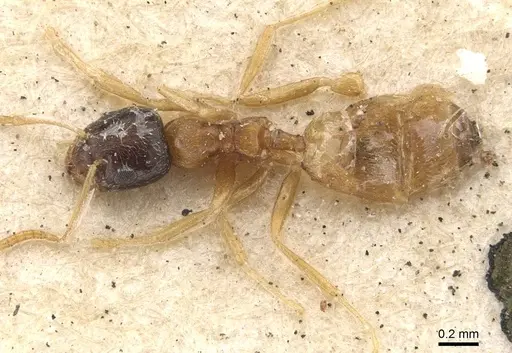
Literatuur
Verspreidingskaart laden...Producten laden...