
Ooceraea coeca
- Wetenschappelijke naam
- Ooceraea coeca
- Subfamilie
- Dorylinae
- Auteur
- Mayr, 1897
- Verspreiding
- Gevonden in 0 landen
Introductie
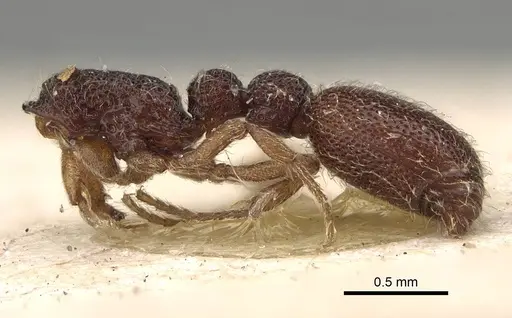
Ooceraea coeca is a blind ant species endemic to Sri Lanka . Workers have 11-segmented antennae and a conspicuously foveolate body . Eyes are absent or vestigial . Size data is unavailable from research . This species is one of the least-studied ants in the hobby, with all confirmed records from Sri Lanka's forests .
Quick Summary
- Difficulty: Expert
- Origin & Habitat: Sri Lanka (Ceylon), found in forest floor environments [1][3].
- Colony Type: Colony structure is unconfirmed. No specific data available.
- Size & Growth:
- Antkeeping:
- Temperature: Based on tropical origin, keep warm around 24-28°C, but no specific data [4].
- Humidity: Keep nest substrate consistently moist but not waterlogged, as Dorylinae often prefer humid conditions [4].
- Diapause: Unknown, Sri Lanka has tropical climate with minimal variation, so diapause may not be necessary.
- Nesting: Use humid nests like Y-tong or plaster. Provide dark, enclosed spaces for their subterranean lifestyle [4].
- Behavior: Likely cryptic and secretive, avoiding light. Based on Dorylinae patterns, may be predatory but not aggressive towards humans [4].
- Common Issues: blindness makes them sensitive to light, keep nesting areas dark., high humidity requirements can lead to mold if ventilation is poor., escape prevention is important, they are small but persistent explorers., no established feeding protocols, experimentation needed., very rare in the hobby with almost no keeper experience.
Appearance and Identification
Ooceraea coeca workers are small ants, but specific size data is unavailable [4]. Their most distinctive feature is their complete lack of functional eyes [1][3]. Body is foveolate, meaning pitted [1][3]. Antennae have 11 segments [1][2][3]. Postpetiole is almost as long as wide [1]. Pronotum has a distinct ridge and is slightly convex dorsally [2][3].
Natural History and Distribution
Ooceraea coeca is endemic to Sri Lanka [1][2][3]. It likely inhabits forest floor environments, foraging in dark, humid microhabitats [1][3].
Housing and Nest Preferences
Based on their blind, subterranean nature, provide dark, humid nests like Y-tong or plaster [4]. Keep nesting areas dark and use simple outworlds since they are not strong climbers.
Feeding and Diet
Feeding protocols are not established. Based on Dorylinae patterns, they may be predatory on small invertebrates [4]. Offer small live prey and observe acceptance.
Temperature and Humidity Requirements
No specific data, but as tropical ants, keep warm and humid [4]. Maintain temperatures around 24-28°C and keep substrate moist but not waterlogged.
Behavior and Temperament
Likely cryptic and secretive, avoiding light [4]. Based on Dorylinae patterns, they may raid other colonies but are not aggressive towards humans.
Frequently Asked Questions
How long does it take for Ooceraea coeca to produce first workers?
The egg-to-worker timeline is unknown for this species since it has never been documented. Be patient, this is a rare species with no development data.
Can I keep Ooceraea coeca in a test tube setup?
Yes, a test tube setup works well for founding colonies. Keep it in darkness and maintain humidity. Once the colony grows, move to a proper nest.
What do Ooceraea coeca eat?
Feeding is not well-established. Based on Dorylinae behavior, they are likely predatory. Offer small live prey like fruit flies or pinhead crickets.
Are Ooceraea coeca good for beginners?
No. This species is rated Expert difficulty due to high humidity needs, rarity, and lack of established care protocols.
Do Ooceraea coeca need hibernation?
Diapause requirements are unknown. Sri Lanka has a tropical climate, so a true hibernation may not be necessary.
How big do Ooceraea coeca colonies get?
Colony size is unknown, no data exists for this species.
Why are Ooceraea coeca blind?
Their blindness is an adaptation to their subterranean lifestyle, where functional eyes provide no advantage [1].
Report an Issue
The current care sheet is based fully on literature. See inconsistencies, or something that's incorrect? Please , it will be resolved after review from an admin. Contributing to the blogs tab also helps providing information, to make us be able to further improve the caresheets. Thank you for your support!
References

Dit verzorgingsblad is gelicentieerd onder CC BY-SA 4.0 .
Community-blogs
CASENT0922424
Bekijk op AntWeb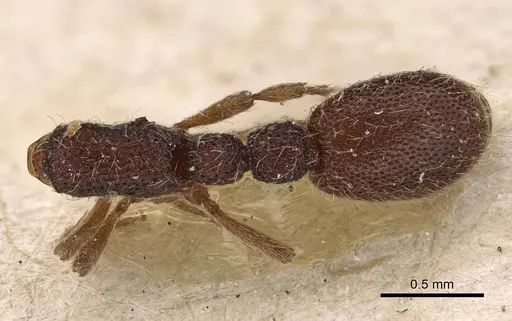
Literatuur
Verspreidingskaart laden...Producten laden...