
Carebara hornata
- Wetenschappelijke naam
- Carebara hornata
- Tribus
- Crematogastrini
- Subfamilie
- Myrmicinae
- Auteur
- Bharti & Kumar, 2013
- Verspreiding
- Gevonden in 0 landen
Introductie
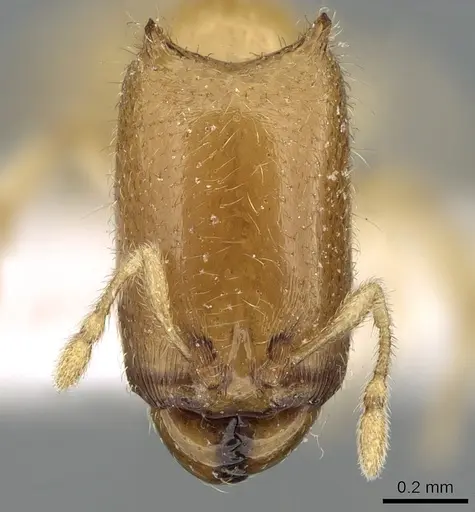
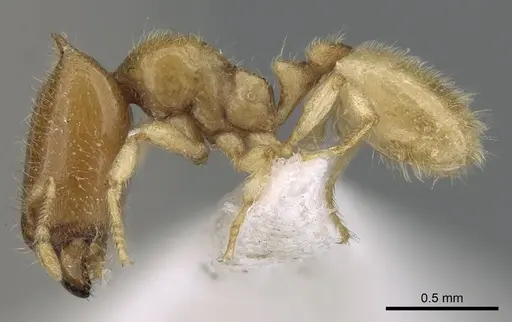
Carebara hornata is a tiny dimorphic ant species endemic to the Himalayan region of India, specifically found in Himachal Pradesh at elevations around 940 meters. The species gets its name from the distinctive horns protruding from the back of the major workers' heads - a striking feature that makes them easily identifiable. Major workers measure 2.7-3.5mm in total length with a large, nearly rectangular head featuring forward-directed horns, while minor workers are considerably smaller at around 1.55mm and lack the horned appearance. Both castes have nine-segmented antennae and remarkably simple eyes consisting of just a single ommatidium, suggesting a subterranean or ground-dwelling lifestyle. The body is yellowish-brown in color. This species remains one of the most poorly studied ants in existence - no biological data exists whatsoever, and even basic colony structure and captive care requirements are completely unknown [AntWiki].
Quick Summary
- Difficulty: Expert
- Origin & Habitat: Endemic to India, specifically found in Himachal Pradesh around Andretta at approximately 940 meters elevation. The region features a subtropical highland climate with moderate temperatures and seasonal monsoons. They have been collected from soil cores, indicating ground-nesting behavior [1][2][3].
- Colony Type: Unconfirmed, colony structure has not been documented in scientific literature.
- Size & Growth:
- Queen: Undescribed, queen caste has not been documented in scientific literature [1][5]
- Worker: Major workers: 2.7-3.5mm total length. Minor workers: ~1.55mm total length [1]
- Colony: Unknown, no colony size data exists
- Growth: Unknown
- Development: Unknown, development has not been studied. (No direct data exists.)
- Antkeeping:
- Temperature: Unknown, no thermal studies exist. Based on the Himalayan location (Himachal Pradesh at 940m), they likely tolerate cooler temperatures than tropical species. Room temperature (18-24°C) is a reasonable starting point. Observe colony activity and adjust accordingly.
- Humidity: Unknown, no humidity data exists. The Himalayan region experiences monsoons, so moderate to high humidity is likely preferred. Keep nest substrate consistently moist but not waterlogged.
- Diapause: Unknown, no overwintering data exists. Given the Himalayan distribution, they likely experience a winter dormancy period. A cool period around 10-15°C for 2-3 months may be appropriate based on similar Himalayan ant species.
- Nesting: No captive nesting data exists. In the wild, they have been collected from soil cores, suggesting ground-nesting behavior. Test tubes or small ytong nests with moist substrate would be appropriate starting points. Their tiny size and simple eyes suggest they prefer dark, humid, subterranean-style nests.
- Behavior: Behavior is completely unstudied. As a Carebara species with very simple eyes (single ommatidium), they are likely subterranean or nocturnal, spending most of their time in soil or under cover. They probably forage for small prey items underground. Escape risk is significant given their tiny size, fine mesh barriers are essential. Aggression levels are unknown but likely low given their cryptic lifestyle. Defense mechanism involves smearing venom onto enemies using a modified stinger.
- Common Issues: completely unknown biology means any captive attempt is essentially experimental, no information on founding behavior, unknown if claustral or semi-claustral, no dietary information exists, unknown what they eat in captivity, tiny size makes escape prevention critical, no data on colony size limits or maximums, keepers must discover through trial and error, no information on queen founding success rates or common failure points
Why Carebara hornata Is an Expert-Only Species
Carebara hornata represents one of the most poorly documented ant species in the world. The scientific literature provides only morphological descriptions of the worker castes, no biological data exists whatsoever. This means there are no studies on their diet, founding behavior, temperature preferences, humidity needs, colony development, nuptial flight timing, or any other aspect of their captive care. Keeping this species is essentially contributing to citizen science, you will be discovering their biology through observation and experimentation. This makes them unsuitable for beginners who need established care protocols. Only experienced antkeepers who understand experimental husbandry and can document their findings should attempt this species. Expect to face many failures and treat each success as a discovery [1][2].
Appearance and Identification
Carebara hornata is a dimorphic species, meaning it has two distinct worker sizes: major workers and minor workers. The most striking feature is the pair of well-developed horns protruding from the back of the major worker's head, these horns are directed upward and forward, giving them a distinctive appearance. Major workers measure 2.7-3.5mm in total length with a large, nearly rectangular head that is about twice as long as it is wide. Minor workers are considerably smaller at around 1.55mm total length and lack the horned appearance. Both castes have nine-segmented antennae and remarkably simple eyes consisting of just a single ommatidium (a single light-sensing cell), which strongly suggests they are adapted to dark, subterranean environments. The body is yellowish-brown in color [1][5].
Natural Habitat and Distribution
This species is endemic to India, known only from a very limited range in Himachal Pradesh. The type locality is Andretta, at approximately 940 meters elevation. This region in the western Himalayas features a subtropical highland climate with moderate temperatures and seasonal monsoon rains. The only specimens have been collected from soil cores, indicating they nest in the ground rather than in wood or above-ground locations. Their extremely limited distribution and the simple eye structure suggest they are cryptic ground-dwellers that rarely venture into open areas [1][2][3].
Housing and Nesting Recommendations
Since no captive data exists, recommendations must be based on inference from morphology and related species. Their tiny size (1.5-3.5mm), simple eyes, and soil-core collection suggest a preference for dark, humid, subterranean conditions. Test tube setups with moist cotton as a water reservoir can serve as founding chambers. For established colonies, small ytong nests with narrow chambers scaled to their tiny size would be appropriate. The nest material should remain consistently moist but not waterlogged. Given their likely cryptic lifestyle, provide darkness, cover the nest except during observations. Escape prevention must be excellent due to their minute size, standard ant keeping barriers may be insufficient [1].
Feeding and Diet - Complete Unknown
The diet of Carebara hornata is completely unstudied. As a Myrmicinae member and given the typical habits of Carebara species, they likely consume small invertebrates and may tend aphids for honeydew. However, this is pure speculation. For a new colony, offer a variety of small food items: tiny pieces of honey or sugar water (though acceptance is uncertain), small live prey like springtails or fruit flies, and small insect parts. Start with very small portions and observe for acceptance. Document what foods they accept and reject, this information would be valuable for the antkeeping community. Do not assume they will accept standard ant foods [1].
Temperature and Seasonal Care
No thermal data exists for this species. The Himalayan location (940m elevation in Himachal Pradesh) suggests they experience cooler temperatures than tropical ants and likely have a winter dormancy period. Room temperature (18-24°C) is a reasonable starting point. During winter, a cool period around 10-15°C for 2-3 months may be appropriate based on similar Himalayan ant species, though this is an educated guess. Monitor colony behavior, if workers become sluggish, the temperature may be too low, if they avoid the nest area, it may be too warm. Any temperature data you gather through experimentation would be scientifically valuable [1][2].
Colony Establishment and Growth
No information exists on colony founding, development timeline, or growth rates. The queen caste has never been described, so even basic colony structure is unknown. If you obtain a founding queen, document everything: how she behaves, whether she seals herself in (claustral founding) or forages (semi-claustral), how long until eggs appear, how long until larvae hatch, and how long until workers emerge. The first workers (nanitics) will likely be smaller than normal workers. Expect development to take several months based on typical ant patterns, but exact timelines are unknown. Patience will be essential, this is truly an experimental species [1].
Frequently Asked Questions
How difficult is Carebara hornata to keep?
Carebara hornata is an expert-only species. Unlike well-documented ants where care guides exist, this species has no biological data in scientific literature. Keeping them is essentially experimental husbandry, you will be discovering their needs through observation. Only experienced antkeepers who understand experimental care and can document their findings should attempt this species.
What do Carebara hornata ants eat?
Diet is completely unknown. Based on typical Carebara genus behavior, they likely eat small invertebrates and may accept honeydew. Start by offering tiny amounts of sugar water, small live prey like springtails or fruit flies, and small insect parts. Document what they accept, this information does not exist in any scientific or hobby literature.
What temperature should I keep Carebara hornata at?
No temperature data exists. Based on their Himalayan location (Himachal Pradesh at 940m elevation), room temperature (18-24°C) is a reasonable starting point. Observe your colony's behavior, if they are active and foraging, the temperature is likely suitable. They likely experience cooler temperatures than tropical ants.
Do Carebara hornata need hibernation?
Unknown, but likely yes. The Himalayan distribution suggests they experience seasonal temperature changes and likely have a winter dormancy period. A cool period around 10-15°C for 2-3 months during winter may be appropriate, similar to other Himalayan ant species.
How big do Carebara hornata colonies get?
Unknown, no colony size data exists.
Can I keep multiple Carebara hornata queens together?
Unknown, colony structure has not been documented. Do not attempt combining unrelated queens until more is known about their natural colony structure.
How long does it take for Carebara hornata to produce first workers?
Unknown, no development data exists.
What size nest do Carebara hornata need?
Given their tiny size (1.5-3.5mm), they need very small, tight chambers scaled to their body size. Test tubes work well for founding colonies. For established colonies, small ytong nests with narrow chambers work best. Keep the nest humid and dark.
Do Carebara hornata ants sting?
Unknown, sting presence and potency has not been documented. As tiny Myrmicinae, they likely have a stinger but it is probably too small to penetrate human skin effectively.
Where is Carebara hornata found in the wild?
Carebara hornata is endemic to India, known only from Himachal Pradesh around Andretta at approximately 940 meters elevation. They have been collected from soil cores, indicating ground-nesting behavior in this subtropical highland region.
Report an Issue
The current care sheet is based fully on literature. See inconsistencies, or something that's incorrect? Please , it will be resolved after review from an admin. Contributing to the blogs tab also helps providing information, to make us be able to further improve the caresheets. Thank you for your support!
References

Dit verzorgingsblad is gelicentieerd onder CC BY-SA 4.0 .
Community-blogs
CASENT0906094
Bekijk op AntWeb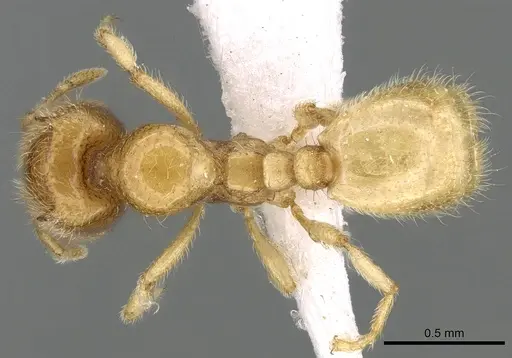
Literatuur
Verspreidingskaart laden...Producten laden...