
Camponotus absquatulator
- Wetenschappelijke naam
- Camponotus absquatulator
- Subgenus
- Tanaemyrmex
- Tribus
- Camponotini
- Subfamilie
- Formicinae
- Auteur
- Snelling, 2006
- Verspreiding
- Gevonden in 0 landen
Introductie
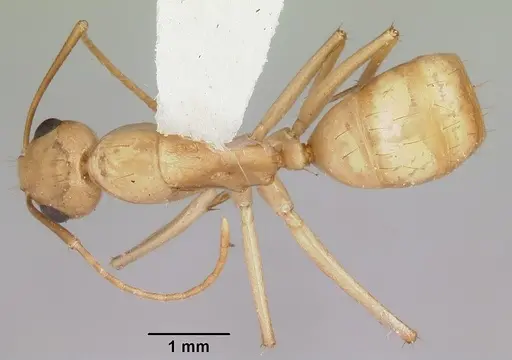
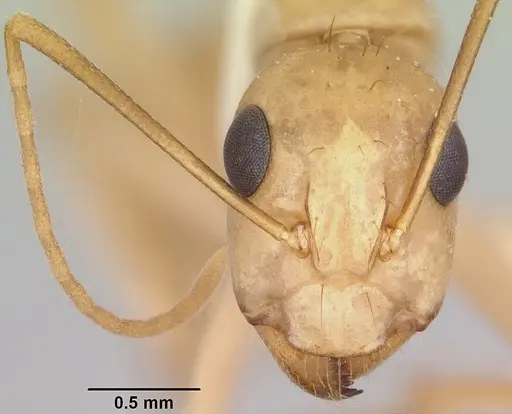
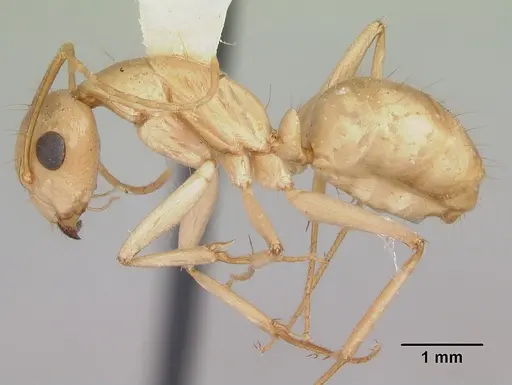
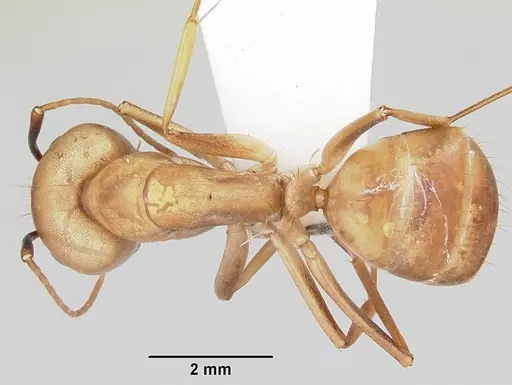
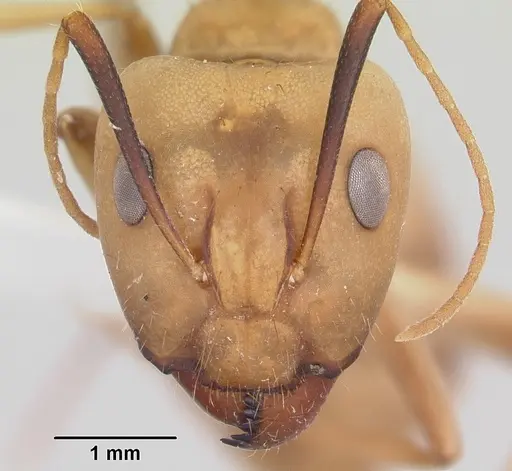
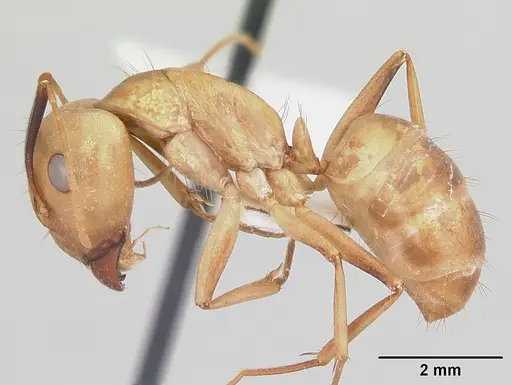
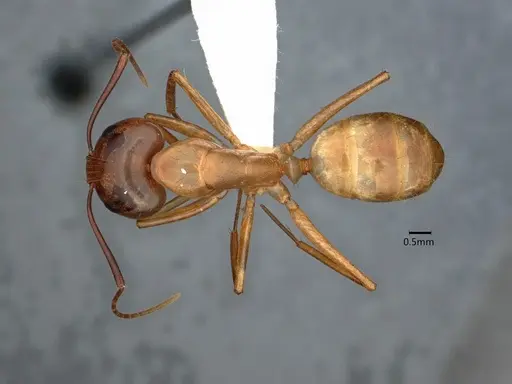
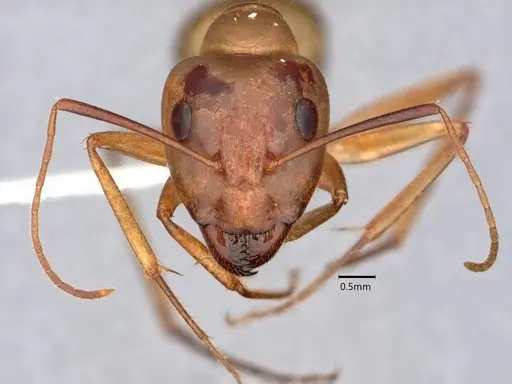
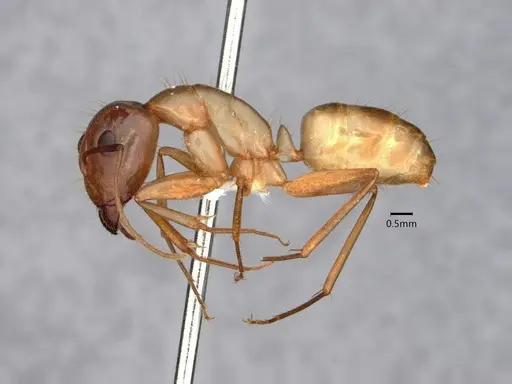
Camponotus absquatulator is a small carpenter ant native to the desert regions of Southern California, Arizona, and Baja California, Mexico. This is one of the smaller species in the Camponotus festinatus complex, with workers coming in two distinct sizes . They have a light yellowish-brown coloration with darker scapes and tibiae, and their most notable identification feature is the complete absence of erect setae along the head margins behind the eyes - a trait that separates them from related species . This species is nocturnal and nests in soil in lowland habitats ranging from Saltbush Scrub to Creosote Scrub . The species name comes from Latin meaning 'one who runs away' - a reference to their skittish behavior when disturbed .
Quick Summary
- Difficulty: Easy
- Origin & Habitat: Southern California (Imperial and Riverside counties), Arizona (Yuma County), and Baja California, Mexico. They inhabit lowland desert scrub habitats including Saltbush Scrub and Creosote Scrub [1][2].
- Colony Type: Colony structure is unconfirmed for this species. Most Camponotus species are typically single-queen, but specific data is unavailable.
- Size & Growth:
- Queen: size data unavailable, inferred from Camponotus genus (~15-20 mm)
- Worker: size data unavailable, inferred from Camponotus genus (major workers ~12-18 mm, minor workers ~6-10 mm)
- Colony: Colony size data unavailable for this species
- Growth: Moderate, typical for Camponotus species
- Development: Development time is unconfirmed for this species (Based on typical Camponotus patterns, development likely takes several months from egg to first worker.)
- Antkeeping:
- Temperature: Keep at 20-26°C. Being from desert/lowland regions of Southern California and Arizona, they tolerate warmer conditions well.
- Humidity: Low to moderate. These are desert-adapted ants from dry scrub habitats. Keep nest substrate moderately dry with occasional moisture zones.
- Diapause: Yes, they require a winter rest period. Based on their range in Southern California and Arizona, a 2-3 month diapause at 10-15°C during winter months is appropriate.
- Nesting: Soil-nesting species. In captivity, they do well in Y-tong (AAC) nests, plaster nests, or naturalistic setups with soil substrate. They prefer dark, enclosed spaces. A test tube setup works well for founding colonies.
- Behavior: Nocturnal and notably skittish, they quickly retreat when disturbed (hence the species name 'absquatulator' meaning 'one who runs away') [1]. They are not aggressive and prefer to flee rather than fight. Workers forage at night. Escape risk is moderate, standard barrier methods work fine.
- Common Issues: desert species prone to mold in overly humid conditions, avoid damp setups, skittish behavior may alarm new keepers, they retreat quickly when the nest is exposed, slow founding phase, queens may seal themselves in for several months, test tube flooding can kill founding colonies, use appropriate water reservoir size, wild-caught colonies may have parasites, quarantine and monitor new colonies
Nest Preferences and Housing
Camponotus absquatulator is a soil-nesting species that naturally founds colonies under objects like wood on the ground [1]. In captivity, they adapt well to various nest types. For founding colonies, a standard test tube setup works excellently, fill the tube one-third with water, plug with cotton, and place the queen in the dark. Once established with workers, you can move them to a Y-tong (AAC) nest, plaster nest, or naturalistic setup with soil. They prefer enclosed, dark spaces and will readily accept these nest types. Since they're a smaller Camponotus species, avoid overly large nest chambers, moderately sized passages suit them better. They do not require high humidity like tropical species, so plaster nests with moderate moisture work well.
Feeding and Diet
As typical carpenter ants, they are omnivorous. They accept sugar sources (honey, sugar water) and protein (dead insects, mealworms, crickets). In the wild, they likely forage for honeydew and small insects at night. Feed them a drop of sugar water or honey once or twice weekly, and offer protein (insects) 2-3 times per week. Remove uneaten prey after 24-48 hours to prevent mold. Since they're nocturnal, place food in the evening and check the next morning.
Temperature and Seasonal Care
These desert-adapted ants prefer warmer temperatures than many temperate species. Keep the nest area at 20-26°C, with room temperature (around 21-23°C) being ideal. They tolerate heat well due to their native range in Southern California and Arizona deserts. A heating cable on one side of the nest can create a gradient if your room runs cool. During winter, they require a diapause period, reduce temperature to 10-15°C for 2-3 months (roughly November through February in the Northern Hemisphere). This mimics their natural seasonal cycle and helps maintain colony health. Do not feed during diapause and keep disturbance to a minimum. [1]
Behavior and Temperament
This species is notably skittish, the scientific name literally means 'one who runs away' because they bolt when disturbed [1]. They are nocturnal, meaning you'll see most activity in the evening and night hours. Workers are not aggressive and will flee rather than defend the nest. This makes them a peaceful species to keep, though it can be startling when they quickly scatter when you first open the nest. They are not stinging ants, Camponotus species have formic acid spray rather than a stinger. Escape risk is moderate, so standard barrier methods like fluon on the rim of the nest are sufficient.
Colony Founding
Founding behavior is unconfirmed for this species. Like many Camponotus species, the queen may seal herself into a small chamber and raise her first workers on stored fat reserves. Expect the founding phase to last several months at room temperature. Do not disturb the queen during this period, excessive vibration or light can cause her to abandon or eat her brood. Once the first workers emerge, you can begin offering tiny amounts of sugar water and small insect pieces.
Growth and Development
Colony growth follows typical Camponotus patterns. After the nanitic workers emerge, the colony grows slowly at first. Over the following months, as more workers hatch, the colony accelerates. Major workers (soldiers) typically appear once the colony reaches several hundred workers. Growth is faster at warmer temperatures within their range, but avoid extreme heat.
Overwintering and Diapause
Camponotus absquatulator requires a winter diapause period. Being native to desert regions of Southern California and Arizona, they experience cooler winter temperatures in their native range. Reduce the nest temperature to 10-15°C for 2-3 months during winter (typically November-February). During this period, the colony will slow down significantly, workers may cluster together and do little activity. Do not feed the colony during diapause, but ensure the nest substrate does not dry out completely. Return to normal temperatures in early spring, around March, and resume feeding. This seasonal cycle helps maintain colony health and triggers reproductive behavior in the following season. [1]
Frequently Asked Questions
How long does it take for Camponotus absquatulator to have first workers?
Development time is unconfirmed for this species. Based on typical Camponotus patterns, expect several months from egg to first worker at room temperature.
What temperature do Camponotus absquatulator need?
Keep them at 20-26°C. Room temperature (21-23°C) works well. They tolerate warmer conditions due to their desert origin in Southern California and Arizona.
Do Camponotus absquatulator need hibernation?
Yes, they require a winter diapause. Reduce temperature to 10-15°C for 2-3 months during winter (roughly November-February). This mimics their natural seasonal cycle.
What do Camponotus absquatulator eat?
They are omnivorous. Offer sugar water or honey twice weekly, and protein (dead insects, mealworms) 2-3 times per week. They are nocturnal, so feed them in the evening.
Are Camponotus absquatulator good for beginners?
Yes, they are a good beginner species. They are hardy, adaptable, and have straightforward care requirements.
How big do Camponotus absquatulator colonies get?
Colony size is not specifically documented for this species.
Can I keep multiple Camponotus absquatulator queens together?
Colony structure is unconfirmed for this species. Most Camponotus species are single-queen, but specific data for C. absquatulator is unavailable.
What size nest do Camponotus absquatulator need?
They do well in standard test tubes for founding, then can be moved to Y-tong (AAC), plaster, or naturalistic nests. They prefer enclosed, dark spaces. Since they are a smaller Camponotus species, use moderately sized chambers rather than large open spaces.
Why are my Camponotus absquatulator running away?
This is normal behavior. The species name literally means 'one who runs away' because they bolt when disturbed [1]. They are nocturnal and skittish. When you open the nest, they will quickly scatter, this is not a problem, just their natural behavior.
When do Camponotus absquatulator alates appear?
In the wild, alate queens have been collected at lights during June and July [1]. In captivity, sexual brood (alates) typically appears in established colonies after 1-2 years when the colony is strong.
Is Camponotus absquatulator invasive?
No, they are native to the Southwestern United States (Southern California, Arizona) and Baja California, Mexico. They are not considered invasive and should not be released outside their native range.
Report an Issue
The current care sheet is based fully on literature. See inconsistencies, or something that's incorrect? Please , it will be resolved after review from an admin. Contributing to the blogs tab also helps providing information, to make us be able to further improve the caresheets. Thank you for your support!
References

Dit verzorgingsblad is gelicentieerd onder CC BY-SA 4.0 .
Community-blogs
Literatuur
Verspreidingskaart laden...Producten laden...