
Temnothorax brunneus
- 学名
- Temnothorax brunneus
- 族
- Crematogastrini
- 亜科
- Myrmicinae
- 命名者
- Cagniant, 1985
- 分布
- 0 か国で発見
紹介
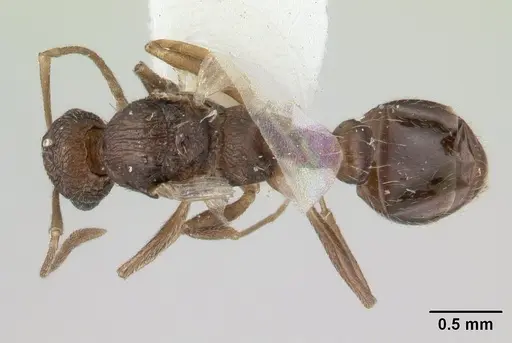
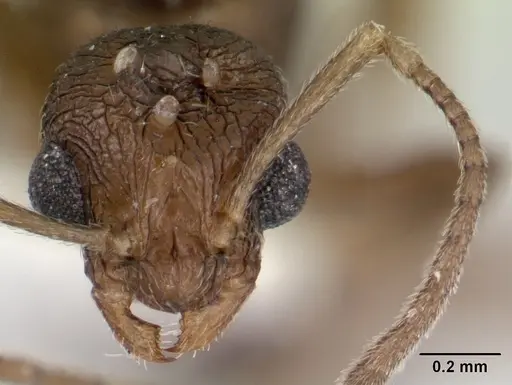
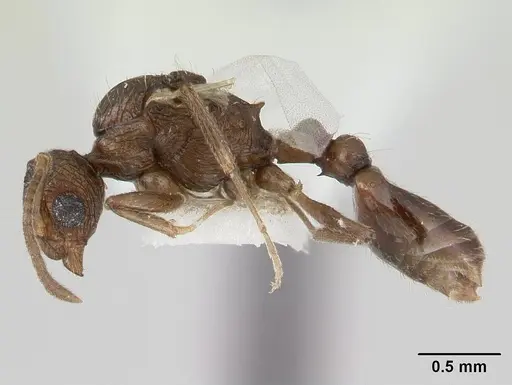
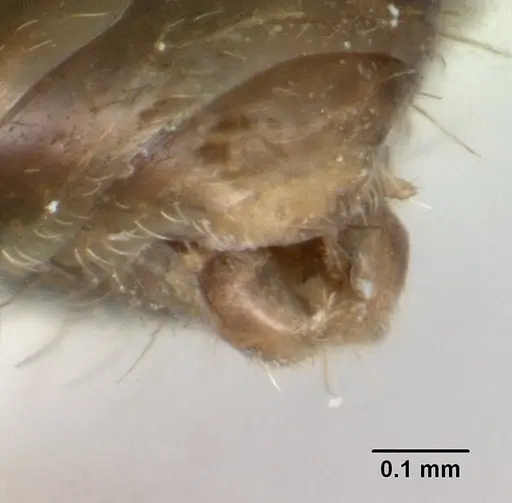
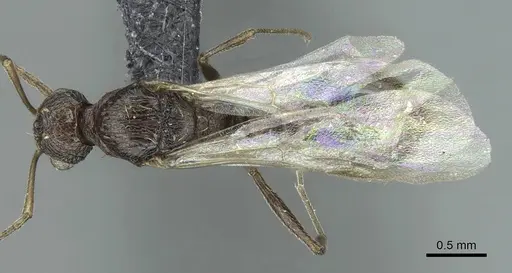
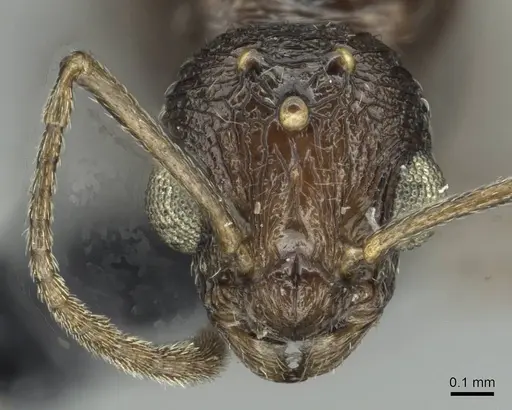
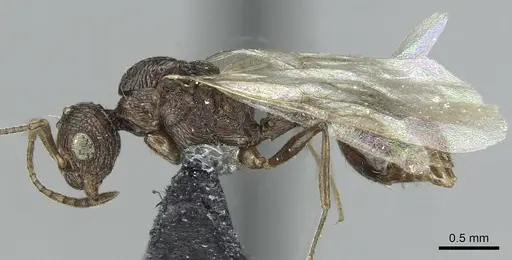
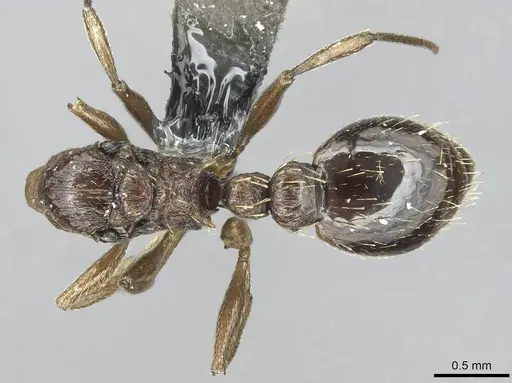
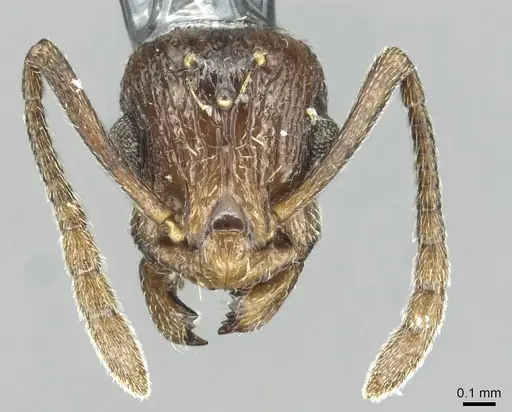
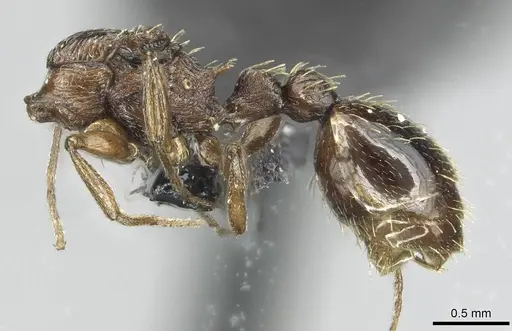
Temnothorax brunneus is an extraordinarily rare workerless parasitic ant, formerly known as Chalepoxenus brunneus . It is found only at a single tiny site in the Great Atlas Mountains of Morocco at around 2000m elevation . This species is what researchers call a 'degenerate slave-maker' - it has lost its own worker caste entirely and must rely completely on host ants to survive . Queens are dark brown with relatively long, erect hairs on their tibiae . Unlike typical slave-makers that raid other colonies for workers, Temnothorax brunneus invades a host colony, eliminates or paralyzes the host queen through stinging, stings some of the host workers, and then gets accepted by the remaining workers who then serve the parasite queen . The species produces only sexuals (males and females), never workers of its own . With a population estimated at fewer than 100 nests in an area of just 50×100 meters, this species is considered Vulnerable on the IUCN Red List and is close to extinction due to overgrazing and deforestation in its native habitat . It belongs to the Crematogastrini tribe, and like other members, it uses a modified flattened stinger to smear venom onto enemies.
Quick Summary
- Difficulty: Expert
- Origin & Habitat: Great Atlas Mountains of Morocco, specifically the Tizi-n'-Test pass at approximately 2000m elevation. This is a high-altitude species from the Palaearctic region, endemic to Morocco [2][5].
- Colony Type: Workerless social parasite, relies entirely on host species (Temnothorax marocanus) workers. Queens are obligate parasites that must invade and manipulate host colonies to survive [2].
- Size & Growth:
- Queen: size data unavailable
- Worker: No worker caste exists in this species [2]
- Colony: Up to 80 host workers [2]
- Growth: Slow
- Development: Not applicable, this species produces no workers [2] (Sexual production (males and females) occurs from spring through summer, with eggs laid 2-3 weeks after successful colony founding if the queen survives [2])
- Antkeeping:
- Temperature: Unknown, this species has not been successfully kept in captivity. Based on its high-altitude Moroccan origin, it likely needs cool to moderate temperatures, but specific requirements are unconfirmed.
- Humidity: Unknown, likely moderate, similar to Mediterranean mountain habitats, but no specific data is available.
- Diapause: Probably requires winter diapause given the high-altitude origin, but this is unconfirmed.
- Nesting: In nature, colonies are found in the nests of the host species, Temnothorax marocanus. Captive housing would require maintaining both the parasite and a host colony, an extremely challenging and likely impossible setup.
- Behavior: This species is highly specialized and cannot survive without its host. Queens use their modified stinger to smear venom onto enemies and to paralyze the host queen and some host workers during colony founding [2]. Unlike dulotic species that kill most host workers, Temnothorax brunneus stings only some workers and is accepted by the survivors [2]. Males show sluggish flight behavior and mating occurs near the nest, often inside the formicary itself [2]. The species has no functional workers and cannot forage or care for brood independently.
Species Overview and Conservation Status
Temnothorax brunneus represents one of the most specialized and endangered ant species in the world. Originally described as Temnothorax brunneus in 1985,genetic research later placed it within the genus Temnothorax [1]. The species is classified as Vulnerable on the IUCN Red List due to its extremely restricted range and small population. Found only at the Tizi-n'-Test pass in Morocco's Great Atlas Mountains, the entire global population occupies an area no larger than 50×100 meters [2]. This makes it one of the rarest ants on the planet. The species is threatened by overgrazing and deforestation that have destroyed much of its suitable habitat, leaving only a tiny relic population [2].
The Degenerate Slave-Maker Lifestyle
Temnothorax brunneus is called a 'degenerate slave-maker' because it has lost the ability to produce its own worker caste entirely, yet retains some behaviors from its slave-making ancestors [2]. Unlike true slave-makers that raid other colonies to steal brood, Temnothorax brunneus uses a unique parasitic strategy. The queen invades a host colony (Temnothorax marocanus), stings and paralyzes the host queen (rather than killing immediately), stings some of the host workers, and is then accepted by the remaining workers [2]. These host workers then care for the parasite queen and her brood as if she were their own. This acceptance by adult host workers is unusual, most dulotic species find their host workers hostile and must kill or drive them off [2]. The queen's stinging behavior is retained from her slave-making ancestors, but she uses it more sparingly, only paralyzing enough workers to gain acceptance rather than eliminating most of the colony [2].
Reproduction and Colony Structure
Temnothorax brunneus colonies contain only the parasite queen and host workers, no parasite workers are ever produced [2]. The queen lays eggs 2-3 weeks after successfully establishing in a host colony, with egg-laying continuing until fall [2]. First sexual pupae appear the summer after colony founding, developing from larvae that overwintered [2]. Sex ratio is strongly female-biased at approximately 0.43 males per female [2]. This queen bias, combined with the observed mating behavior inside formicaries and lack of female sexual pheromones, indicates inbreeding occurs with sexuals mating close to their natal nest [2]. In laboratory colonies, mating has been observed directly inside the nest chambers, and males often make mating attempts within the formicary rather than taking flight [2]. Twelve field colonies examined contained either 1 queen (most common),2 queens, or were queenless, notably, no host queens were present in any wild colonies examined [2].
Why This Species Cannot Be Kept
Temnothorax brunneus is one of the few ant species that is essentially impossible to keep in captivity. As an obligate social parasite with no worker caste, it cannot survive without a host colony of Temnothorax marocanus [2]. Even if you could obtain both species, the parasitic founding process is extremely difficult, in laboratory experiments, only a small percentage of introduced parasite queens successfully established in host colonies, with many being killed by host workers [2]. The species is also critically endangered and protected, collecting any would be both ethically wrong and likely illegal. The tiny wild population of fewer than 100 nests is already on the brink of extinction due to habitat destruction [2]. For antkeepers interested in parasitic ants, there are other species that can be maintained more ethically, such as temporary social parasites like Formica sanguinea or certain Lasius species that can be kept with proper care and without threatening wild populations.
Frequently Asked Questions
Can I keep Temnothorax brunneus as a pet ant?
No. Temnothorax brunneus cannot be kept in captivity. This is an obligate social parasite that produces no workers and must rely entirely on host colonies of Temnothorax marocanus to survive. Even if you could obtain both species, the parasitic founding process has an extremely low success rate in laboratory conditions, and the species is critically endangered with fewer than 100 known nests in the wild [2].
What does Temnothorax brunneus eat?
Specific dietary needs are unknown because this species cannot feed itself, it relies entirely on host workers for food. In a parasitic relationship, the host workers would feed the parasite queen and her brood. If you could establish a mixed colony, the host workers would need their normal diet of small insects and honeydew, but this scenario is not achievable ethically or practically [2].
How big do Temnothorax brunneus colonies get?
Temnothorax brunneus colonies do not grow in the typical sense, they produce no workers of their own. A colony consists of 1-2 parasite queens and up to 80 host workers (Temnothorax marocanus) [2]. The parasite queen produces only sexual offspring (males and females), never workers. This is fundamentally different from typical ant colonies.
Does Temnothorax brunneus sting?
Yes, Temnothorax brunneus queens can sting. They use their modified stinger to paralyze the host queen and to sting some host workers during colony founding [2]. The sting paralyzes rather than kills immediately, host queens may recover after several days or die within a week, and some workers recover from paralysis while others die [2]. However, since this species cannot be kept, sting risk is not a practical concern for antkeepers.
Where is Temnothorax brunneus found in the wild?
Temnothorax brunneus is found only at the Tizi-n'-Test pass in the Great Atlas Mountains of Morocco, at approximately 2000m elevation. This is the entire global range of the species, it is endemic to this single location [2][5].
Is Temnothorax brunneus endangered?
Yes, Temnothorax brunneus is classified as Vulnerable on the IUCN Red List. The species has one of the smallest known distributions of any ant species, with an estimated population of fewer than 100 nests in an area of just 50×100 meters. The population is considered a tiny relic of what was once likely a more widespread species, now close to extinction due to overgrazing and deforestation in the Great Atlas Mountains [2].
How does Temnothorax brunneus differ from other parasitic ants?
Temnothorax brunneus is a 'degenerate slave-maker', it has lost its worker caste entirely but retains the stinging behavior of its slave-making ancestors [2]. Unlike typical slave-makers that raid colonies and kill most workers, Temnothorax brunneus stings only some workers and is then accepted by the survivors [2]. It also differs from true inquilines (like Teleutomyrmex) in that it retains the host-killing behavior. The species is unique in the ant world for this combination of traits.
What is the host species for Temnothorax brunneus?
The primary host species is Temnothorax marocanus (formerly described as Leptothorax cf. marocanus) [2][5]. The parasite queen invades established colonies of this host species, eliminates or paralyzes the host queen through stinging, and manipulates the remaining host workers into serving her [2].
Report an Issue
The current care sheet is based fully on literature. See inconsistencies, or something that's incorrect? Please , it will be resolved after review from an admin. Contributing to the blogs tab also helps providing information, to make us be able to further improve the caresheets. Thank you for your support!
References

この飼育シートのライセンスは: CC BY-SA 4.0 .
コミュニティブログ
文献
分布マップを読み込み中...製品情報を読み込み中...