
Rhopalothrix diadema
- 学名
- Rhopalothrix diadema
- 族
- Attini
- 亜科
- Myrmicinae
- 命名者
- Brown & Kempf, 1960
- 分布
- 1 か国で発見
紹介
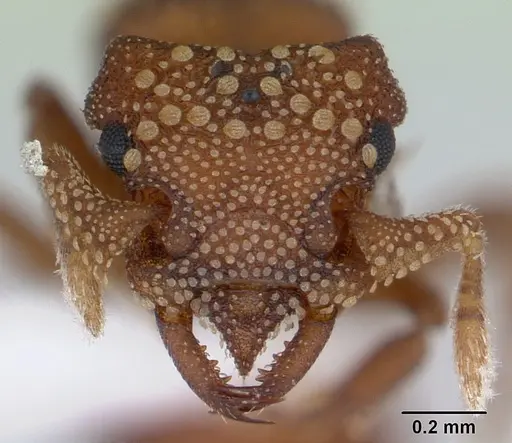
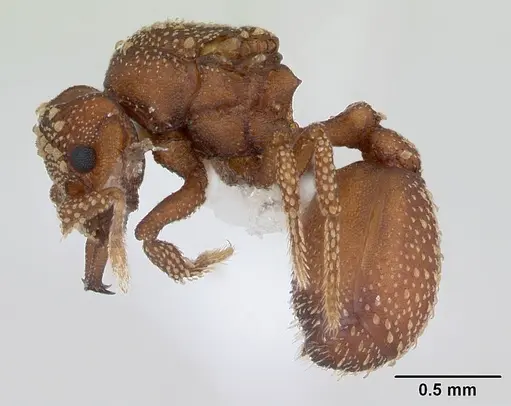
Rhopalothrix diadema is an extraordinarily rare tiny ant, known only from a handful of specimens collected in the lowland rainforests of New Guinea near Lae . Workers measure just 2.2mm in total length, making them among the smallest ants in the world . They belong to the tribe Attini (formerly Basicerotini), a group of cryptic leaf-litter ants characterized by their bizarre appearance: a flattened head covered in large, round scale-like (squamiform) hairs that help them blend into their environment . The head has a distinctive shallow groove just in front of a row of 18 large specialized hairs arranged across the face, giving them an almost alien appearance . Their minute eyes sit on the underside of the head, hidden from dorsal view, and their narrow, curved mandibles bear 4-5 denticles . The entire body has a granular, opaque texture with a light ferruginous (rusty orange) coloration . Nothing is known about their colony structure, founding behavior, or diet in the wild - they remain one of the most poorly documented ant species in existence .
Quick Summary
- Difficulty: Expert
- Origin & Habitat: New Guinea (Papua New Guinea), specifically the lower Busu River area near Lae. Found in lowland rainforest and secondary rainforest leaf litter at soil level [1][2].
- Colony Type: Unknown, only worker specimens have ever been collected. Colony structure, queen presence, and colony size are entirely unconfirmed.
- Size & Growth:
- Queen: Unknown, queens have never been documented [2].
- Worker: 2.2mm total length (TL) [2].
- Colony: Unknown, only 4 specimens have ever been collected [1].
- Growth: Unknown
- Development: Unknown, no breeding or development data exists for this species. (Development timeline is entirely unstudied. Related Basicerotini species typically require 6-10 weeks for egg-to-worker at warm temperatures, but this is a rough estimate only.)
- Antkeeping:
- Temperature: Inferred from lowland New Guinea rainforest habitat: aim for 24-28°C with a slight gradient. Keep warm and stable, similar to other tropical leaf-litter ants. Monitor colony activity to fine-tune.
- Humidity: High humidity required, these are rainforest leaf-litter ants. Keep the nest substrate consistently moist but not waterlogged. Provide a water tube and mist the outworld regularly. Think damp forest floor conditions.
- Diapause: Unknown, no seasonal data exists. As a lowland tropical species, they likely do not require hibernation, but this is unconfirmed.
- Nesting: Natural nesting: soil and leaf litter in lowland rainforest [2]. In captivity, a small test tube setup or tiny plaster or Y-tong nest works well given their minute size. Use very small chambers and narrow passages scaled to their 2mm body length. Keep the nest dark and humid.
- Behavior: Behavior is entirely unstudied [2]. Based on related Basicerotini species, they are likely cryptic, slow-moving leaf-litter ants that forage in the topsoil and decaying wood. Their squamiform pilosity likely serves as camouflage, allowing them to blend into debris [3]. They probably have a mild temperament and are not aggressive. As a Myrmicinae ant, they possess a functional stinger, but given their tiny size, any sting would be negligible. Escape prevention is critical due to their extremely small size, they can squeeze through the tiniest gaps. Use fine mesh and tight-fitting barriers.
- Common Issues: extreme rarity makes obtaining this species nearly impossible, no biological data exists, all care is speculative inference, escape prevention is critical due to tiny 2mm size, slow growth and cryptic behavior may frustrate keepers, high humidity requirements can lead to mold if ventilation is poor
Discovery and Rarity
Rhopalothrix diadema is known from only four specimens collected in a single Berlese sample from the lower Busu River near Lae, Papua New Guinea, by legendary myrmecologist E.O. Wilson in the 1960s [1]. The holotype and three paratypes represent the entire known specimen record for this species [1]. No additional specimens have been collected since, despite extensive ant surveys in New Guinea [1]. This makes R. diadema one of the rarest ants in the world, most antkeepers will never see a live specimen. The species was originally described by Brown & Kempf in 1960 and later confirmed by Longino & Boudinot in 2013,but no biological observations have ever been published [1]. The genus Rhopalothrix contains only a handful of species, all of which are rare and poorly known [1].
Identification and Appearance
Rhopalothrix diadema workers are unmistakable among ants due to their bizarre appearance. At just 2.2mm total length, they are among the smallest ants in the world [2]. The most distinctive feature is the dense covering of squamiform (scale-like) hairs across the body, these are large, round, white structures that lie flat against the cuticle and provide excellent camouflage in leaf litter [3]. The head bears 18 of these specialized hairs arranged in a distinctive pattern, plus a triple row of sparse hairs across the back of the head (occiput) [3][4]. The eyes are minute and positioned on the underside of the head, hidden from above [2]. The mandibles are narrow, curved, and armed with 4-5 spaced teeth [2]. The body is finely granular and opaque, with a light ferruginous (rusty orange) coloration throughout [2]. The postpetiole (the segment behind the petiole) is notably broad, nearly twice the width of the petiolar node [2].
Taxonomy and Relatives
Rhopalothrix belongs to the tribe Attini (formerly Basicerotini) within the subfamily Myrmicinae [3]. This tribe contains a handful of genera with bizarre, cryptic ant species that live in leaf litter and rotting wood. The genus Rhopalothrix contains approximately 10 described species, distributed primarily in Central America and Australasia [1]. Rhopalothrix diadema falls outside the R. isthmica clade, representing a distinct evolutionary lineage within the genus [1]. Related genera in the same tribe include Eurhopalothrix (also known from New Guinea) and Basiceros. These ants are not fungus growers like their Attini cousins, their diet and ecology remain mysterious.
Housing and Care
Since no biological data exists for this species, all care recommendations are speculative inferences from related Basicerotini species and general Myrmicinae biology [2]. Housing: use a small test tube setup or tiny plaster or Y-tong nest with chambers scaled to their 2mm body size. The nest should be dark and humid. Provide a small outworld for foraging. Escape prevention is absolutely critical, these ants are so small they can squeeze through gaps invisible to the naked eye. Use fine mesh barriers and check all connections carefully. Temperature: maintain 24-28°C, consistent with lowland tropical rainforest conditions. Humidity: keep high (70-85%) with consistently moist substrate. Provide a water tube. Feeding: entirely speculative, but related species are likely omnivorous or predatory on small micro-arthropods. Offer small insects (fruit flies, springtails), and sugar water occasionally. Observe acceptance. This species is NOT recommended for beginners due to the complete lack of biological data and the extreme difficulty of obtaining specimens.
Conservation and Availability
Rhopalothrix diadema is not available in the antkeeping hobby, no live colonies have ever been documented. The species is known only from museum specimens and has never been observed in the wild since its original collection in the 1960s [1]. There are no breeding programs or cultures in captivity. For antkeepers interested in this species, the only option would be supporting conservation efforts in New Guinea and hoping future expeditions locate living colonies. This highlights the importance of field research in biodiversity hotspots, many ant species remain completely unknown to science despite being described decades ago. The tropical rainforests of New Guinea continue to hold many undiscovered ant species, and habitat destruction threatens these populations before we even know they exist.
Frequently Asked Questions
Can I keep Rhopalothrix diadema as a pet ant?
No, this species is not available in the antkeeping hobby and has never been documented in captivity. Only four specimens have ever been collected, all in the 1960s in Papua New Guinea [1]. No live colonies are known to exist anywhere in the world.
How big do Rhopalothrix diadema workers get?
Workers are extremely tiny at just 2.2mm total length, making them among the smallest ants in the world [2].
Where does Rhopalothrix diadema live?
This species is known only from the lowland rainforests of Papua New Guinea, specifically the lower Busu River area near Lae. Specimens were collected from soil-leaf litter berlesate in primary and secondary rainforest [1][2].
What do Rhopalothrix diadema eat?
Unknown, no feeding observations have ever been documented. Based on related Basicerotini species, they likely prey on small soil micro-arthropods or scavenge. They may also accept honeydew or sugar sources, but this is entirely speculative.
How long do Rhopalothrix diadema colonies live?
Unknown, no colony has ever been observed. Even basic colony structure (queen number, colony size) is completely unstudied for this species [2].
Are Rhopalothrix diadema good for beginners?
No, this species is absolutely not suitable for beginners or even experienced antkeepers. No biological data exists to guide care, the species is virtually impossible to obtain, and it represents one of the rarest ants on Earth.
Do Rhopalothrix diadema need hibernation?
Unknown, no seasonal data exists. As a lowland tropical species from Papua New Guinea, they likely do not require hibernation, but this is unconfirmed. Related tropical leaf-litter ants typically remain active year-round.
How many queens does Rhopalothrix diadema have?
Unknown, no queens have ever been documented. Only worker specimens have been collected. The colony structure (monogyne, polygyne) is entirely unconfirmed [2].
Why is Rhopalothrix diadema so rare?
This species is known from only four specimens collected in a single sample in the 1960s [1]. Despite being described in 1960,no additional specimens have been found in over 60 years of subsequent ant surveys in New Guinea [1]. They may be genuinely rare, have very small and localized populations, or live in microhabitats that are rarely sampled.
Report an Issue
The current care sheet is based fully on literature. See inconsistencies, or something that's incorrect? Please , it will be resolved after review from an admin. Contributing to the blogs tab also helps providing information, to make us be able to further improve the caresheets. Thank you for your support!
References

この飼育シートのライセンスは: CC BY-SA 4.0 .
コミュニティブログ
CASENT0434848
AntWebで見る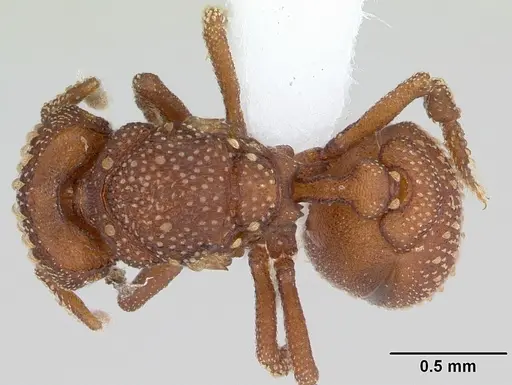
文献
分布マップを読み込み中...製品情報を読み込み中...