
Protanilla furcomandibula
- 学名
- Protanilla furcomandibula
- 族
- Leptanillini
- 亜科
- Leptanillinae
- 命名者
- Xu & Zhang, 2002
- 分布
- 0 か国で発見
紹介
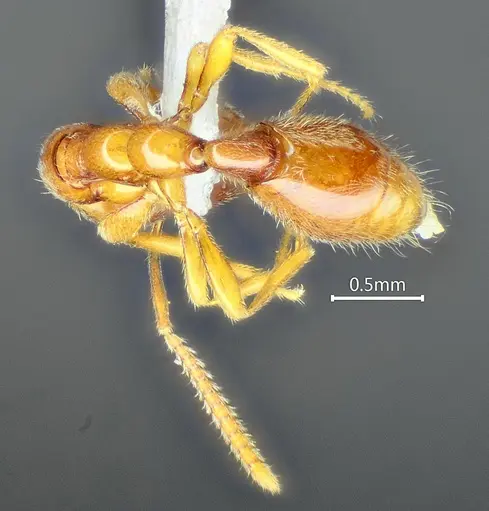
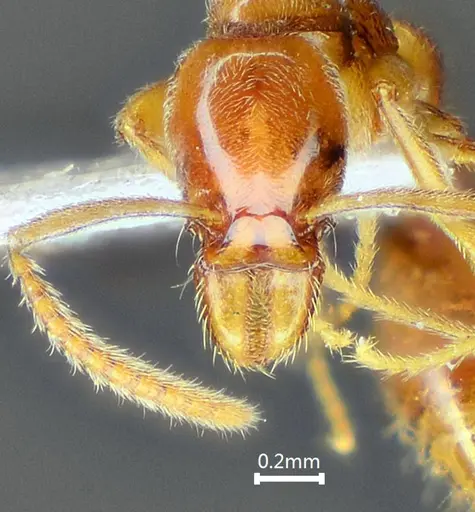
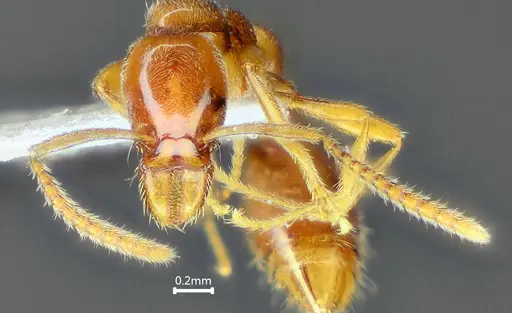
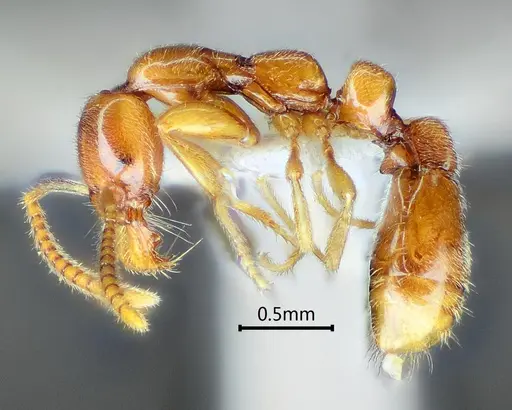
Protanilla furcomandibula is a tiny, pale yellowish-brown ant in the subfamily Leptanillinae, native to high-altitude forests in Yunnan, China. Workers measure about 4.0-4.1 mm in total length, lack eyes entirely, and have mandibles with two teeth on the lateroventral margin. The postpetiole has a deeply concave ventral surface, and the first gastral segment has a narrow notch. This species is known only from worker castes, with no documented queens or males. It nests in soil and forages on the ground in conifer-broadleaf mixed forests at approximately 2250 m elevation .
Quick Summary
- Difficulty: Expert
- Origin & Habitat: Yunnan Province, China, conifer-broadleaf mixed forest at 2250 m elevation [1]
- Colony Type: Unknown colony structure, only worker caste described. Colony type (single-queen or multi-queen) is unconfirmed.
- Size & Growth:
- Antkeeping:
- Temperature: Based on high-altitude habitat, likely cool temperatures around 15-20°C. Keep stable and avoid overheating [1].
- Humidity: Based on soil-nesting in mixed forest, keep nest substrate consistently moist but not waterlogged [1].
- Diapause: Based on temperate high-altitude range, likely requires winter diapause. Duration unknown [1].
- Nesting: Soil-nesting species, use moist soil substrate in captivity [1].
- Behavior: Workers are blind and forage on the ground. They possess a sting for defense [1]. Escape risk is moderate due to tiny size, use fine mesh barriers. Temperament is unknown but likely non-aggressive.
- Common Issues: extreme rarity makes obtaining this species nearly impossible for hobbyists., no queen or male descriptions exist, cannot establish captive colonies from wild-caught queens., complete lack of captive husbandry data means all care is speculative., high-altitude origin means temperature management is critical, overheating is likely fatal., blind ants may be stressed by bright lighting in captivity.
Rarity and Availability
Protanilla furcomandibula is one of the rarest ants to keep. It has only been collected once, a handful of workers from a soil sample in Yunnan, China in 2001. No queens, males, or colony fragments have been described. The worker caste was described in 2002 and remains known only from those specimens [1][2]. This means virtually no captive colonies exist, and obtaining this species would require wild-collection in remote Yunnan or finding an extremely rare breeder.
Natural History and Habitat
This species is known only from the type locality in Kunming, Yunnan Province, at Xishan Forest Park, Huatingsi Temple, around 2250 m elevation. It lives in conifer-broadleaf mixed forest, nests in soil, and forages on the ground [1]. The high elevation indicates a cool, temperate climate with distinct seasons.
Unique Morphology
Workers completely lack eyes [1]. Mandibles have two distinct teeth on the lateroventral margin, giving a forked appearance [4][1]. The postpetiole has a deeply concave ventral surface [2]. The first gastral segment has a narrow deep notch at the anterior margin, and the anterior margin of the gaster is deeply concave to accept the postpetiole [1]. They possess a sting that can be extruded [1].
Temperature and Seasonal Care
Based on the high-altitude habitat (2250 m), these ants likely require cool conditions. Aim for temperatures around 15-20°C during active seasons, avoiding overheating. During winter, a diapause period at reduced temperatures may be needed, but duration is unknown [1].
Feeding and Diet
The natural diet is unknown, no feeding observations are available in the research context. In captivity, you could experiment with tiny live prey like springtails, but success is uncertain [3].
Nesting Requirements
In the wild, this species nests in soil [1]. For captivity, use a naturalistic setup with moist soil substrate. They are blind, so avoid bright lighting near the nest. Provide appropriately scaled chambers for their tiny size.
Frequently Asked Questions
Can I keep Protanilla furcomandibula in a test tube?
A test tube setup could work for founding, but soil-based setups are better due to their natural nesting. Ensure darkness and cool temperatures around 15-20°C [1].
How long does it take for Protanilla furcomandibula to go from egg to worker?
Unknown, no development data exists for this species.
Are Protanilla furcomandibula good for beginners?
No. This species is rated Expert due to extreme rarity, lack of captive data, and specific cool temperature needs.
Do Protanilla furcomandibula ants sting?
Yes, they possess a sting that can be extruded [1]. However, their tiny size makes it unlikely to affect humans.
What temperature do Protanilla furcomandibula need?
Based on their high-altitude origin, likely cool temperatures around 15-20°C. Avoid overheating [1].
Can I keep multiple queens of Protanilla furcomandibula together?
This is impossible to answer, no queens of this species have ever been described or observed.
Do Protanilla furcomandibula need hibernation?
Based on temperate high-altitude range, likely yes, but duration is unknown [1].
Why are Protanilla furcomandibula so rare?
This species is known from only a single collection event in 2001, a few workers from a soil sample in Yunnan, China [1].
What do Protanilla furcomandibula eat?
Their natural diet is completely unknown. In captivity, you could experiment with tiny live prey, but success is uncertain [3].
How big do Protanilla furcomandibula colonies get?
Unknown, no colony size data exists.
Are Protanilla furcomandibula dangerous?
No. While they possess a sting, their tiny size makes it impractical for defense against humans. They are not aggressive.
Where can I buy Protanilla furcomandibula?
You almost certainly cannot. This species is one of the rarest ants, known only from a single collection in 2001. No captive breeding programs exist.
Report an Issue
The current care sheet is based fully on literature. See inconsistencies, or something that's incorrect? Please , it will be resolved after review from an admin. Contributing to the blogs tab also helps providing information, to make us be able to further improve the caresheets. Thank you for your support!
References

この飼育シートのライセンスは: CC BY-SA 4.0 .
コミュニティブログ
ANTWEB1060536
AntWebで見る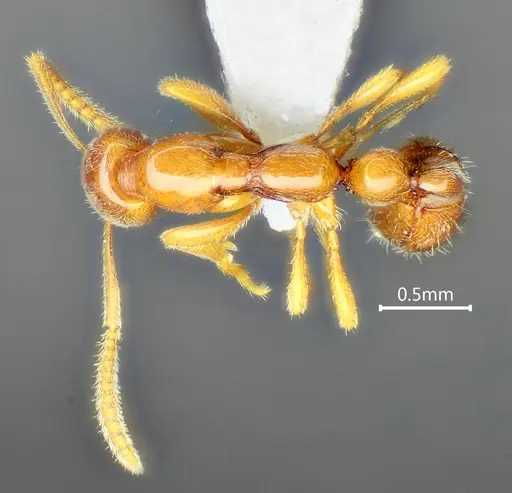
文献
分布マップを読み込み中...製品情報を読み込み中...