
Polyrhachis leonidas
- 学名
- Polyrhachis leonidas
- 亜属
- Cyrtomyrma
- 族
- Camponotini
- 亜科
- Formicinae
- 命名者
- Forel, 1901
- 分布
- 0 か国で発見
紹介
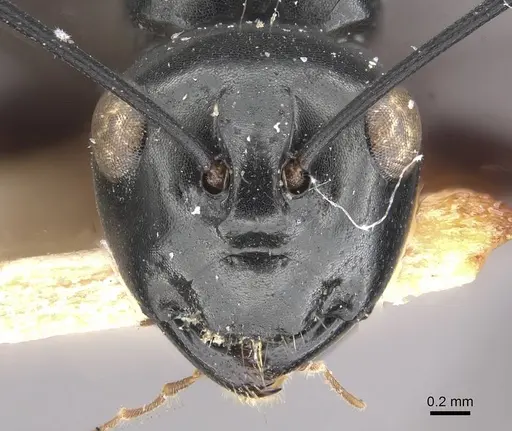
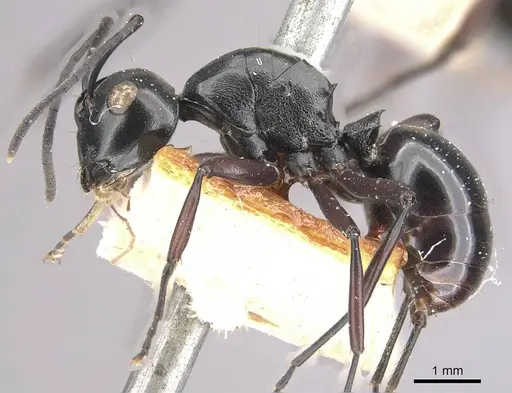
Polyrhachis leonidas is a medium-sized ant species belonging to the subgenus Cyrtomyrma. Workers measure up to 6.5 mm and queens reach 8.5 mm. They are predominantly black with brownish antennae, legs, and mandibles. The species has distinctive short, strongly upturned propodeal spines and relatively short petiolar spines. Their eyes are notably convex and prominent, clearly breaking the lateral outline of the head in full-face view. This species is limited to the Bismarck Archipelago and New Guinea region . The biology of Polyrhachis leonidas is completely unstudied. The type material was collected from a tube nest, suggesting they may nest in pre-existing cavities .
Quick Summary
- Difficulty: Hard
- Origin & Habitat: Bismarck Archipelago and New Guinea. Found in the Australasian region, specifically on Mioko Island, New Britain, and Keravat on Gazelle Peninsula [1][2].
- Colony Type: Colony structure is unconfirmed. No data exists on whether this species is single-queen (monogyne) or multi-queen (polygyne).
- Size & Growth:
- Antkeeping:
- Temperature: Unknown, no specific data. Based on tropical origin, aim for warm conditions around 24-28°C with a gradient.
- Humidity: Unknown, no specific data. As a tropical species, keep nest substrate consistently moist but not waterlogged.
- Diapause: Unknown, no seasonal data exists. As a tropical species, diapause may not be required.
- Nesting: Based on type specimen collected from a tube nest, provide a nest with narrow chambers or tubes. Use Y-tong or plaster nests with tight-fitting chambers [1].
- Behavior: Behavior is completely unstudied. Escape prevention should be moderate due to worker size of 6-6.5 mm.
- Common Issues: no biological data exists, this is one of the least-studied ant species in the hobby., colony founding may be difficult since founding behavior is unconfirmed., temperature and humidity requirements are unknown, requiring careful observation., obtaining colonies may be difficult as the species appears rare., diet preferences are unknown, offer varied foods and observe acceptance.
Species Identification and Distinction
Polyrhachis leonidas can be distinguished from similar species like Polyrhachis barryi by short, strongly upturned propodeal spines and convex eyes that break the lateral cephalic outline. Workers measure up to 6.5 mm and queens are 8.5 mm. The coloration is predominantly black with brownish parts [1].
Distribution and Habitat
This species has a limited distribution in the Bismarck Archipelago and Papua New Guinea. The type locality is Mioko Island, with additional specimens from Keravat on Gazelle Peninsula. The species appears rare, with few documented specimens [1][2].
Nesting Preferences
The type material was collected from a tube nest, suggesting nesting in pre-existing cavities like hollow stems or under bark. In captivity, provide a nest with narrow chambers or tubes, such as Y-tong or plaster formicaria [1].
Care Recommendations
Since no biological data exists, keepers must approach care experimentally. Start with warm, humid conditions based on tropical origin. Offer varied diet including sugar sources and protein. Use standard escape prevention for 6 mm ants. Monitor colony behavior closely and adjust conditions based on activity.
Frequently Asked Questions
How long does it take for Polyrhachis leonidas to develop from egg to worker?
The egg-to-worker development timeline is completely unconfirmed. No scientific data exists on their development.
What do Polyrhachis leonidas ants eat?
Diet is unconfirmed for this species. Offer varied foods and observe what the colony accepts.
What temperature do Polyrhachis leonidas need?
Temperature requirements are not documented. As a tropical ant, aim for warm conditions around 24-28°C with a gradient.
Do Polyrhachis leonidas ants need hibernation?
Diapause requirements are unknown. As a tropical species, they may not require a winter rest period.
Are Polyrhachis leonidas good for beginners?
This species is not recommended for beginners due to lack of established care protocols.
How big do Polyrhachis leonidas colonies get?
Colony size is unknown. No data exists on maximum colony size.
Can I keep multiple Polyrhachis leonidas queens together?
Colony structure is unconfirmed. Do not attempt to combine unrelated queens until more is known.
What type of nest is best for Polyrhachis leonidas?
Based on type specimen from a tube nest, provide a cavity-based nest like Y-tong or plaster with narrow chambers [1].
Where is Polyrhachis leonidas found?
Polyrhachis leonidas is limited to the Bismarck Archipelago and Papua New Guinea [1][2].
Report an Issue
The current care sheet is based fully on literature. See inconsistencies, or something that's incorrect? Please , it will be resolved after review from an admin. Contributing to the blogs tab also helps providing information, to make us be able to further improve the caresheets. Thank you for your support!
References

この飼育シートのライセンスは: CC BY-SA 4.0 .
コミュニティブログ
CASENT0910961
AntWebで見る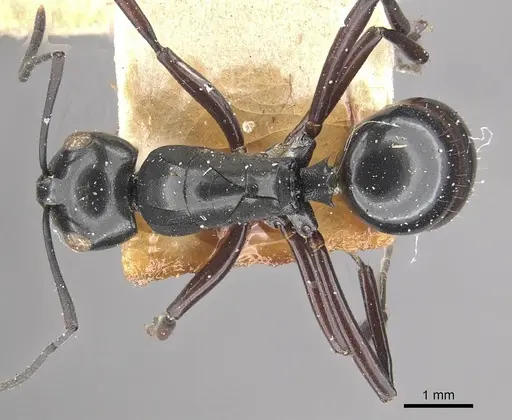
文献
分布マップを読み込み中...製品情報を読み込み中...