
Myopias menba
- 学名
- Myopias menba
- 族
- Ponerini
- 亜科
- Ponerinae
- 命名者
- Xu & Liu, 2012
- 分布
- 0 か国で発見
紹介
Myopias menba is a tiny ponerine ant native to southeastern Tibet, China. Workers measure 3.3mm in total length, making them one of the smaller ant species. They have a brownish-yellow body with black eyes, and their most notable feature is the extremely small eyes - each with only two light-sensitive facets. The antennae are short with a 4-segmented club, and the petiolar node is thick and trapezoid-shaped. These ants were discovered in 2012 and are named after the Menba people, a Chinese minority ethnic group living in southeastern Tibet. They were collected foraging on the ground in secondary rainforest at 720m elevation. Only the worker caste has been described - queens and males remain unknown.
Quick Summary
- Difficulty: Unknown, Insufficient data for care recommendations
- Origin & Habitat: Tibet, China in secondary rainforest at 720m elevation [1]. Collected as foragers on the ground in humid, shaded forest conditions [1].
- Colony Type: Unknown, only worker caste has been described, colony structure and queen information unconfirmed
- Size & Growth:
- Antkeeping:
- Temperature: Unknown, no thermal studies exist. Based on the Tibetan location at 720m elevation, they likely tolerate moderate temperatures. Start around 20-24°C and observe colony activity.
- Humidity: Likely requires high humidity given the rainforest origin. Keep nest substrate consistently moist but not waterlogged.
- Diapause: Unknown, no seasonal studies exist. Tibetan location suggests they may experience cooler winters, so a cool period may be appropriate but this is not confirmed.
- Nesting: No specific nesting data exists. Based on being ground-foragers in rainforest, they likely nest in soil or under stones. Test tubes with moist cotton and a naturalistic setup with damp substrate would be appropriate starting points.
- Behavior: These ants are foragers on the forest floor, suggesting they search for prey items. As a Ponerine ant, they have a functional stinger and may be predatory on small invertebrates. Their tiny size means escape prevention is critical, they can squeeze through very small gaps. Handle with care as their stinger may be functional despite their small size.
- Common Issues: tiny size makes escape likely without fine mesh barriers., no established care protocols exist, experimental keeping only., predatory diet may be difficult to provide in captivity., humidity requirements may be easily upset by dry indoor conditions., wild-caught colonies may carry parasites that cause captive failures.
Species Overview and Identification
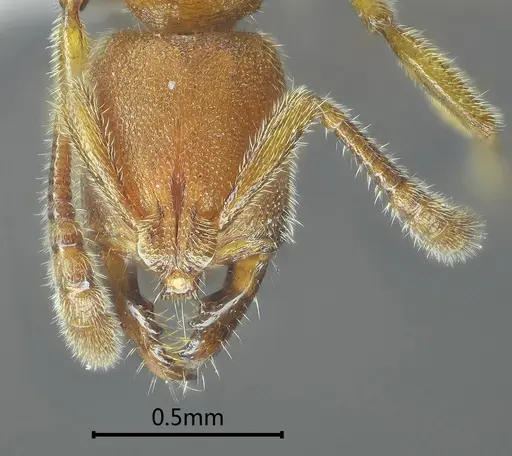
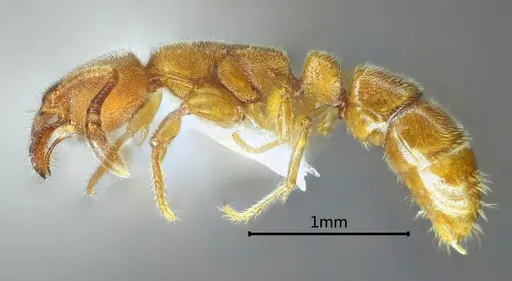
Myopias menba is a recently described species from the Ponerinae subfamily, found only in Tibet, China. Workers are tiny at 3.3mm, with a brownish-yellow body and notably small eyes containing only two facets each. The antennae are 12-segmented with a 4-segmented club, and the mandibles have four teeth. The petiolar node is thick and roughly trapezoid. This species is closely related to Myopias nops but can be distinguished by the presence of eyes, the scapes not reaching the occipital corners, and the rounded posterodorsal corner of the petiolar node. Only the worker caste has been described, no queens or males are known from scientific collections. [1]
Natural History and Habitat
This species is known only from Medog County in southeastern Tibet, China, at approximately 720m elevation. The type locality is Yarang in Medog Town, a secondary rainforest area. Workers were collected foraging on the ground, suggesting they are ground-dwelling predators. The Tibetan location means they experience a temperate climate with distinct seasons. The secondary rainforest habitat indicates they prefer humid, shaded conditions with plenty of leaf litter and ground cover. Nothing is known about their colony size, nesting habits, or reproductive behavior in the wild. [1]
Housing and Nesting
Since no captive husbandry data exists for this species, housing recommendations are based on inference from related Ponerines and the natural habitat. A test tube setup with moist cotton provides a simple starting point, but given their small size and likely humidity needs, a small naturalistic setup with damp substrate may work better. The key is maintaining consistently humid conditions without flooding. Because workers are only 3.3mm, escape prevention must be excellent, use tight-fitting lids and consider fine mesh barriers. Provide a foraging area where they can hunt small prey items.
Feeding and Diet
As a Ponerine ant, Myopias menba is likely predatory on small invertebrates. The ground-foraging behavior observed in the wild supports this. In captivity, you should offer small live prey such as springtails, fruit flies, small mealworms, and other micro-arthropods. Sugar sources may or may not be accepted, some Ponerines take honeydew or nectar, but many are strictly predatory. Start with protein-rich live prey and experiment with occasional sugar offerings. Feed small amounts frequently, removing uneaten prey after 24-48 hours to prevent mold.
Temperature and Seasonal Care
No specific temperature data exists for this species. The Tibetan location at 720m elevation suggests a subtropical to temperate climate. Room temperature (20-24°C) is likely suitable as a starting point. Observe your colony, if workers cluster together and show reduced activity, they may want it warmer, if they avoid heated areas, reduce temperature. Regarding winter dormancy, the Tibetan climate does experience cold winters, so a cool period may be beneficial but this is not confirmed for this species.
Behavior and Handling
Myopias menba is likely similar to other Ponerine ants in temperament, they may be more defensive than many common ant genera, with a functional stinger despite their tiny size. When disturbed, they may attempt to sting rather than flee. The extremely small eyes (only 2 facets) suggest they rely more on chemical and tactile senses than vision. Workers forage on the ground, likely searching for prey or scavenging. Their small size means they are not aggressive toward humans but could deliver a mild sting if handled carelessly. Always use caution when working with this species. [1]
Important Keeper Notes
This is an expert-level species to keep primarily because no established husbandry protocols exist. Everything about their care must be learned through careful observation and experimentation. Start with a small colony if available, and be prepared to adjust conditions based on colony response. Document your observations carefully since no standard protocols exist. The limited distribution (only known from Tibet) and recent scientific description mean wild colonies are rarely available, and any colonies in the hobby likely represent very few breeding events.
Frequently Asked Questions
How do I care for Myopias menba ants?
Care is unestablished, this is one of the least studied ant species in the hobby. Based on their Ponerine classification and rainforest origin, provide high humidity (damp substrate), room temperature (20-24°C), and small live prey. Start with a test tube setup and transition to a small nest as the colony grows. Document your observations carefully since no standard protocols exist.
What do Myopias menba ants eat?
They are likely predatory like other Ponerines. Offer small live prey including springtails, fruit flies, tiny beetles, and other micro-arthropods. Sugar sources may be accepted experimentally but should not be the primary food. Remove uneaten prey after 24-48 hours.
How big do Myopias menba colonies get?
Unknown, no colony size data exists for this species.
Do Myopias menba ants sting?
As Ponerine ants, they have a functional stinger. However, at 3.3mm, the sting may be very mild. Handle with care but the sting risk to humans is minimal.
What temperature do Myopias menba ants need?
No specific data exists. Start around 20-24°C (room temperature) and adjust based on colony behavior. The Tibetan origin suggests they can tolerate cooler conditions than tropical species.
Do Myopias menba need hibernation?
Unknown, no seasonal data exists. The Tibetan location suggests they may benefit from a cool period during winter, but this is not confirmed.
Are Myopias menba good for beginners?
No, this species is not recommended for beginners. No established care protocols exist, and they require experimental keeping. The tiny size also makes escape prevention challenging.
Can I keep multiple Myopias menba queens together?
Unknown, colony structure has not been studied. Without data on natural colony structure, combining unrelated queens is not recommended.
How long does it take for Myopias menba to develop from egg to worker?
Unconfirmed, no development data exists for this species.
Where is Myopias menba found in the wild?
Only known from Medog County, Tibet, China, at 720m elevation in secondary rainforest. This is a very restricted distribution.
Why are Myopias menba ants so small?
This is their natural size, workers are 3.3mm total length. The tiny eyes (only 2 facets) are also a species characteristic. Small size is typical for the genus Myopias.
Is Myopias menba invasive or dangerous?
No, this species has a very restricted range in Tibet, China, and is not invasive. The sting risk to humans is minimal due to their tiny size.
Report an Issue
The current care sheet is based fully on literature. See inconsistencies, or something that's incorrect? Please , it will be resolved after review from an admin. Contributing to the blogs tab also helps providing information, to make us be able to further improve the caresheets. Thank you for your support!
References

この飼育シートのライセンスは: CC BY-SA 4.0 .
コミュニティブログ
ANTWEB1060514
AntWebで見る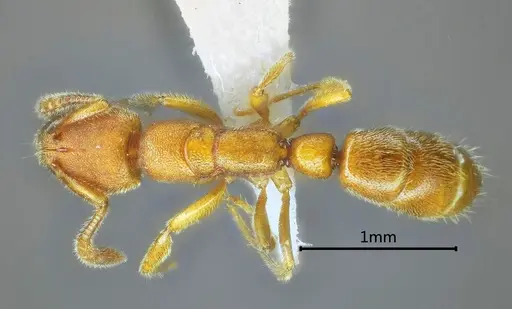
文献
分布マップを読み込み中...製品情報を読み込み中...