
Emeryopone franzi
- 学名
- Emeryopone franzi
- 族
- Ponerini
- 亜科
- Ponerinae
- 命名者
- Baroni Urbani, 1975
- 分布
- 0 か国で発見
紹介
Emeryopone franzi is an extremely rare ponerine ant endemic to Nepal, originally described in 1975 and then rediscovered 45 years later during surveys in Nagarjun forest . Workers measure 4.88-5.88mm in total length, with a distinctively elongated head that is longer than broad, very small eyes positioned near the mandibular base, and a long, powerful sting . Their body is ferruginous to dark reddish-brown with lighter legs, antennae, and mandibles, covered in very dense punctures and abundant appressed pubescence . Based on morphological traits and collecting data, this species is almost certainly cryptobiotic, meaning it lives in concealed underground habitats rather than visible on the surface . This is one of the rarest ants in existence - only four worker specimens have ever been documented.
Quick Summary
- Difficulty: Expert
- Origin & Habitat: Endemic to Nepal, found only in Nagarjun forest within Shivapuri Nagarjun National Park at elevations of 1400-1912m [1][2]. The habitat is a forested mountain region with moderate altitude.
- Colony Type: Colony structure is unconfirmed. Only four worker specimens have ever been collected [1].
- Size & Growth:
- Antkeeping:
- Temperature: Unknown, no thermal studies exist. Start around 22-24°C and observe colony activity.
- Humidity: Unknown, no humidity data exists. Given the elevation and forest habitat, keep substrate consistently moist but not waterlogged.
- Diapause: Unknown, no seasonal data exists. Nepal has distinct seasons, so some form of seasonal dormancy is possible.
- Nesting: Cryptobiotic species require concealed nesting sites. Provide deep, dark spaces with multiple chambers. Test tubes with additional cover or a naturalistic setup with deep soil layers work well. Avoid bright lighting and keep nesting areas shaded.
- Behavior: Behavior is unstudied in captivity. Based on being cryptobiotic and a ponerine, they are likely secretive, spend most time underground, and have a potent sting [1]. They will likely be defensive of their nest. Escape prevention is important given their small size, use fine mesh barriers.
- Common Issues: extreme rarity makes obtaining this species nearly impossible, only four wild specimens have ever been documented, no captive husbandry information exists, keepers must develop care from related species, cryptobiotic habits mean they may be rarely visible, which can be disappointing for keepers expecting active ants, queen and colony structure are completely unknown, making captive breeding uncertain, potential legal concerns, as a Nepal-endemic species, export may be restricted
Rarity and Collection History
Emeryopone franzi holds a special place in ant keeping as one of the rarest species in existence. Originally described by Baroni Urbani in 1975 from specimens collected in Nepal, the species was then lost to science for 45 years before being rediscovered during recent ant surveys in Nagarjun forest [1]. Only four worker specimens have ever been documented, two from pitfall traps in 2019 and two from hand collection [1]. This extreme rarity makes established colonies in captivity virtually nonexistent. The species was originally placed in the genus Belonopelta before being moved to Emeryopone by Bolton in 1995 [1]. For keepers, obtaining this species would be extraordinary and would likely require connecting directly with researchers working in Nepal.
Natural History and Habitat
This species is endemic to Nepal, found only in the Nagarjun forest area of Shivapuri Nagarjun National Park at elevations between 1400 and 1912 meters [1]. The forest is a temperate to subtropical montane environment. Based on morphological analysis and collecting data, researchers believe E. franzi is almost certainly cryptobiotic, living in concealed underground habitats rather than on the surface [1]. This explains both its extreme rarity and the difficulty in finding specimens. The species was collected using pitfall traps and by hand collection, suggesting it forages at ground level or just below the surface.
Identification and Morphology
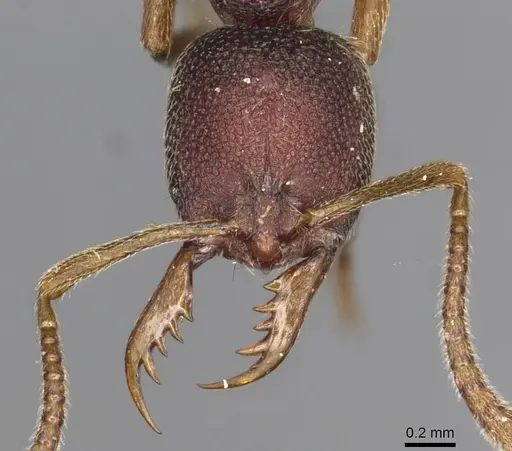
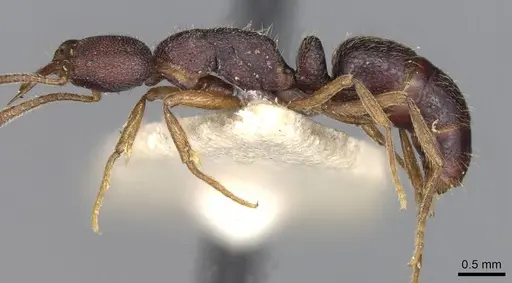
Workers measure 4.88-5.88mm in total length, making them a small ponerine ant [1]. The head is distinctly longer than broad with slightly convex lateral margins and a weakly concave posterior margin [1]. Eyes are very small and located laterally towards the anterior corner of the head, near the mandibular base, a trait consistent with cryptobiotic, light-avoiding species [1]. The mandibles are elongate-triangular and roughly as long as the head, equipped with 5 powerful teeth including a very long apical tooth [1]. The antennae have 12 segments with a 3-segmented club [1]. The petiolar node is thick and roughly triangular in profile [1]. Most notably, the species has a long and powerful sting [1]. The body coloration is ferruginous or dark reddish-brown, with lighter legs, antennae, and mandibles [1]. The entire body is covered in very dense punctures, with distance between punctures shorter than the puncture diameter [1].
Housing and Nesting
Since this is a cryptobiotic species, housing should prioritize dark, concealed spaces. Provide deep nesting areas with multiple chambers that the ants can use for different activities. Test tube setups with additional cover to create darkness work well, or a naturalistic setup with deep soil layers. Keep nesting areas shaded and avoid bright direct lighting. The small worker size means escape prevention should use fine mesh barriers. Given the complete lack of captive data, observe your colony closely and adjust conditions based on their behavior.
Feeding and Diet
Diet is completely unstudied for this species. As a ponerine ant, related species are typically predators or omnivores. Start with offering small live prey appropriate to their size and observe acceptance. Sugar sources like honey or sugar water may be accepted but are not guaranteed. Ponerines often specialize in protein-rich diets, so prioritize invertebrate prey. Feed small amounts a few times per week and remove uneaten prey to prevent mold.
Temperature and Seasonal Care
No specific temperature data exists for this species. The elevation range in Nepal suggests a temperate climate with moderate temperatures. Start around 22-24°C as a baseline and observe colony activity. Regarding seasonal care, Nepal experiences distinct seasons including a cool winter. Some form of seasonal dormancy may be beneficial, though this is unconfirmed. Consider providing a slight temperature drop during winter months and reduce feeding to see if the colony naturally slows down.
Frequently Asked Questions
How rare is Emeryopone franzi in the ant keeping hobby?
Extremely rare, virtually nonexistent in captivity. Only four worker specimens have ever been documented in the scientific literature, all collected from Nagarjun forest in Nepal [1]. There are no established captive colonies known.
What does Emeryopone franzi look like?
Workers measure 4.88-5.88mm in total length with a distinctively elongated head that is longer than broad [1]. They have very small eyes near the mandibular base, powerful mandibles with 5 teeth, and a long, powerful sting [1]. Their body is ferruginous to dark reddish-brown with lighter legs, antennae, and mandibles, covered in very dense punctures [1].
Where is Emeryopone franzi found in the wild?
This species is endemic to Nepal, found only in Nagarjun forest within Shivapuri Nagarjun National Park at elevations of 1400-1912m [1][2]. It has never been documented anywhere else in the world.
What do I feed Emeryopone franzi?
Diet is unconfirmed. As a ponerine, start with small live prey like fruit flies, small mealworms, or pinhead crickets. Sugar sources like honey water may be accepted but are not guaranteed. Ponerines are typically protein-focused predators, so prioritize invertebrate prey.
What temperature should I keep Emeryopone franzi at?
No specific data exists. Start around 22-24°C and adjust based on colony behavior. The high-elevation Nepal forest habitat suggests moderate temperatures. Observe activity levels and adjust accordingly.
Does Emeryopone franzi need hibernation?
Unknown, no seasonal data exists. Nepal has distinct seasons including a cool winter, so some form of seasonal dormancy is possible. Consider providing a slight temperature drop during winter months and reduce feeding to observe if the colony naturally slows.
What type of nest should I use for Emeryopone franzi?
As a cryptobiotic species, provide deep, dark spaces with multiple chambers. Test tubes with covers to create darkness or naturalistic setups with deep soil layers work well. Keep nesting areas shaded and avoid bright lighting.
How big do Emeryopone franzi colonies get?
Unknown, colony size has never been documented. Only four worker specimens have ever been collected [1].
Is Emeryopone franzi suitable for beginners?
No, this is an expert-level species due to extreme rarity, complete lack of captive husbandry data, and cryptobiotic habits. There are no established care protocols, and keepers must develop everything from related species knowledge. This species is suitable only for highly experienced keepers seeking a challenge.
Report an Issue
The current care sheet is based fully on literature. See inconsistencies, or something that's incorrect? Please , it will be resolved after review from an admin. Contributing to the blogs tab also helps providing information, to make us be able to further improve the caresheets. Thank you for your support!
References

この飼育シートのライセンスは: CC BY-SA 4.0 .
コミュニティブログ
CASENT0915183
AntWebで見る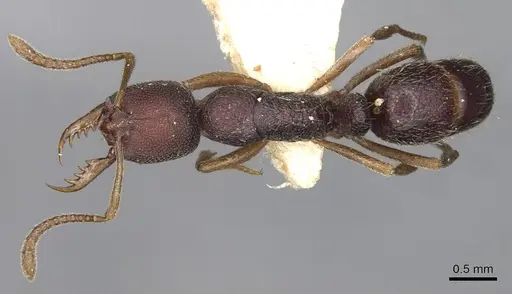
文献
分布マップを読み込み中...製品情報を読み込み中...