
Echinopla madli
- 学名
- Echinopla madli
- 族
- Camponotini
- 亜科
- Formicinae
- 命名者
- Zettel & Laciny, 2015
- 分布
- 0 か国で発見
紹介
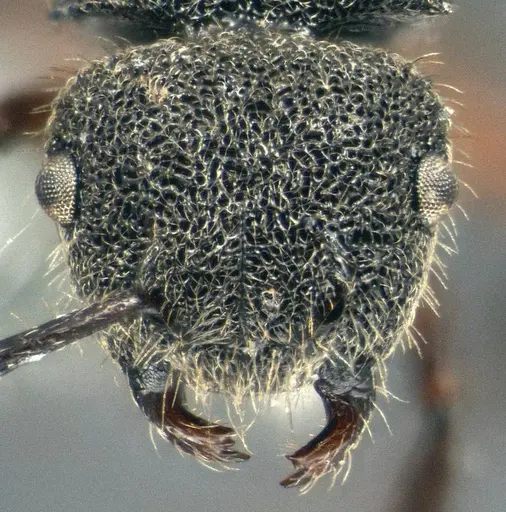
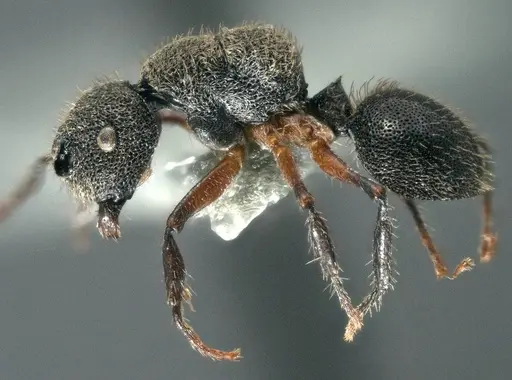
Echinopla madli is a tiny, stout ant measuring just 3.9–4.6 mm . It belongs to the serrata species group and has a distinctive appearance, predominantly black without any metallic sheen, with a unique polyporous surface texture that looks like tiny coral rock pores . The mesosoma has sharp tubercles along its upper edges, and the petiole (waist) features distinctive teeth . Workers have been collected from lower montane mixed dipterocarp forests in Borneo at elevations above 650 m, as well as rainforest habitats in Thailand and Malaysia . This species was only described in 2015,so very little is known about its behavior in the wild or in captivity.
Quick Summary
- Difficulty: Unknown, no captive data exists
- Origin & Habitat: Southern Thailand (Satun Province) and Borneo (Sabah), West Malaysia. Found in lower montane mixed dipterocarp forest and rainforest at elevations of 525–650 m+ [1][2][3].
- Colony Type: Unknown, only the worker caste has been documented. Colony structure has not been studied.
- Size & Growth:
- Queen: Unknown, queen caste has not been described [3].
- Worker: 3.9–4.6 mm total length [1].
- Colony: Unknown, no colony size data available.
- Growth: Unknown, no development data available.
- Development: Unknown, development has not been studied. (No data available on egg‑to‑worker timeline. Related Echinopla species may give hints, but specific data is lacking.)
- Antkeeping:
- Temperature: No thermal studies exist. Based on its rainforest and lower montane forest origin (Borneo, Thailand), it likely prefers warm, humid conditions similar to other Formicinae from Southeast Asian forests. A range of 24–28 °C is a reasonable starting point. Monitor colony activity and adjust.
- Humidity: Likely needs high humidity, it comes from tropical rainforest and lower montane forest habitats. Keep the nest substrate consistently moist but not waterlogged. Provide a water tube for drinking.
- Diapause: Unknown, no seasonal data available. As a tropical species from low latitudes, it may not need a true hibernation period, but it could show reduced activity during cooler months.
- Nesting: In the wild, workers have been collected from forest canopy via tree fogging, suggesting they may be arboreal or nest in elevated locations [1]. A naturalistic setup with vertical surfaces, or a Y‑tong/plaster nest with good humidity retention, would likely work well. Avoid dry conditions.
- Behavior: Behavior in captivity is unstudied. Based on related Echinopla species and its small size, workers are likely moderate to active foragers. Escape prevention must be excellent, these ants are only 3.9–4.6 mm long and can squeeze through very small gaps. The genus Echinopla is not known for aggressive stinging, but defensive behavior has not been documented for this particular species.
- Common Issues: no captive husbandry data exists, this is an extremely rare species in the antkeeping hobby, tiny size means escapes are likely without fine mesh barriers and tight-fitting lids, no information on founding behavior makes it difficult to establish wild-caught colonies, unknown humidity requirements may lead to keeping conditions too dry or too wet, no data on accepted foods, feeding is experimental, lack of queen documentation means propagation from wild colonies is uncertain
Appearance and Identification
Echinopla madli is a very small ant, with workers measuring just 3.9–4.6 mm in total length [1]. The body is predominantly black without any metallic sheen, appearing greyish thanks to dense white hairs (pilosity) covering the surface [1]. The most distinctive feature is the polyporous surface, tiny pores closely set across the head, mesosoma, and gaster, giving it a texture similar to coral rock [1][2]. The mesosoma has sharp tubercles along its upper margin, and the petiole (waist) features 1–2 sharp teeth with smaller denticles below [1]. The first gaster segment is hardly longer than wide (about 1.01 times), with widely spaced pores and shiny interspaces [2][4]. Leg color varies: some specimens have testaceous (reddish‑brown) legs, others are mostly blackish [1].
Natural Habitat and Distribution
This species is known from southern Thailand (Satun Province, Thale Ban National Park) and Borneo (Sabah, including Danum Valley and Poring Spring), as well as West Malaysia [1][2]. Workers have been collected from lower montane mixed dipterocarp forest at elevations above 650 m, and from rainforest habitats at around 525 m elevation [1]. The collection method (tree fogging) suggests these ants may be arboreal or nest in the forest canopy [1]. The species was only described in 2015,so its full distribution and habitat preferences are still being discovered.
Housing and Nesting
Since workers have been collected from forest canopy via tree fogging, this species likely prefers elevated nesting sites [1]. A naturalistic setup with vertical surfaces, or a Y‑tong/plaster nest that retains humidity well, would be appropriate. Given its small size (under 5 mm), escape prevention must be excellent, use fine mesh and seal all openings. The nest should provide humid conditions because the species comes from rainforest environments. Always provide a water tube for drinking.
Feeding and Diet
The diet of Echinopla madli has not been documented in scientific literature. As a member of the subfamily Formicinae, they likely have a typical ant diet including nectar/honeydew and small insects. Related Echinopla species are known to forage in trees and may tend aphids for honeydew. In captivity, offering sugar water or honey water alongside small protein sources like fruit flies or small mealworms would be a reasonable starting point. Observe acceptance and adjust based on colony preferences.
Temperature and Humidity Requirements
No specific thermal data exists for this species. Based on its origin in lower montane rainforest in Borneo and Thailand, it likely prefers warm, humid conditions. A temperature range of 24–28 °C is a reasonable starting point, similar to other Southeast Asian forest ants. Keep humidity high, keep the nest substrate consistently moist but not waterlogged. Monitor your colony’s activity levels: if workers cluster in cooler areas, lower the temperature slightly, if they avoid heated areas, conditions may be too warm. Always provide a gradient so ants can choose their preferred conditions.
Challenges and Considerations
Echinopla madli is a big challenge for antkeepers because virtually no captive husbandry information exists. The species was only described in 2015,and only the worker caste has been documented, queens have never been described [1][3]. That means setting up a sustainable captive colony would be extremely difficult, since wild‑caught colonies would need to be collected (tricky if they are arboreal) and their founding requirements are completely unknown. Their tiny size also demands excellent escape prevention. For these reasons, this species is not recommended for beginners or even most experienced antkeepers until more information becomes available.
Frequently Asked Questions
How long do Echinopla madli workers live?
Worker lifespan has not been studied for this species. Typical Formicinae workers live several months to a few years depending on species and conditions.
Can I keep Echinopla madli in a test tube?
A test tube could work for a small colony, but their likely arboreal nature and need for humidity may make a naturalistic or Y‑tong setup more appropriate. Their tiny size requires excellent escape prevention regardless of housing method.
How fast do Echinopla madli colonies grow?
Growth rate is unknown, no development data exists for this species. Related Echinopla species may give clues, but specific data is lacking.
Are Echinopla madli good for beginners?
No. This species is not recommended for beginners or most experienced antkeepers. It was only described in 2015,only the worker caste is known, and no captive husbandry information exists. Establishing a colony would be extremely challenging [1].
What do Echinopla madli eat?
Diet is unconfirmed. Based on related species and the Formicinae subfamily, they likely accept sugar sources (honey water) and small insects. Start with sugar water and small protein sources like fruit flies, and observe acceptance.
Do Echinopla madli need hibernation?
Diapause requirements are unknown. As a tropical species from low latitudes (Thailand, Borneo), they likely do not require a true hibernation period, but may show reduced activity during cooler seasons.
How big do Echinopla madli colonies get?
Maximum colony size is unknown. No colony size data has been published for this species.
Can I keep multiple Echinopla madli queens together?
Unknown, the queen caste has never been documented, so colony structure is completely unstudied. Combining unrelated queens is not recommended given the lack of information [1].
When do Echinopla madli have nuptial flights?
Nuptial flight timing is unknown. The queen caste has never been described, so reproductive behavior is completely unstudied.
Why are my Echinopla madli dying?
Without any captive data, it’s impossible to identify specific mortality causes. However, common issues with poorly understood species include: incorrect humidity (too dry or too wet), inappropriate temperature, stress from collection, and escape‑related losses. Start with high humidity (70–80%) and warm temperatures (24–28 °C), and ensure excellent escape prevention.
Is Echinopla madli invasive?
No. This species is native to Thailand, Borneo, and West Malaysia. There are no records of it being introduced anywhere [1][2].
Report an Issue
The current care sheet is based fully on literature. See inconsistencies, or something that's incorrect? Please , it will be resolved after review from an admin. Contributing to the blogs tab also helps providing information, to make us be able to further improve the caresheets. Thank you for your support!
References

この飼育シートのライセンスは: CC BY-SA 4.0 .
コミュニティブログ
CASENT0914948
AntWebで見る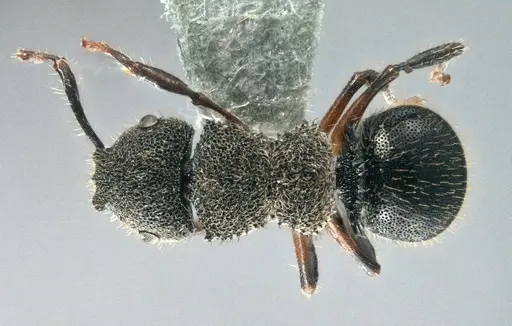
文献
分布マップを読み込み中...製品情報を読み込み中...