
Cardiocondyla sulcata
- 学名
- Cardiocondyla sulcata
- 族
- Crematogastrini
- 亜科
- Myrmicinae
- 命名者
- Seifert, 2023
- 分布
- 0 か国で発見
紹介
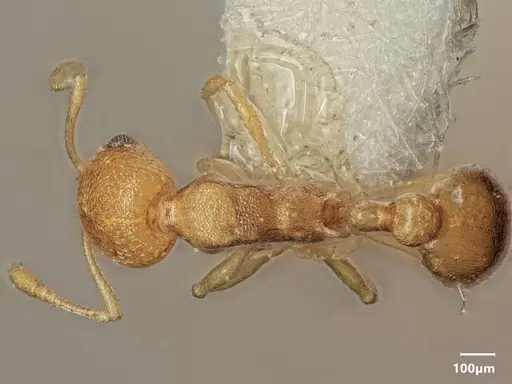
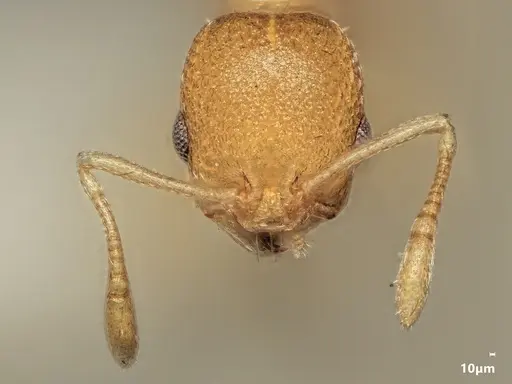
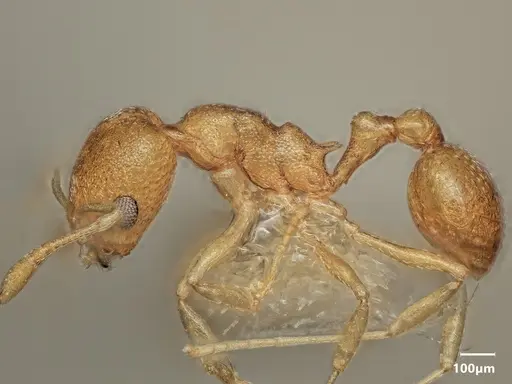
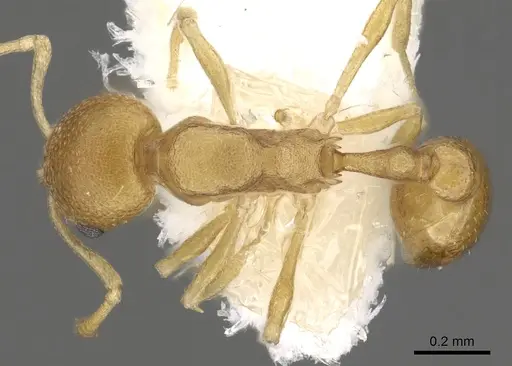
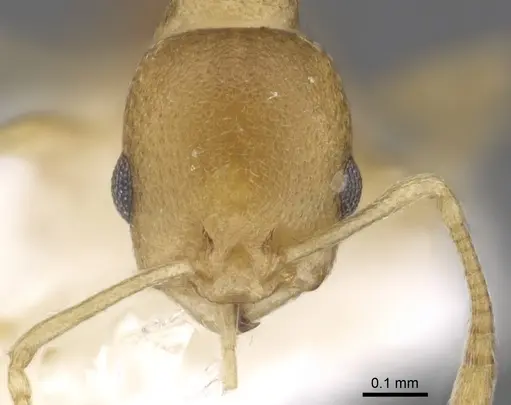
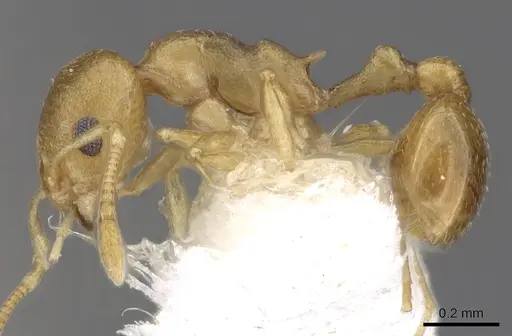
Cardiocondyla sulcata is an extremely tiny ant species from the lowland rainforests of Peninsular Malaysia. Workers are among the smallest ants in the world, with a head size of approximately 0.4mm . They are uniformly yellowish in color with a distinctive very deep groove on their mesosoma (the middle body section) and an extremely narrow waist. The species was only recently described in 2022 and is known only from Pasoh Forest Reserve, where they were collected from forest canopy samples - suggesting they forage arboreally in the treetops . This could represent a unique evolutionary lineage within the genus, as their morphology doesn't closely match any known related species .
Quick Summary
- Difficulty: Expert
- Origin & Habitat: Pasoh Forest Reserve, Malaysia (2.982°N, 102.313°E, 130m elevation), lowland tropical rainforest. The fogging sample collection method indicates they forage in the forest canopy [1].
- Colony Type: Unconfirmed. Colony structure for this specific species has not been documented.
- Size & Growth:
- Queen: Size data unavailable, queens have been described but not measured [1]
- Worker: Extremely small, head size approximately 0.4mm (CS 415 µm) [1]. Full body length data unavailable.
- Colony: Unknown, likely small colonies based on genus patterns for tiny species
- Growth: Unknown
- Development: Unknown (No development data exists for this species.)
- Antkeeping:
- Temperature: Keep warm at 24-28°C. This species comes from a warm, lowland tropical rainforest in Malaysia, so maintain stable temperatures in the mid-to-high 20s Celsius [1].
- Humidity: High humidity required. Pasoh Forest Reserve is a tropical rainforest with consistently moist conditions. Keep nest substrate damp but not waterlogged.
- Diapause: No diapause required. As a tropical species from near the equator, they do not experience cold winters and do not need a hibernation period [1].
- Nesting: Given their arboreal foraging behavior and extremely small size, they likely prefer nests in rotting wood, bark, or tight cavities. A plaster nest or soil nest with very fine chambers would work well. Escape prevention is critical due to their microscopic size.
- Behavior: Very small, likely peaceful ants. Their tiny size and presence in canopy fogging samples suggest they are arboreal foragers, probably foraging for honeydew and small arthropods in trees. They likely have minimal defensive capabilities due to their minute size. Escape prevention is absolutely critical, they can squeeze through the tiniest gaps and will require fine mesh barriers and tightly sealed enclosures.
- Common Issues: escape prevention is critical, workers are extremely small and can squeeze through gaps invisible to the naked eye, no captive care information exists, this is a newly described species with zero established husbandry protocols, wild-caught colonies may be extremely difficult to obtain since they forage in the forest canopy, tiny size makes them vulnerable to minor environmental fluctuations, high humidity requirements create mold risk if ventilation is inadequate
Discovery and Identification
Cardiocondyla sulcata was formally described in 2022 by ant taxonomist Bernhard Seifert. The species is known only from Pasoh Forest Reserve in Malaysia, where it was collected using fogging samples from the forest canopy between March and April 1994. The type specimens (holotype worker and paratypes) are deposited in the Natural History Museum in London and the SMNG in Goerlitz, Germany [1]. The species name comes from the Latin word 'sulcata' meaning 'grooved', referring to their very pronounced metanotal groove, a distinctive groove on the back of their middle body section that forms an angle of 90-100 degrees [1]. This unique morphology suggests C. sulcata may represent a monotypical clade, meaning it could be the only species in its evolutionary branch within Cardiocondyla.
Size and Morphology
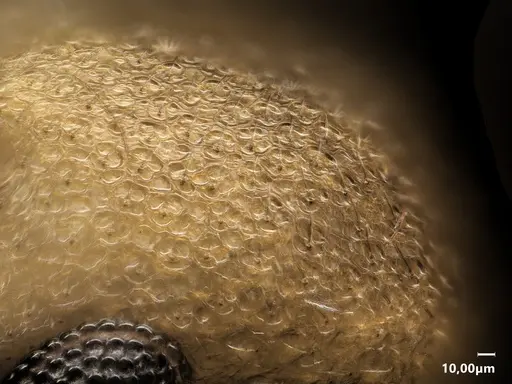
This is an extremely tiny ant species. Workers have a head size of approximately 0.4mm (measured as CS 415 µm), making them among the smallest ants in the world [1]. They have relatively large eyes for their size, short antennae scapes, and very short spines on their mesosoma. Their most distinctive features are the extremely deep metanotal groove and an unusually narrow petiole (the first segment of their waist) that is more than twice as long as it is wide when viewed from above [1]. The entire body is a uniform yellowish color without any darker markings. Queens have been described but not measured in detail [1].
Natural History and Foraging
The fact that C. sulcata was collected exclusively from fogging samples (where insecticide is released into the forest canopy to knock down insects from trees) strongly suggests they are arboreal foragers, living and feeding in the forest canopy rather than on the ground [1]. Pasoh Forest Reserve is a lowland tropical rainforest at just 130m elevation near the equator, meaning this species experiences warm temperatures and high humidity year-round with no seasonal temperature changes. They likely feed on honeydew from aphids and scale insects in the canopy, plus small arthropods. The deep metanotal groove and narrow waist may be adaptations for their arboreal lifestyle, though the exact function is unclear.
Housing and Care Challenges
Keeping Cardiocondyla sulcata presents significant challenges due to their extremely small size and the complete lack of established husbandry information. You will need to use an escape-proof setup with fine mesh barriers, standard ant keeping barriers will not work for ants this small. A small plaster nest or soil nest with very fine, tight chambers scaled to their tiny size is essential. Maintain high humidity and warm temperatures. Since they appear to be arboreal, you might consider providing climbing structures and perhaps a small foraging area elevated above the nest. Start with small live prey like springtails or tiny fruit fly larvae, and offer sugar water or honey diluted with water. This species is recommended only for expert antkeepers with experience with micro-ant species.
Related Species and Genus Context
Cardiocondyla is a genus of tiny myrmicine ants with over 80 described species found mostly in tropical and subtropical regions worldwide. Many species are known for their unusual colony structures, including some with multiple queens and others where workers can mate and reproduce (gamergates). The genus includes several invasive species that have spread globally through human commerce. However, C. sulcata appears to be a rare and localized species known only from a single forest in Malaysia, with no evidence of being invasive or widespread. Its unique morphology suggests it occupies a specialized ecological niche in the forest canopy.
Frequently Asked Questions
How big do Cardiocondyla sulcata ants get?
Workers are extremely tiny with a head size of approximately 0.4mm (CS 415 µm). This makes them among the smallest ants in the world. Queens have been described but not precisely measured.
Where does Cardiocondyla sulcata live in the wild?
This species is known only from Pasoh Forest Reserve in Peninsular Malaysia. They were collected from the forest canopy using fogging samples, suggesting they live and forage in trees rather than on the ground.
Are Cardiocondyla sulcata good for beginners?
No. This species is not recommended for beginners. It was only described in 2022 and has no established captive husbandry protocols. Their microscopic size makes escape prevention extremely difficult, and they require very specific humidity and temperature conditions.
What do Cardiocondyla sulcata eat?
Their exact diet is unknown, but based on genus patterns and their arboreal lifestyle, they likely feed on honeydew from canopy aphids and scale insects, plus small arthropods. In captivity, offer small live prey like springtails or fruit fly larvae, plus diluted honey or sugar water.
Do Cardiocondyla sulcata ants sting?
Given their microscopic size, they would be unable to penetrate human skin even if they had a stinger. They are completely harmless to humans.
How long does it take for Cardiocondyla sulcata to develop from egg to worker?
The development timeline has not been documented for this species.
Do Cardiocondyla sulcata need hibernation?
No. As a tropical species from near the equator in Malaysia, they do not experience cold winters and do not require any diapause or hibernation period.
How do I prevent Cardiocondyla sulcata from escaping?
Escape prevention is absolutely critical. Standard ant keeping barriers will not work for ants this small. Use fine mesh (at least 0.5mm or finer), tightly sealed lids, and consider coating enclosure edges with fluon or similar barriers. Even tiny gaps invisible to the naked eye can allow escape.
Can I keep multiple Cardiocondyla sulcata queens together?
The colony structure of this species is unconfirmed. Do not attempt to combine unrelated queens without specific knowledge of this species' behavior.
What temperature should I keep Cardiocondyla sulcata at?
Keep them warm at 24-28°C. Pasoh Forest Reserve is a lowland tropical rainforest with year-round warm temperatures.
What humidity do Cardiocondyla sulcata need?
High humidity. This species comes from a tropical rainforest in Malaysia. Keep the nest substrate consistently damp but not waterlogged, and ensure adequate ventilation to prevent mold.
Is Cardiocondyla sulcata available for sale?
This is an extremely rare species with no established captive breeding populations. It is unlikely to be available in the ant keeping hobby. Most specimens remain in museum collections.
Report an Issue
The current care sheet is based fully on literature. See inconsistencies, or something that's incorrect? Please , it will be resolved after review from an admin. Contributing to the blogs tab also helps providing information, to make us be able to further improve the caresheets. Thank you for your support!
References

この飼育シートのライセンスは: CC BY-SA 4.0 .
コミュニティブログ
文献
分布マップを読み込み中...製品情報を読み込み中...