
Cardiocondyla monardi
- 学名
- Cardiocondyla monardi
- 族
- Crematogastrini
- 亜科
- Myrmicinae
- 命名者
- Santschi, 1930
- 分布
- 0 か国で発見
紹介
Cardiocondyla monardi is a tiny ant species from Angola in the Afrotropical region. Workers measure approximately 2.7mm in total length and are easily recognized by their yellow body with silvery highlights, unusually long antennae that extend past the back of the head, completely unarmed propodeum (no spines or teeth), and elongated pedicel segments. This species is so morphologically distinct that it stands apart from all other Afrotropical Cardiocondyla species - it is the only known species in the genus with a completely smooth propodeum. Only two worker specimens have ever been collected (in 1928), making it one of the rarest and least-studied ants in existence. The genus Cardiocondyla contains small, monomorphic ants native to the Old World, with many species having spread globally as tramp species .
Quick Summary
- Difficulty: Unknown, no captive breeding data exists
- Origin & Habitat: Angola, Afrotropical region. Based on related species, likely nests in soil in tropical or subtropical habitats [1].
- Colony Type: Unconfirmed, only worker caste has been described. Based on genus patterns, likely single-queen colonies with potential ergatoid (wingless) males for intranidal mating [1].
- Size & Growth:
- Queen: Unknown, queen has never been described [2]
- Worker: ~2.7mm [2]
- Colony: Unknown, only two workers known from type specimens [2]
- Growth: Unknown
- Development: Unknown, no development data exists for this species (Based on related Cardiocondyla species, development likely takes several weeks at optimal temperature, but this is entirely estimated.)
- Antkeeping:
- Temperature: Unknown for this species. Based on genus patterns for tropical African ants, start around 24-28°C and observe colony activity.
- Humidity: Unknown. Most Cardiocondyla species prefer moderate humidity. Keep nest substrate lightly moist but not waterlogged.
- Diapause: Unknown, no seasonal data exists for this species. As a tropical species, likely does not require formal hibernation.
- Nesting: Based on genus patterns, likely nests in soil. A test tube setup or small nest with moist substrate would be an appropriate starting point [1].
- Behavior: No specific behavior data exists for this species. Based on genus patterns, Cardiocondyla are typically non-aggressive, ground-nesting ants that forage individually or in small groups. They are known for producing ergatoid (wingless) males that mate within the nest. Their tiny size means escape prevention is critical, they can squeeze through extremely small gaps. Defense mechanism: Members of the Myrmicinae subfamily use a smear defense, wiping venom onto enemies with a modified stinger [1].
- Common Issues: this species has never been kept in captivity, no captive care information exists, only known from two museum specimens collected in 1928,making any care advice speculative, queen caste undescribed, founding behavior unknown, no feeding preferences documented for this species, tiny size requires excellent escape prevention
Species Overview and Identification
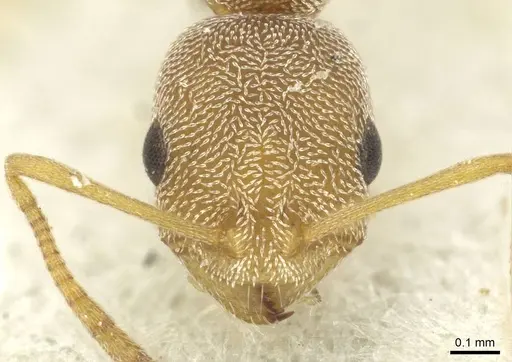
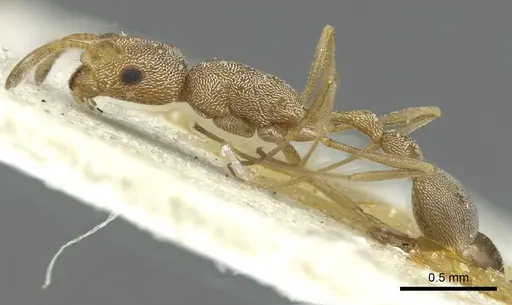
Cardiocondyla monardi is an extremely rare ant species described from only two worker specimens collected in Angola in 1928. It is considered one of the most distinctive Cardiocondyla species in the Afrotropical region due to several unique morphological features. Workers are tiny at approximately 2.7mm total length and have a yellow body covered in glinting silvery pubescence that gives them a metallic appearance. The most distinctive features include antennae with scapes (the long basal segments) that extend past the back of the head when laid back, a completely smooth propodeum without any spines or teeth, and unusually elongated pedicel segments (the petiole and postpetiole that connect the thorax to the abdomen). Unlike most Cardiocondyla species that have some form of propodeal spines or denticles, C. monardi has a smoothly rounded propodeum that transitions evenly into the declivity, a feature so unusual it is only known in this species among modern Cardiocondyla ants [1][2].
Distribution and Habitat
This species is known only from the type locality in Angola: Rio Mbalé (a tributary of the Kubango River), approximately 120km south of Vila da Ponte, collected in September 1928. The exact habitat type at this location is not documented. The genus Cardiocondyla is native to the Old World, with most species distributed in tropical and subtropical regions, though several tramp species have been introduced worldwide. Most Cardiocondyla species nest in soil, with some species occasionally nesting in plant material [1].
Biology and Colony Structure
Almost nothing is known about the biology of Cardiocondyla monardi. The species has only ever been collected twice, and only the worker caste has been described, no queens or males have ever been found. Based on general Cardiocondyla biology, the genus is known for several unusual reproductive traits. Many species produce both normal winged males and wingless ergatoid males that mate with females inside the nest (intranidal mating). Many species also have dimorphic queens, some individuals are fully winged (macropterous) while others have reduced wings (brachypterous), which relates to their dispersal strategy. The typical colony structure for the genus involves single-queen colonies, though some species can form multi-queen colonies. Workers are monomorphic (all the same size) in this genus [1].
Keeping Cardiocondyla monardi - What We Don't Know
It is important to understand that Cardiocondyla monardi has never been kept in captivity, and no biological data exists to guide care. The queen has never been described, so founding behavior (whether the queen seals herself in to raise young alone, or must hunt for food) is completely unknown. Colony size, development time, temperature and humidity preferences, and diet have not been documented. Any care advice for this species would be entirely speculative, based only on general patterns from related Cardiocondyla species. This makes C. monardi unsuitable for antkeepers unless the primary goal is establishing the first captive colony of an entirely unknown species, a research project rather than typical antkeeping. For keepers interested in Cardiocondyla, better-documented species like C. obscurior or C. wroughtonii would be far more practical choices [1].
Frequently Asked Questions
Can I keep Cardiocondyla monardi as a pet ant?
It is not recommended. This species has never been kept in captivity and is known only from two museum specimens collected in 1928. No queen has ever been described, so obtaining a colony would be essentially impossible. Even if you could find one, there is no care information to guide successful keeping.
What does Cardiocondyla monardi look like?
Workers are tiny at approximately 2.7mm total length with a yellow body covered in glinting silvery pubescence. They have unusually long antennae (the scapes extend past the back of the head), a completely smooth and unarmed propodeum (no spines), and elongated pedicel segments connecting the thorax to the abdomen.
Where is Cardiocondyla monardi found?
Only known from Angola, specifically from Rio Mbalé (a tributary of the Kubango River) collected in 1928. It has not been recorded anywhere else.
How big do Cardiocondyla monardi colonies get?
Unknown. Only two workers have ever been collected. Related Cardiocondyla species typically reach a few hundred workers, but this is entirely speculative for C. monardi.
Do Cardiocondyla monardi ants sting?
Given their tiny size, any sting would be negligible even if present. Most small Myrmicinae ants can sting but rarely penetrate human skin.
What do Cardiocondyla monardi ants eat?
Unknown, no feeding observations exist for this species. Based on genus patterns, they likely forage for small insects and honeydew, similar to other small myrmicine ants.
What temperature do Cardiocondyla monardi ants need?
Unknown for this specific species. Based on related tropical African Cardiocondyla species, they likely prefer warm conditions around 24-28°C, but this is entirely estimated.
Can I buy Cardiocondyla monardi queens or colonies?
Extremely unlikely. This species is only known from two museum specimens and has never been documented in the antkeeping hobby. No queen has ever been described or collected.
Is Cardiocondyla monardi a good beginner ant?
No. This species is not available in the antkeeping hobby, and no captive care information exists. Even if available, the complete lack of biological data would make successful keeping impossible.
Do Cardiocondyla monardi need hibernation?
Unknown. As a tropical African species, they likely do not require formal hibernation, but no seasonal data exists for this species.
What makes Cardiocondyla monardi different from other Cardiocondyla?
It is the only known Cardiocondyla species with a completely smooth, unarmed propodeum (no spines or teeth) and extremely long antennae that extend past the back of the head. This unique morphology makes it easily distinguishable from all other Afrotropical Cardiocondyla species.
Why is Cardiocondyla monardi so rare?
This species is known only from two workers collected in 1928 in Angola. It may be genuinely rare in the wild, or it may have been collected from an unusual microhabitat that is rarely sampled. Many small ant species are overlooked due to their tiny size.
Report an Issue
The current care sheet is based fully on literature. See inconsistencies, or something that's incorrect? Please , it will be resolved after review from an admin. Contributing to the blogs tab also helps providing information, to make us be able to further improve the caresheets. Thank you for your support!
References

この飼育シートのライセンスは: CC BY-SA 4.0 .
コミュニティブログ
CASENT0912879
AntWebで見る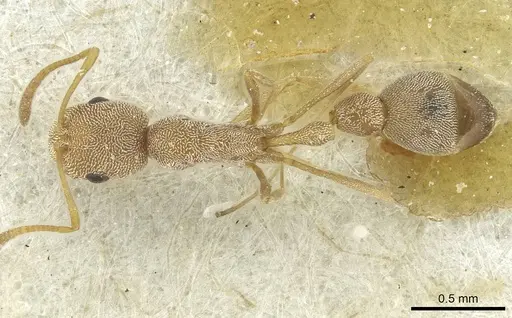
文献
分布マップを読み込み中...製品情報を読み込み中...