
Anillomyrma tridens
- 学名
- Anillomyrma tridens
- 族
- Solenopsidini
- 亜科
- Myrmicinae
- 命名者
- Bolton, 1987
- 分布
- 0 か国で発見
紹介
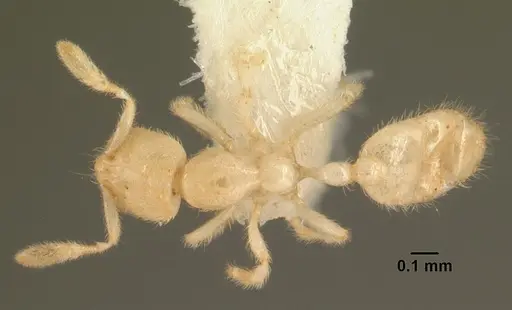
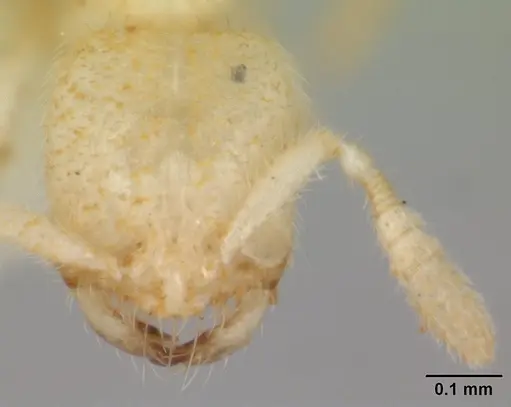
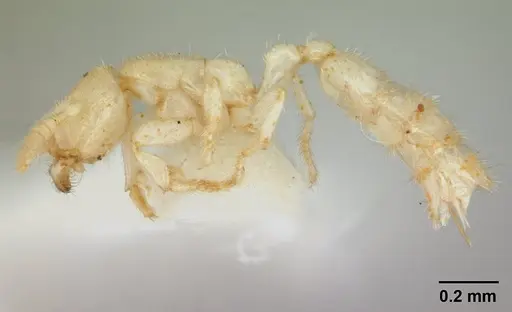
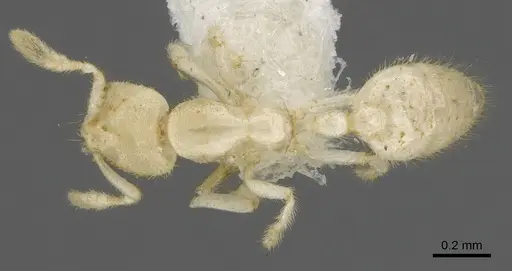
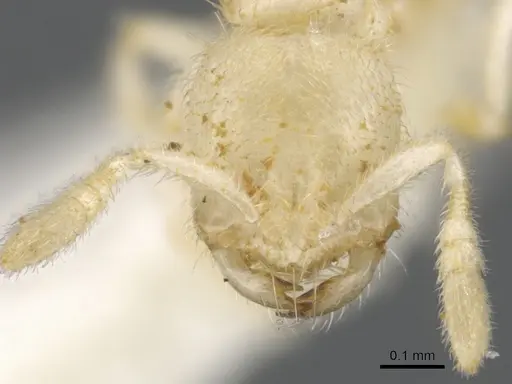
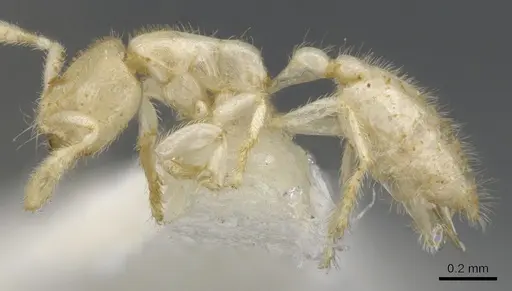
Anillomyrma tridens are among the smallest ants in the world. These pale yellowish-white ants are completely blind, lacking eyes entirely, and have soft, weakly hardened bodies . They inhabit the sandy soils of lowland rainforests in Sarawak, Borneo . Unlike typical ants that form permanent nests, the only known observation describes them using temporary covered runways in the topsoil rather than a fixed nest structure, leading to suggestions that they may be nomadic . When disturbed, they pour out in large numbers and deliver surprisingly painful stings despite their minute size .
Quick Summary
- Difficulty: Expert
- Origin & Habitat: Lowland rainforest in sandy soil, Gunong Mulu National Park, Sarawak, Borneo [1][2]
- Colony Type: Unknown, only the worker caste has ever been documented, no queens or brood observed [2]
- Size & Growth:
- Queen: Unknown, queens have never been collected [2]
- Worker: Size data unavailable, workers are extremely small (among the smallest ants in the world) but exact total length measurements are not published [1]
- Colony: Unknown
- Growth: Unknown
- Development: Unknown, no brood or reproductive castes have ever been observed [2] (Development timeline is completely undocumented for this species.)
- Antkeeping:
- Temperature: Warm tropical conditions, approximately 24-28°C based on lowland rainforest habitat [1]
- Humidity: High humidity with moist but not waterlogged sandy substrate, consistent with rainforest floor conditions [1]
- Diapause: No, this is a tropical species that does not require winter rest [2]
- Nesting: Natural covered runways in sandy topsoil, captive housing methods are unknown and likely impractical due to extremely small size [2]
- Behavior: Completely blind (eyeless), potentially nomadic, and capable of delivering painful stings despite tiny size [1][2]. Workers are monomorphic and pale in color [1].
- Common Issues: extreme escape risk, workers are among the smallest ants in the world and can pass through the finest mesh and smallest gaps in any standard formicarium., unknown colony biology means no established methods exist for founding or raising colonies., potential nomadic behavior may prevent establishment in static nest setups., painful sting capability requires careful handling despite the ants' tiny size [2].
Natural History and Discovery
Anillomyrma tridens is known only from workers collected in 1977 in Gunong Mulu National Park, Sarawak [1]. The type series was discovered when workers were seen crossing a forest path using a covered runway in the topsoil. This runway consisted of a narrow shallow groove covered by a canopy of small soil particles, forming a tube that concealed the ants moving inside [2]. When the soil was disturbed, large numbers of minute yellowish ants poured out to investigate [2]. The runway appeared temporarily, was deserted the day after discovery, and was washed away shortly after by rain. The site was checked periodically for weeks, but the ants never returned, and no trace of sexuals or brood could be found [2]. This pattern led Bolton (1987) to tentatively suggest that the species may be nomadic rather than maintaining a permanent nest structure [2].
Morphology and Identification
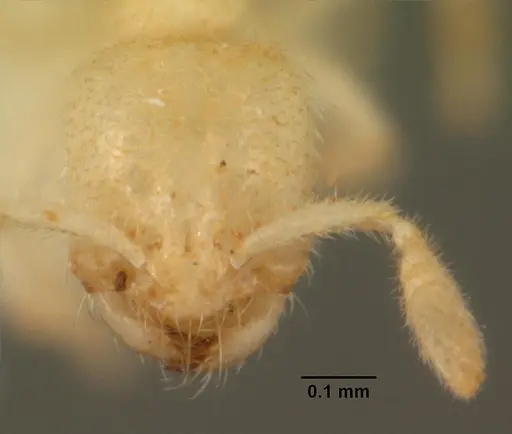
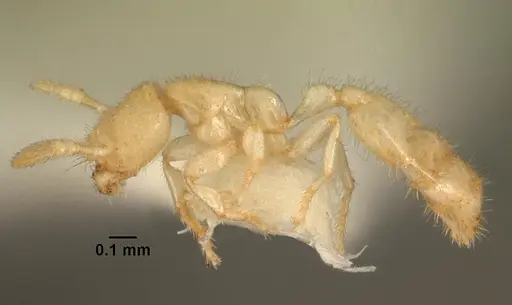
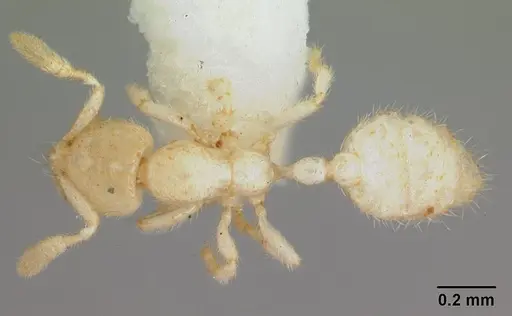
Workers are monomorphic and extremely small, among the smallest ants in the world [1]. They are very pale yellowish-white and extensively depigmented, with soft bodies that are weakly hardened [1]. The head is roughly rectangular and longer than broad, with mandibles that have three large sharp teeth [1]. The eyes are completely absent [1]. Antennae are 10-segmented with a 3-segmented club, and the scapes are short [1]. The body lacks sculpture except for hair-pits, and is covered with short fine hairs [1].
The Reality of Keeping This Species
You cannot currently keep Anillomyrma tridens in captivity. No queens have ever been documented, so founding a colony is impossible. The workers are smaller than a grain of sand, making containment practically impossible with any standard antkeeping equipment. Additionally, their suspected nomadic lifestyle means they may not accept static nest structures even if you could contain them. This species remains a scientific curiosity rather than a candidate for captive keeping. [2]
Defense Mechanism
Anillomyrma tridens belongs to the subfamily Myrmicinae and tribe Solenopsidini, which typically use stingers for defense. Bolton (1987) reported that they use their stings freely and are capable of penetrating human skin, delivering a painful sting out of all proportion to the size of the ant [2]. While they are not dangerous in the sense of causing serious harm, the sting is surprisingly potent for such a minute insect.
Frequently Asked Questions
Can I keep Anillomyrma tridens in a test tube or formicarium?
No. This species is not currently viable for captive keeping. No queens have ever been found, and the workers are among the smallest ants in the world, small enough to escape through the tiniest gaps in any standard equipment. Their biology remains too poorly known to support captive colonies.
How big are Anillomyrma tridens workers?
Workers are extremely small, among the smallest ants in the world, but exact total length measurements are not published in available literature [1].
Do Anillomyrma tridens ants sting?
Yes. Despite their minute size, they can sting and the sting is painful, capable of penetrating human skin [2].
Where do Anillomyrma tridens live in the wild?
They inhabit lowland rainforests in sandy soil in Sarawak, Borneo, specifically documented from Gunong Mulu National Park [1][2].
What do Anillomyrma tridens eat?
Their diet is unknown. As members of the Solenopsidini tribe, they may be generalist predators or scavengers, but no specific feeding observations exist.
Do Anillomyrma tridens need hibernation?
No. They are a tropical species from Borneo and do not require winter rest or diapause [2].
Are Anillomyrma tridens good for beginners?
Absolutely not. This species is unsuitable for any level of antkeeping due to unknown biology, lack of available queens, and impossibly small size.
Why are Anillomyrma tridens so difficult to keep?
Three main reasons: First, no queens have ever been documented, so you cannot start a colony. Second, workers are among the smallest ants in the world and can escape through any gap. Third, they may be nomadic, meaning they do not stay in one place like typical ants [2].
Report an Issue
The current care sheet is based fully on literature. See inconsistencies, or something that's incorrect? Please , it will be resolved after review from an admin. Contributing to the blogs tab also helps providing information, to make us be able to further improve the caresheets. Thank you for your support!
References

この飼育シートのライセンスは: CC BY-SA 4.0 .
コミュニティブログ
文献
分布マップを読み込み中...製品情報を読み込み中...