
Aenictus wilaiae
- 学名
- Aenictus wilaiae
- 亜科
- Dorylinae
- 命名者
- Jaitrong & Yamane, 2013
- 分布
- 0 か国で発見
紹介
Aenictus wilaiae are tiny army ants from Thailand. Workers measure 2.10 to 2.55 millimeters long with yellowish-brown heads and gasters and reddish-brown middle sections . They live in lowland primary forests where they hunt other ants and termites . Scientists have only ever found workers - no queens or males have been described . This makes them impossible to keep using standard antkeeping methods, as you cannot obtain a founding queen.
Quick Summary
- Difficulty: Expert
- Origin & Habitat: Lowland primary forests of Thailand [1][2]
- Colony Type: Army ant structure, large colonies with a single permanent wingless queen, reproducing by colony fission
- Size & Growth:
- Antkeeping:
- Temperature: Warm and stable, roughly 25-28°C based on tropical lowland forest habitat
- Humidity: High humidity, damp tropical forest floor conditions
- Diapause: No, tropical species without winter dormancy
- Nesting: Not applicable, army ants are nomadic and form temporary bivouacs rather than permanent nests. They require large foraging areas
- Behavior: Highly aggressive, nomadic predators that hunt in raiding columns. They prey specifically on other ants and termites [1]. Their tiny size means they can escape through the tiniest gaps in standard enclosures.
- Common Issues: no queens are available to start a colony, you cannot found a colony from a single queen., specialized diet requires live ant and termite colonies as food, they will starve on standard sugar water and feeder insects., nomadic army ant behavior means they do not stay in one place and need large enclosures., tiny worker size allows escape through minute gaps in mesh or barriers., tropical requirements mean they need constant warmth and high humidity, they die quickly if conditions dry out or cool down.
What Aenictus wilaiae Looks Like
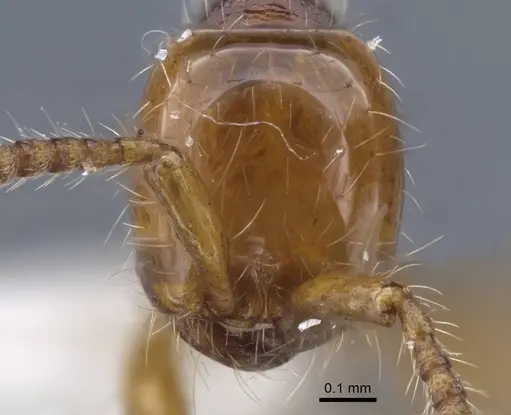
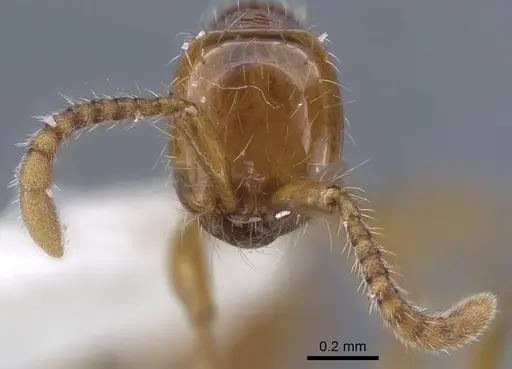
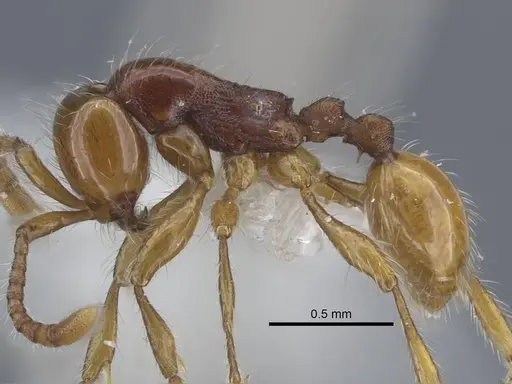
These are extremely small ants. Workers range from 2.10 to 2.55 millimeters in total length [1]. Their heads, gasters, and legs are yellowish-brown, while their middle body sections (mesosoma), petiole, and postpetiole are reddish-brown [1]. The mandibles are reddish-brown with a large sharp apical tooth followed by smaller teeth and denticles [1]. Their heads are slightly longer than broad with weakly convex sides, and their antennae are relatively short, not reaching two-thirds of the head length [1]. The body is mostly smooth and shiny, though the middle section has some reticulate texture and short rugae [1][3].
Natural Habitat and Distribution
Aenictus wilaiae lives in lowland primary forests in Thailand [1][2]. The type specimens were collected in Chachoengsao Province in eastern Thailand [1]. This tropical habitat means they experience warm, stable temperatures year-round with high humidity. They are ground-dwelling ants that forage through the leaf litter and soil of pristine forest habitats.
Hunting Behavior and Diet
These ants are specialized predators that hunt other ants and termites. Researchers observed them preying on Monomorium pharaonis (pharaoh ants) and termites in the field [1]. Unlike many ants that accept sugar water and standard feeder insects, Aenictus wilaiae require live ant or termite prey to survive. They hunt in groups using army ant raiding columns to overwhelm prey colonies.
Why These Ants Cannot Be Kept in Standard Formicaria
You cannot keep Aenictus wilaiae using normal antkeeping equipment. First, only worker ants have ever been found, no queens are available to start a colony [2]. Army ants reproduce by colony fission, where a large piece of an existing colony splits off with the queen, rather than by a single queen founding alone. Second, they are nomadic army ants that do not build permanent nests. They form temporary bivouacs and move constantly, requiring large foraging areas. Third, their specialized diet of live ants and termites is extremely difficult to maintain in captivity.
Colony Structure and Reproduction
Based on typical Aenictus army ant patterns, colonies likely contain hundreds to thousands of workers with a single large wingless queen (called a dichthadiiform queen). These queens are permanent residents of the colony and do not leave to found new nests. When the colony grows large enough, it splits through colony fission, a process where the queen moves with a large worker force to a new location, leaving the original colony to raise a new queen. This reproductive strategy means you cannot start a colony by catching and keeping a single queen. [1]
Frequently Asked Questions
Can I keep Aenictus wilaiae in a test tube?
No. These are army ants that require large space for foraging and nomadic movement. Additionally, you cannot obtain a founding queen to start a colony in a test tube, as only workers have been described for this species [2].
How do I start a colony of Aenictus wilaiae?
You cannot start a colony from a single queen. Army ants reproduce by colony fission, meaning new colonies split off from existing ones. You would need to collect a large fragment of a wild colony containing the queen, which is impractical, ethically questionable, and almost certainly unsuccessful in captivity.
What do Aenictus wilaiae eat?
They are specialized predators of other ants and termites. They have been observed preying on Monomorium pharaonis and termites in Thailand [1]. They cannot survive on sugar water, honey, or standard feeder insects like mealworms or crickets.
How long until first workers for Aenictus wilaiae?
This question does not apply to this species. Since they cannot be founded by a single queen, there is no timeline from egg to first workers in a founding context.
How big do Aenictus wilaiae colonies get?
Exact colony size is unknown, but based on typical Aenictus army ant patterns, they likely reach hundreds to thousands of workers.
Are Aenictus wilaiae good for beginners?
No. They are unsuitable for captive keeping at any skill level due to their specialized diet, nomadic behavior, lack of available queens, and large space requirements.
Do Aenictus wilaiae need hibernation?
No. They are tropical ants from lowland Thailand and do not require winter rest or cooling.
Do Aenictus wilaiae ants sting or bite?
They are small army ants that primarily use their mandibles to bite. At only 2.1-2.5mm in size, they are too small to effectively sting humans.
Can I keep multiple Aenictus wilaiae queens together?
This is not applicable. Army ants typically have only one queen per colony, and queens are not available to keepers since they are permanent residents of established colonies rather than founding individuals.
Why are my Aenictus wilaiae dying?
If you somehow obtained these ants, they are likely dying because they require live ant or termite prey, large foraging space for their nomadic lifestyle, and consistent tropical heat and humidity that is difficult to maintain outside their natural habitat.
Report an Issue
The current care sheet is based fully on literature. See inconsistencies, or something that's incorrect? Please , it will be resolved after review from an admin. Contributing to the blogs tab also helps providing information, to make us be able to further improve the caresheets. Thank you for your support!
References

この飼育シートのライセンスは: CC BY-SA 4.0 .
コミュニティブログ
CASENT0917245
AntWebで見る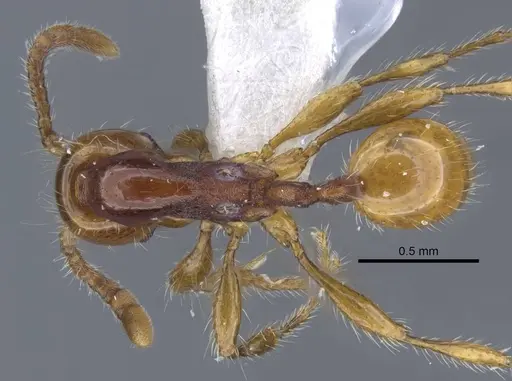
文献
分布マップを読み込み中...製品情報を読み込み中...