
Vollenhovia pwidikidika
- Nom. sci.
- Vollenhovia pwidikidika
- Tribù
- Crematogastrini
- Sottofamiglia
- Myrmicinae
- Autore
- Clouse, 2007
- Distribuzione
- Trovata in 0 paesi
Introduzione
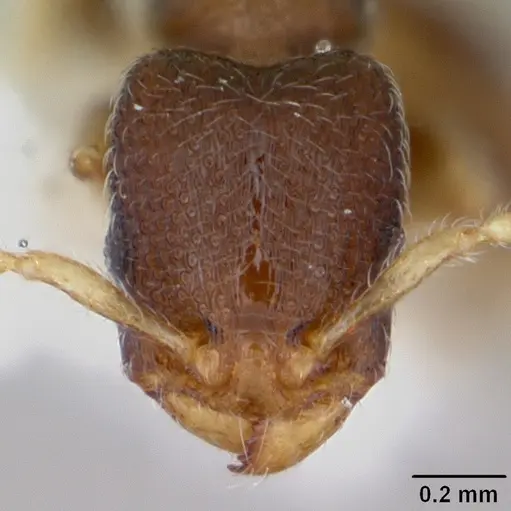
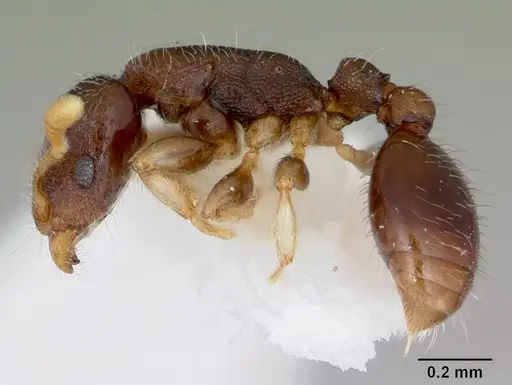
Vollenhovia pwidikidika is an exceptionally tiny ant, with workers measuring just 1.48-1.58 mm total length - one of the smallest Vollenhovia species ever described . The species name comes from the Pohnpeian word 'pwidikidik, ' meaning 'tiny' . Workers are orange-brown with black markings on the front of the middle body and the upper rear of the petiole; the mandibles, clypeus, and legs are yellow-orange . The head has fine scratches among large pits, but the cheek area (gena) is smooth and glossy - a key feature that separates them from the similar *V. kaselela* . This ant is known only from Pohnpei Island in the Federated States of Micronesia, where it lives in leaf litter in damp, shaded spots such as swamp‑taro fields and under pandanus trees .
Quick Summary
- Difficulty: Expert
- Origin & Habitat: Pohnpei Island, Federated States of Micronesia (Pacific Ocean). Found in leaf litter among swamp taro and under pandanus trees, indicating a damp, shaded forest‑floor habitat [1][2].
- Colony Type: Colony structure is unconfirmed. Only a handful of worker specimens have been collected, all via Berlese funnel from leaf litter [2][3].
- Size & Growth:
- Queen: Unknown, no queen caste has been described. Workers are 1.48-1.58 mm total length [1].
- Worker: 1.48-1.58 mm total length [1].
- Colony: Unknown, no colony data exists.
- Growth: Unknown, no development data exists for this species.
- Development: Unknown, no direct observations exist. (No biological data exists for this species. All care recommendations are based on genus‑level patterns and inference from its tropical habitat.)
- Antkeeping:
- Temperature: Keep at 24-28 °C, mimicking the warm, stable tropical conditions of Pohnpei. Provide a gentle gradient so the ants can choose a cooler spot [1][2].
- Humidity: High humidity is essential, they come from damp leaf litter in shaded areas. Keep the nest substrate consistently moist but not waterlogged. Use a water tube and ensure the enclosure does not dry out [1].
- Diapause: Unlikely, being a tropical species from near the equator, they probably do not require a diapause period. Maintain consistent warm conditions year‑round.
- Nesting: These tiny ants likely prefer a naturalistic setup with moist substrate. Use a small test‑tube setup with fine mesh or a Y‑tong/plaster nest with very tight chambers. Escape prevention is critical, they can squeeze through standard cotton and mesh.
- Behavior: Nothing is known about their behavior in captivity. In the wild they are found in leaf litter, suggesting they are ground‑dwelling and forage slowly through the substrate. As Myrmicinae they have a functional stinger, but given their tiny size the sting is negligible to humans. Their small size means excellent escape prevention is essential, they can slip through gaps invisible to the naked eye. They are likely shy and non‑aggressive.
- Common Issues: no biological data exists, all care is speculative and based on genus patterns, escape prevention is critical due to their extremely small size (under 2 mm), high humidity requirements can lead to mold if ventilation is poor, tiny size makes feeding difficult, prey must be appropriately sized (e.g., springtails, fruit flies), no colony development data makes predicting growth challenging, wild‑caught colonies may have parasites that are difficult to treat
Discovery and Naming
Vollenhovia pwidikidika was first described in 2007 by Ronald M. Clouse from specimens collected on Pohnpei Island in the Federated States of Micronesia [1]. The species name comes from the Pohnpeian word 'pwidikidik, ' meaning 'tiny', a perfect description for these ants, which rank among the smallest Vollenhovia species ever discovered [1]. The Pohnpeian language is known for melodic repetition of syllables in adjectives (like 'reirei' for tall and 'tikitik' for small) [1]. The type specimens were collected using a Berlese funnel from leaf litter samples taken in October 1995: among swamp taro at the Ponape Agriculture and Trade School (PATS) farm, and from leaf litter under a pandanus tree [1]. This species was initially confused with the similar V. kaselela, but can be distinguished by the smooth, glossy genae (cheek area) of pwidikidika versus the striate (scratched) genae of V. kaselela [1].
Distribution and Habitat
Vollenhovia pwidikidika is known only from Pohnpei Island in the Federated States of Micronesia, making it an endemic species with a very restricted range [2]. This is one of the smallest islands in the Caroline Islands chain, located in the western Pacific Ocean near the equator. The specimens were collected from leaf litter in damp, shaded locations, specifically among swamp taro and under pandanus trees [1]. This habitat suggests they prefer the warm, humid microclimate of the forest floor in tropical settings. Pohnpei has a tropical rainforest climate with high year‑round humidity and temperatures, and these ants have likely evolved to thrive in those stable conditions. The exclusive collection by Berlese funnel (a device that extracts insects from soil and leaf litter) indicates they are litter‑dwelling ants that rarely venture to the surface [1][3].
Identification and Morphology
Workers of Vollenhovia pwidikidika are among the smallest ants in the genus, measuring just 1.48-1.58 mm in total length [1]. They have 11‑segmented antennae with a distinct three‑segmented club, and their head is rectangular with a slightly concave rear edge [1]. The body is primarily orange‑brown, with distinctive black markings on the front of the middle body (mesepisternum) and the upper rear of the petiole [1]. Their mandibles have five teeth along the chewing margin, and the clypeus has two long, straight hairs immediately below the antenna bases [1]. The sculpturing includes fine scratches among large pits on the head, with a notable smooth, glossy strip above the clypeus extending nearly to the top of the head, this feature helps distinguish them from the similar V. brachycera, which has scratches in that area [1]. The gaster (abdomen) is smooth and elliptical, covered about 80% by the first tergite [1]. Their small size and distinctive color pattern make them relatively identifiable under magnification.
Defense Mechanism
As a member of the subfamily Myrmicinae and tribe Crematogastrini, Vollenhovia pwidikidika likely uses a 'smear' defense: rather than piercing with its stinger, it has a modified, flattened spatulate stinger used to wipe or smear venom onto enemies. No specific literature on its defense exists, so this is inferred from its taxonomic group.
Housing and Care Recommendations
Since absolutely no biological data exists for this species, all care recommendations are speculative and based on what we know about similar tiny Myrmicinae and the genus Vollenhovia. These ants should be kept in very small, humid setups with excellent escape prevention, their tiny size means they can slip through standard test‑tube cotton and mesh that appears secure. Use fine mesh (like silk mesh or very tight‑fitting lids) and consider coating rim edges with fluon. A small test‑tube setup works well, but ensure the water reservoir is appropriately sized for such minute ants. Temperature should be warm (24-28 °C) to mimic their tropical island habitat [1][2]. Humidity must be high, their natural habitat is damp leaf litter in shaded areas. Feed appropriately sized prey such as fruit flies, springtails, or other tiny arthropods. Sugar water may be accepted but is not guaranteed. Given their unknown colony structure and the complete lack of captive husbandry information, this species is recommended only for expert antkeepers who can adapt to unpredictable needs and are comfortable with experimental care.
Research Gaps and Future Study
Vollenhovia pwidikidika represents a significant knowledge gap in ant biology. Absolutely nothing is known about their colony structure, queen biology, founding behavior, development timeline, diet preferences, or any aspect of their social or reproductive behavior [1]. Even basic information like colony size, nuptial flight timing, and worker behavior remains undocumented. The only specimens known are the type series collected via Berlese funnel from leaf litter samples [1][3]. This makes V. pwidikidika one of the most poorly understood ant species in existence. Any captive colony would represent a valuable opportunity to document biology that has never been observed. Keepers should maintain detailed notes on any behaviors they observe and consider contributing observations to citizen‑science platforms. The restricted distribution to Pohnpei Island also makes wild collection extremely difficult, as the species is known only from a handful of specimens.
Frequently Asked Questions
How big do Vollenhovia pwidikidika ants get?
Workers are extremely tiny, measuring just 1.48-1.58 mm in total length. This makes them among the smallest Vollenhovia species ever described, the species name literally means 'tiny' in Pohnpeian [1].
Where is Vollenhovia pwidikidika found?
This species is known only from Pohnpei Island in the Federated States of Micronesia (Pacific Ocean). It has never been found anywhere else [2].
What do Vollenhovia pwidikidika ants eat?
Unknown, no feeding observations exist. Based on their tiny size and genus patterns, they likely eat small micro‑arthropods like springtails, mites, and other leaf‑litter invertebrates. They may also tend aphids for honeydew. Offer tiny live prey appropriately sized for their 1.5 mm workers.
Do Vollenhovia pwidikidika ants sting?
As Myrmicinae ants, they have a functional stinger. However, given their extremely tiny size (1.5 mm), any sting would be negligible to humans and barely detectable.
Are Vollenhovia pwidikidika good for beginners?
No. This species is not recommended for beginners, it is recommended only for expert antkeepers. Absolutely no biological or husbandry data exists for this species, making captive care entirely experimental. Their tiny size also creates significant practical challenges.
What temperature do Vollenhovia pwidikidika ants need?
Keep them warm at 24-28 °C. Pohnpei Island has a tropical climate with year‑round warmth, so these ants likely evolved in stable, warm conditions. A gentle temperature gradient is recommended [1][2].
Do Vollenhovia pwidikidika need hibernation?
Unlikely. Being a tropical species from an island near the equator, they probably do not require any diapause or winter rest period. Maintain consistent warm conditions year‑round.
How long does it take for Vollenhovia pwidikidika to develop from egg to worker?
Unknown, no development data exists for this species.
What kind of nest should I use for Vollenhovia pwidikidika?
A small test‑tube setup with fine mesh, or a Y‑tong/plaster nest with very tight chambers scaled to their tiny size. Escape prevention is critical, they can slip through gaps invisible to the naked eye. Keep the substrate consistently moist.
Can I keep multiple Vollenhovia pwidikidika queens together?
Unknown, no information exists about their colony structure or queen behavior. The colony type (single‑queen vs. multiple‑queen) has never been documented. Do not attempt combining unrelated queens without data.
Why is so little known about Vollenhovia pwidikidika?
This species was only described in 2007 and has been found in just a handful of specimens collected from leaf litter on Pohnpei Island [1]. It is extremely small, lives in hidden microhabitats, and the island has received very little ant research. No captive observations have been documented [1][3].
Is Vollenhovia pwidikidika invasive or dangerous?
No. This species is known only from a tiny island in Micronesia and has never been documented as invasive anywhere. Being only 1.5 mm long, they pose no danger to humans or structures. They are not considered a pest species [2].
Report an Issue
The current care sheet is based fully on literature. See inconsistencies, or something that's incorrect? Please , it will be resolved after review from an admin. Contributing to the blogs tab also helps providing information, to make us be able to further improve the caresheets. Thank you for your support!
References

Questa scheda di allevamento è concessa in licenza con CC BY-SA 4.0 .
Blog della comunità
CASENT0173091
Visualizza su AntWeb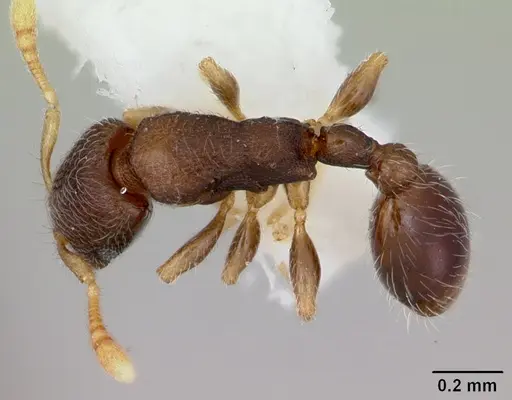
Letteratura
Caricamento mappa di distribuzione...Caricamento prodotti...