
Tetramorium seiferti
- Nom. sci.
- Tetramorium seiferti
- Tribù
- Crematogastrini
- Sottofamiglia
- Myrmicinae
- Autore
- Kiran & Karaman, 2017
- Distribuzione
- Trovata in 0 paesi
Introduzione
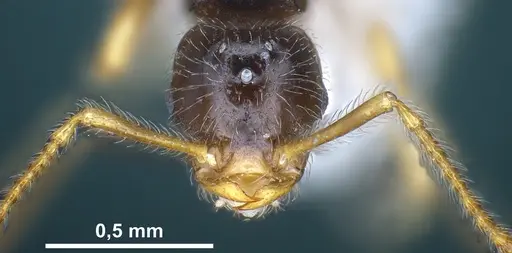
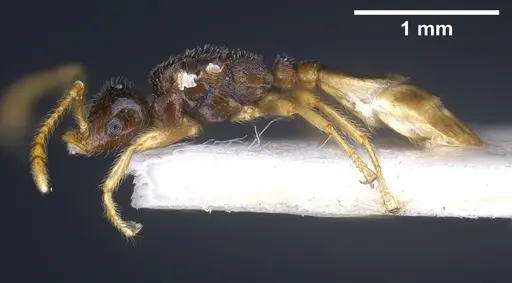
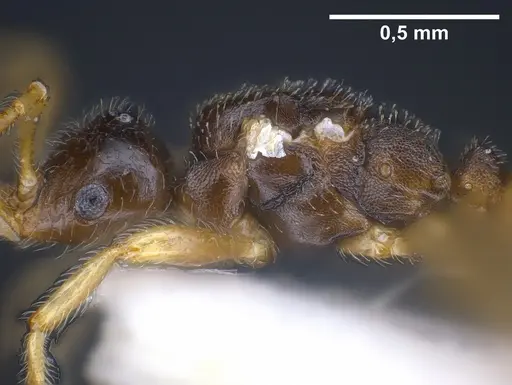
Tetramorium seiferti is an extraordinary workerless ant - a permanent social parasite that cannot survive without a host colony. Originally described as Teleutomyrmex seiferti in 2017,it belongs to the Tetramorium inquilinum species group, known as the 'ultimate social parasites' because they have lost the ability to produce workers entirely . Queens are tiny (size data unavailable) with reduced mandibles, small protruding eyes, and well-developed ocelli. Their body is yellowish-brown with the head, mesosoma, and petiole being darker brown . This species was discovered living in a Tetramorium cf. chefketi nest at 1801m altitude in a pine forest in Turkey - only the second known species in this rare group . What makes Tetramorium seiferti stand out is its complete dependence on host workers. Unlike slave-making ants, these parasitic queens are fully integrated into the host nest, where host workers tend to the parasite's brood . The type series was collected from a nest containing 16 parasite gynes,7 males,3 host alate queens, and 75 host workers . This is an extremely rare species, known from only a single collection in Turkey.
Quick Summary
- Difficulty: Expert
- Origin & Habitat: Native to northeastern Turkey (Artvin region). Found at 1801m altitude in a Pinus sylvestris forest over 100 years old, with many dying trees creating sun-exposed areas. The habitat features herbaceous plants including Astragalus, Thymus, and Juniperus [1][3].
- Colony Type: Workerless permanent social parasite, lives exclusively within nests of Tetramorium cf. chefketi. Multiple parasite queens (up to 16 recorded) can coexist with the host colony [1].
- Size & Growth:
- Queen: Size data unavailable [1]
- Worker: N/A, workerless species [1]
- Colony: Up to 16 parasite queens and 7 males recorded in a single host colony [1]
- Growth: Unknown, dependent on host colony
- Development: Not applicable, workerless species [1] (No worker caste exists. Parasite produces only alate reproductives (queens and males) [1])
- Antkeeping:
- Temperature: Unconfirmed, type locality averages 11.3°C during summer months (May-August) [1][3]. Likely requires cool conditions matching the high-altitude Turkish habitat.
- Humidity: Unconfirmed, likely moderate, matching the dry pine forest floor habitat where the type was collected under a stone [1].
- Diapause: Likely requires winter dormancy given the high-altitude cold habitat (1801m) in Turkey [1].
- Nesting: Natural nesting is entirely within host Tetramorium cf. chefketi nests, typically under stones in pine forests [1].
- Behavior: Extremely docile by necessity, this species cannot defend itself or forage independently. Queens have reduced mandibles and cannot chew, relying entirely on host workers for feeding [1]. They produce only alate reproductives (new queens and males). The parasite queens are accepted by host workers through chemical mimicry, a common adaptation in social parasites [4].
- Common Issues: this species cannot be kept, it is a permanent social parasite requiring a living host colony to survive., no workers means the parasite cannot feed itself or maintain the nest on its own., obtaining a queen requires destroying or severely disrupting a host Tetramorium cf. chefketi colony., extremely rare in the wild, only known from a single collection in Turkey., collecting may require permits as this is a newly described species with a very limited range.
Understanding Workerless Social Parasites
Tetramorium seiferti belongs to an extraordinary category of ants called 'workerless social parasites' or 'inquilines.' These species have evolved to live entirely within host colonies and have lost the ability to produce workers altogether [2][3]. Instead of workers, these parasites produce only new reproductives, alate queens and males, that mate and continue the cycle by invading new host colonies. This is different from temporary social parasites (like some Lasius species) that only use hosts during founding before raising their own workers. Tetramorium seiferti is considered an 'ultimate' social parasite because it has completely abandoned the worker caste [3]. The genus Teleutomyrmex (now synonymized with Tetramorium) contains only a handful of these extreme parasites, making each discovery scientifically significant [1].
Host Species and Colony Integration
The only known host of Tetramorium seiferti is Tetramorium cf. chefketi, a member of the chefketi species-group [1][2]. In the type colony, researchers found 16 parasite gynes,7 males,3 host alate queens, and 75 host workers all living together [1]. This suggests the parasite queens are chemically accepted as part of the colony. Social parasites typically achieve this integration by producing cuticular hydrocarbons that match the host species, effectively masking their identity [4]. Once integrated, parasite queens are fed and tended by host workers just like the host queen, living permanently within the host nest.
Why This Species Cannot Be Kept
Keeping Tetramorium seiferti is not feasible for several reasons. First, they are permanent social parasites, they cannot survive without a living host colony. Obtaining a parasite queen would require locating and destroying a Tetramorium cf. chefketi colony, which is unethical and likely illegal given the parasite's extremely limited range [1]. Second, even if you obtained both species, establishing a mixed colony would be extraordinarily difficult, the host colony must be healthy and established, and there is no guarantee the parasite would be accepted. Third, this species has never been found in the antkeeping trade and is known from only a single wild collection [2]. The scientific value of these ants far exceeds any potential benefit of captive observation. Antkeepers interested in parasites should consider studying well-documented temporary social parasites like Lasius fuliginosus or Lasius umbratus, which are more accessible.
Distribution and Habitat
Tetramorium seiferti is known only from a single location in northeastern Turkey: Artvin, Yusufeli,3 km northwest of Kınalıçam Village at 1801m altitude [1][3]. The habitat is a Pinus sylvestris (Scots pine) forest over 100 years old, with many dying trees creating large sun-exposed areas on the forest floor [1]. The ground is relatively flat, positioned at the top of a hill. Associated ant species at the type locality include Camponotus aethiops, Cataglyphis aenescens, Formica cunicularia, Lasius alienus, Temnothorax interruptus, and multiple Tetramorium species [1][3]. The long-term average summer temperature (May-August) is only 11.3°C, indicating this is a cold-adapted species [1]. The extreme specificity of this habitat explains why the species has never been found elsewhere.
Identification and Morphology
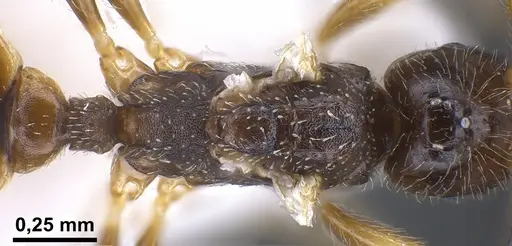
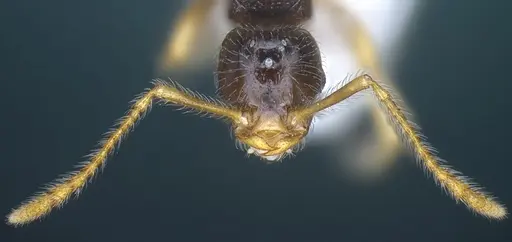
0.945), the antennal scape is nearly as long as the head, and they have distinctive ridge-like structures (carinae) on the propodeum rather than the spines typical of most Tetramorium [1][2]. Their eyes are small and protruding, occupying less than a quarter of the side of the head. The body has long erect hairs, especially on the head and hind tibiae. Coloration is distinctive: the clypeus, mandibles, antennae, and legs are yellow, while the rest of the head, mesosoma, and petiole are brown [1]. Males are similarly small with reduced mandibles and short antennal scapes [1].
Frequently Asked Questions
Can I keep Tetramorium seiferti as a pet ant?
No. This is a workerless social parasite that cannot survive without a living Tetramorium cf. chefketi host colony. Keeping it would require destroying a host colony, which is neither ethical nor practical. This species is also extremely rare, known from only a single collection in Turkey [1][2].
What does Tetramorium seiferti eat?
They do not eat independently. Like all social parasites, Tetramorium seiferti is fed by host workers through trophallaxis. The queens have reduced, atrophied mandibles and cannot chew food themselves [1]. They rely entirely on host workers for nutrition.
Why does Tetramorium seiferti have no workers?
This species has evolved to be a permanent social parasite. Over evolutionary time, it lost the worker caste because host workers do all the work, foraging, nest maintenance, and caring for brood. This is an extreme adaptation seen only in a handful of ant genera worldwide [3][2].
How do I start a colony of Tetramorium seiferti?
You cannot. Starting a colony would require introducing parasite queens into an established, healthy Tetramorium cf. chefketi colony, and even then, success would be extremely unlikely. The parasite queens use chemical mimicry to integrate, which cannot be replicated artificially [4]. Additionally, Tetramorium seiferti has never been found in the antkeeping hobby and is known from only one scientific collection [2].
Where does Tetramorium seiferti live in the wild?
Only in northeastern Turkey (Artvin region) at 1801m altitude in a Scots pine forest. The type was collected under a stone in a forest over 100 years old with many dying trees creating sunny openings [1][3].
Do Tetramorium seiferti ants sting?
No. This species has no workers to defend the colony, and the queens have reduced, non-functional mandibles [1]. They are completely dependent on host colony acceptance for survival.
Is Tetramorium seiferti endangered?
The conservation status has not been formally assessed, but the species is known from only a single location. Its extreme specialization on one host species and tiny range make it potentially vulnerable. Any collection would require permits and should be avoided given the species' scientific value [1][2].
What is the difference between Tetramorium seiferti and slave-making ants?
Slave-making ants (like Formica sanguinea) raid other colonies and steal pupae, which hatch as workers that serve the slavemaker. Tetramorium seiferti is different, it permanently lives within a host colony, produces no workers, and is fully integrated through chemical mimicry. The host workers unknowingly raise parasite brood alongside their own [4][3].
Can I find Tetramorium seiferti in my area?
No. This species is only known from a single location in northeastern Turkey. It has never been recorded anywhere else in the world [1][2]. Even in Turkey, it would require specific permission and expertise to locate.
Are there other workerless ant parasites I can keep?
While no workerless parasites are suitable for keeping, some temporary social parasites are more accessible. Lasius fuliginosus (the jet ant) and Lasius umbratus are temporary parasites that can be kept with more effort. However, all social parasites require ethical consideration and proper host colonies.
Report an Issue
The current care sheet is based fully on literature. See inconsistencies, or something that's incorrect? Please , it will be resolved after review from an admin. Contributing to the blogs tab also helps providing information, to make us be able to further improve the caresheets. Thank you for your support!
References

Questa scheda di allevamento è concessa in licenza con CC BY-SA 4.0 .
Blog della comunità
ANTWEB1041295
Visualizza su AntWeb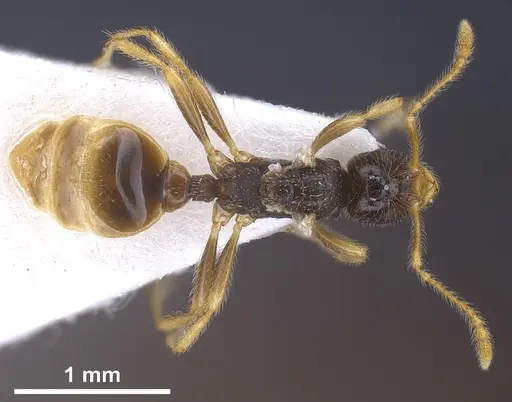
Letteratura
Caricamento mappa di distribuzione...Caricamento prodotti...