
Tetramorium pisarskii
- Nom. sci.
- Tetramorium pisarskii
- Tribù
- Crematogastrini
- Sottofamiglia
- Myrmicinae
- Autore
- Radchenko & Scupola, 2015
- Distribuzione
- Trovata in 0 paesi
Introduzione
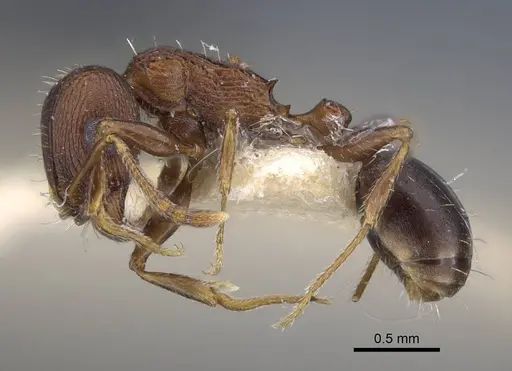
Tetramorium pisarskii is a recently described ant species from Afghanistan, belonging to the *striativentre* species group . Workers are small, with a brownish-red head, mesosoma, and waist, lighter appendages, and a blackish-brown gaster . The species was formally identified in 2015 by Radchenko and Scupola, after originally being misidentified as *Tetramorium kabulistanicum* . Almost nothing is known about its biology - queens, males, and ecology remain unstudied . It is named after Polish myrmecologist Prof. Bohdan Pisarski . The only specimens known were collected in 1957 from Hassan Guilan in Afghanistan, making it one of the most poorly documented *Tetramorium* species.
Quick Summary
- Difficulty: Unknown
- Origin & Habitat: Afghanistan, Palaearctic region [1]. The type locality is Hassan Guilan between Guerechk and Dilaram [1]. Nothing is known about natural habitat preferences.
- Colony Type: Unknown, only the worker caste has been described. Queens, males, and colony structure have never been documented [1].
- Size & Growth:
- Queen: Unknown, queens have never been described [1]
- Worker: Size data unavailable, based on related *Tetramorium* species, workers are estimated to be around 3-4mm [1]
- Colony: Unknown, no colony size data exists [1]
- Growth: Unknown
- Development: Unknown, development has never been studied [1] (No data exists on any life stage beyond workers)
- Antkeeping:
- Temperature: Unknown. Most *Tetramorium* prefer warm conditions, roughly 22-28°C, but for this species you would need to experiment carefully [1].
- Humidity: Unknown, likely prefers dry to moderate conditions typical of Afghan steppe habitats. Allow substrate to dry between waterings, but this is speculative.
- Diapause: Unknown, no data on overwintering. Related temperate *Tetramorium* often require a winter rest period, but this is unconfirmed for *T. pisarskii* [1].
- Nesting: Unknown, no observations exist. Most *Tetramorium* are ground-nesting, preferring soil or small chambers in test tubes and plaster nests.
- Behavior: Completely unstudied. Based on typical *Tetramorium* behavior, workers are likely active foragers that search for seeds and small insects. Their tiny size means good escape prevention is essential. Temperament is unknown, but most *Tetramorium* defend their nest when threatened.
- Common Issues: no captive husbandry information exists, this species has never been kept in captivity, queen biology completely unknown, claustral vs semi-claustral founding is unconfirmed, development timeline unknown, egg-to-worker time is unstudied, nesting preferences unconfirmed, no data on natural or captive nesting, diet unknown, must infer from genus patterns (seeds, small insects, honeydew)
Identification and Distribution
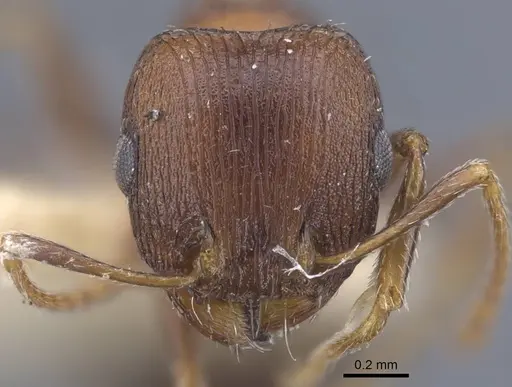
Tetramorium pisarskii workers are small ants with a distinctive appearance: brownish-red on the head, mesosoma, and waist, a blackish-brown gaster, and lighter appendages [1]. They are separated from their close relative T. kabulistanicum by having more regular, almost straight longitudinal rugae on the mesosoma, and regular longitudinally-concentric rugae on the waist (instead of sinuous rugae) [1]. Additionally, T. pisarskii has more rugae between the frontal carinae (about 20 versus 15 or fewer) [1]. This species is known only from Afghanistan, specifically the Hassan Guilan area between Guerechk and Dilaram [1].
What Makes This Species Unique
Tetramorium pisarskii is one of the most poorly documented ant species in the entire genus. It was only recognized as a distinct species in 2015,despite being collected over 60 years earlier in 1957 [1]. The original specimens were misidentified as T. kabulistanicum and sat in museum collections for decades [1]. Only two worker specimens have ever been documented, the holotype and paratype [1]. No queens, males, or ecological data have ever been collected [1]. This makes T. pisarskii a blank slate for anyone interested in documenting new species behavior.
Inferred Care Requirements
Since no direct husbandry information exists, care must be inferred from related Tetramorium species. Tetramorium queens are typically claustral, they seal themselves in a chamber and survive on stored fat reserves until the first workers emerge. Workers are small, active foragers that collect seeds, small insects, and honeydew from aphids. In captivity, they likely accept standard ant foods like fruit flies, small crickets, mealworms, and sugar water or honey. The species was collected in Afghanistan, so it may tolerate warmer, drier conditions than many European Tetramorium. However, these are educated guesses. Any successful captive husbandry would contribute genuine new scientific knowledge. [1]
Challenges and Considerations
Attempting to keep Tetramorium pisarskii would be extremely challenging. No established care protocols exist because the species has never been kept in captivity. You would be pioneering all aspects of husbandry, from temperature and humidity to diet and nesting preferences. Wild colonies are essentially impossible to obtain since the species is only known from a single remote location in Afghanistan and has rarely been collected. If you did establish a colony, growth would likely be slow given the tiny worker size and unknown development timeline. This species is only suitable for advanced antkeepers willing to document observations carefully. [1]
Frequently Asked Questions
Can I keep Tetramorium pisarskii as a pet ant?
It would be extremely difficult. No captive husbandry information exists because the species has never been kept in captivity. Wild colonies are essentially inaccessible, they are only known from a remote region in Afghanistan and have rarely been collected.
What do Tetramorium pisarskii ants eat?
Diet is completely unconfirmed. Based on typical Tetramorium behavior, they likely forage for small insects and seeds and may tend aphids for honeydew. In captivity, you might try offering small live prey like fruit flies, tiny crickets, and sugar water or honey, but acceptance is entirely speculative.
How big do Tetramorium pisarskii colonies get?
Unknown, no colony size data exists. Only two worker specimens have ever been documented, and no colony has ever been observed in the wild or captivity.
Do Tetramorium pisarskii ants sting?
T. pisarskii belongs to the subfamily Myrmicinae and tribe Crematogastrini, which use a modified spatulate stinger to smear venom onto attackers rather than piercing flesh. However, actual stinging behavior has never been documented for this specific species. The deterrent effect of the venom is likely mild due to the small size of the workers.
What temperature do Tetramorium pisarskii ants need?
Temperature requirements are completely unknown. The species was collected in Afghanistan, which suggests it may tolerate warm conditions. Most Tetramorium species do well at room temperature (20-25°C). Without data, you would need to experiment and observe colony response.
How long does it take for Tetramorium pisarskii to develop from egg to worker?
The development timeline is completely unknown, this species has never been studied in any developmental context. Related Tetramorium species typically take 6-10 weeks from egg to worker at optimal temperatures, but that is purely speculative for T. pisarskii.
Are Tetramorium pisarskii good for beginners?
No, this species is not suitable for beginners or even most experienced antkeepers. There is zero captive care information, and establishing a colony would require pioneering all aspects of husbandry. The species is also extremely rare and may not be available in the hobby.
Do Tetramorium pisarskii queens need to forage during founding?
Founding behavior is unconfirmed. Most Tetramorium species are claustral, the queen seals herself in a chamber and survives on stored fat reserves until her first workers emerge. However, this has never been documented for T. pisarskii specifically.
What type of nest should I use for Tetramorium pisarskii?
Nesting preferences are completely unknown. Most Tetramorium are ground-nesting ants that do well in test tubes, plaster nests, or Y-tong setups with soil. Given their small size, small chambers would be appropriate if the species can be kept at all.
Do Tetramorium pisarskii ants need hibernation?
Diapause requirements are completely unknown. The species is from Afghanistan (Palaearctic region), so it may require a winter rest period, but this is speculative. No data exists on their seasonal biology.
Can I keep multiple Tetramorium pisarskii queens together?
Colony structure is completely unknown. No one has ever documented whether this species is single-queen (monogyne) or multi-queen (polygyne). Without any data, combining queens would be extremely risky.
Where can I get Tetramorium pisarskii ants?
This species is essentially unavailable in the antkeeping hobby. It is only known from two worker specimens collected in Afghanistan in 1957 and has never been documented in captivity. Even researchers have not collected additional specimens.
Report an Issue
The current care sheet is based fully on literature. See inconsistencies, or something that's incorrect? Please , it will be resolved after review from an admin. Contributing to the blogs tab also helps providing information, to make us be able to further improve the caresheets. Thank you for your support!
References

Questa scheda di allevamento è concessa in licenza con CC BY-SA 4.0 .
Blog della comunità
CASENT0917246
Visualizza su AntWeb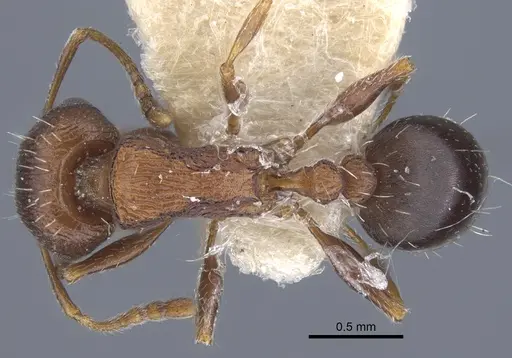
Letteratura
Caricamento mappa di distribuzione...Caricamento prodotti...