
Temnothorax confucii
- Nom. sci.
- Temnothorax confucii
- Tribù
- Crematogastrini
- Sottofamiglia
- Myrmicinae
- Autore
- Forel, 1912
- Distribuzione
- Trovata in 0 paesi
Introduzione
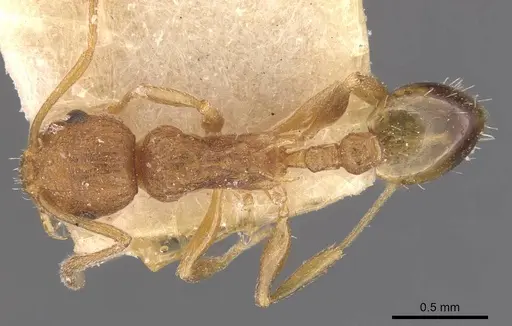
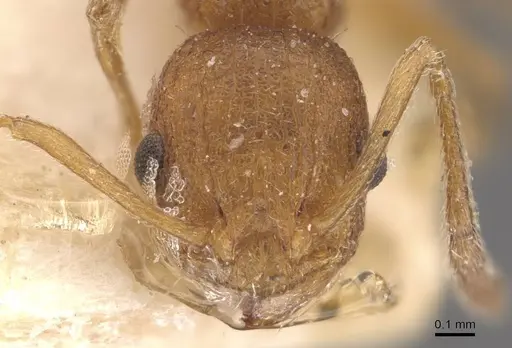
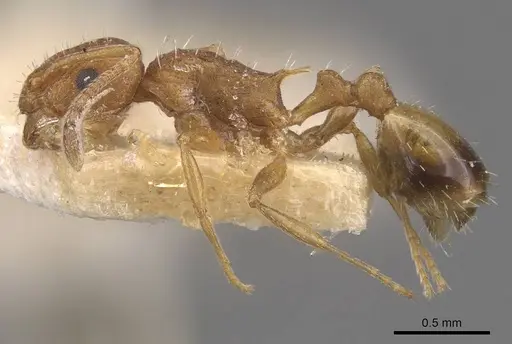
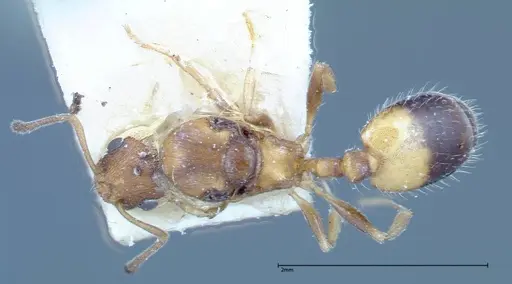
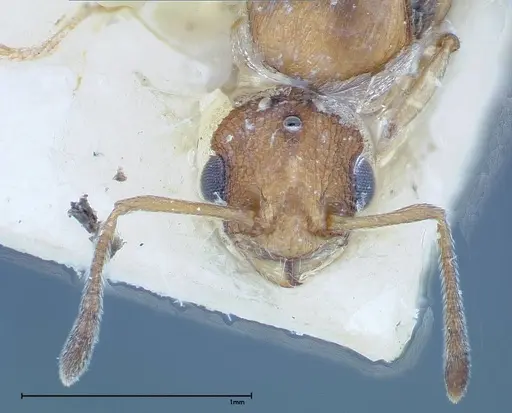
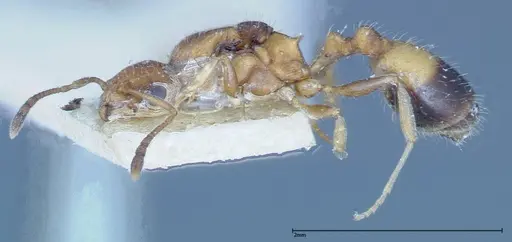
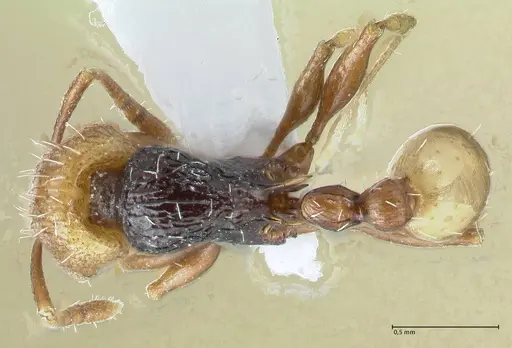
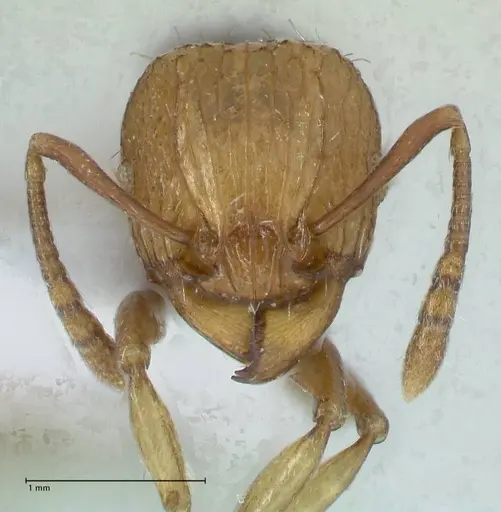
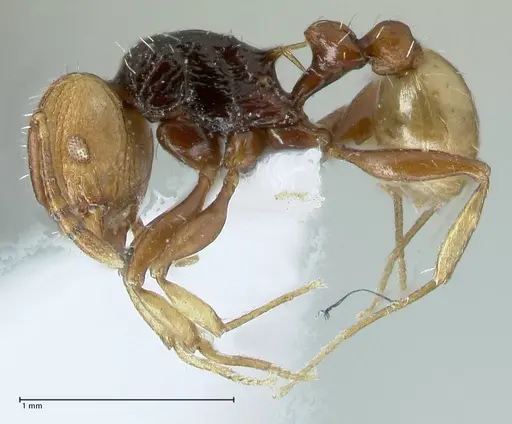
Temnothorax confucii is a tiny, slender ant native to Taiwan and southern China . Workers are 2.5 mm long, light yellow‑red with a broad brown transverse band across the yellowish abdomen; the antenna club is slightly darkened . Queens are larger at 3.7 mm, with a broader thorax and the anterior two‑fifths of the abdomen yellow and the rest brown . The species was originally described as Tetramorium confucii in 1912,later moved to Leptothorax and then to Temnothorax . Its most distinctive feature is the very long epinotal teeth, which are longer than the declivous face .
Quick Summary
- Difficulty: Easy
- Origin & Habitat: Recorded from Taiwan (Indomalaya Region) and southern China (Palaearctic Region) [1][2]. Likely nests in small cavities in rotting wood, under stones, or in leaf litter, as is typical for Temnothorax.
- Colony Type: Unknown, but likely monogyne (single queen) based on typical Temnothorax patterns.
- Size & Growth:
- Queen: 3.7 mm [1]
- Worker: 2.5 mm [1]
- Colony: Unknown, typical Temnothorax colonies are small, likely up to a few hundred workers.
- Growth: Moderate
- Development: Unknown, estimated 6-10 weeks based on related species. (Development depends on temperature, warmer conditions within acceptable range speed growth.)
- Antkeeping:
- Temperature: Room temperature (20-24°C) is recommended. They can tolerate 18-26°C, but growth slows outside this range.
- Humidity: Moderate. Keep the nest substrate lightly moist but allow some drying between waterings.
- Diapause: Yes. A winter rest period of 2-3 months at 10-15°C is recommended to mimic natural seasonal cues.
- Nesting: Small, compact nests work best, use Y‑tong (AAC) or plaster nests, or test tubes for founding. The tiny worker size (2.5 mm) means chambers and passages should be appropriately scaled [1].
- Behavior: Calm, non‑aggressive, and harmless to humans. Workers forage individually. Their small size (2.5 mm) requires secure enclosures to prevent escape. Defense mechanism: smear venom (subfamily Myrmicinae, tribe Crematogastrini).
- Common Issues: escape prevention is critical, workers can slip through gaps smaller than 3 mm., colonies grow slowly, which may disappoint beginners expecting rapid development., winter diapause is likely required, skipping it may weaken colonies over time., wild‑caught colonies may carry parasites that can harm captive colonies.
Housing and Nest Setup
Because workers are only 2.5 mm, the nest must be small and snug [1]. A test tube with a cotton water reservoir works well for founding. Once the colony grows, move them to a Y‑tong (AAC) or plaster nest with narrow chambers. Keep the outworld compact and seal all joints, these ants can escape through tiny gaps. A layer of sand or soil in the outworld allows natural foraging.
Feeding and Diet
Offer small live prey such as fruit flies, pinhead crickets, or other tiny insects 2-3 times per week. Provide a constant sugar source (sugar water, honey water, or diluted honey). Remove uneaten prey after 24 hours to prevent mold. In the wild, they likely feed on small arthropods and honeydew.
Temperature and Seasonal Care
Keep the colony at 20-24°C (room temperature). They tolerate 18-26°C, but growth slows outside this range. As a species from subtropical/temperate Asia, a winter diapause of 2-3 months at 10-15°C is recommended. During this period, reduce feeding and keep the nest slightly cooler. Do not feed during the coldest part of diapause.
Colony Development and Growth
Colonies start from a single queen (likely claustral founding). First workers (nanitics) emerge after an estimated 6-10 weeks, depending on temperature. Growth is moderate, expect it to take several months to reach a few dozen workers and a year or more to approach maximum size. Colony size is modest, likely up to a few hundred workers in captivity. [1]
Behavior and Temperament
Temnothorax confucii is a peaceful, non‑aggressive species. Workers forage calmly for small prey and honeydew. Their defense relies on smearing venom rather than stinging (typical of Crematogastrini). They are not known to sting or bite humans. Their small size means you must pay close attention to escape prevention, all openings must be sealed. [1]
Frequently Asked Questions
How long does it take for Temnothorax confucii to produce first workers?
Exact timing is unknown, but based on related species, first workers likely appear 6-10 weeks after the queen starts laying, provided temperatures are around 22-24°C.
What do Temnothorax confucii ants eat?
They eat small live prey (fruit flies, tiny crickets) and sugar water or honey. Provide a constant sugar source and offer protein 2-3 times per week.
Do Temnothorax confucii ants sting?
No, they do not sting. Their defense is to smear venom, which is harmless to humans. They are not aggressive toward keepers.
How big do Temnothorax confucii colonies get?
Colony size is not well documented, but typical Temnothorax colonies remain modest, likely up to a few hundred workers.
Do Temnothorax confucii need hibernation?
Yes, a winter rest period is recommended. Keep them at 10-15°C for 2-3 months, reduce feeding, and let them enter a resting state. This mimics their native seasonal cycle.
What size nest do I need for Temnothorax confucii?
Use small, scaled housing: a test tube for founding, then a Y‑tong (AAC) or plaster nest with narrow chambers. Because workers are only 2.5 mm, avoid large open spaces [1].
Are Temnothorax confucii good for beginners?
Yes, they are calm, non‑aggressive, and easy to care for. However, their slow growth and tiny size require patience and careful escape‑proofing.
Why are my Temnothorax confucii escaping?
Workers are only 2.5 mm and can slip through extremely small gaps. Use fine mesh on ventilation, seal all joints, and check that any tube connections are tight [1].
Can I keep multiple Temnothorax confucii queens together?
Not recommended. There is no evidence of polygyny in this species, they are likely monogyne. Keeping multiple queens together would probably lead to aggression.
What temperature is best for Temnothorax confucii?
Room temperature (20-24°C) is ideal. They tolerate 18-26°C, but avoid extremes. No direct heat sources.
How often should I feed Temnothorax confucii?
Offer protein (small insects) 2-3 times per week and keep sugar water always available. Adjust quantity to colony size and remove uneaten prey after a day.
Where is Temnothorax confucii native to?
They are native to Taiwan and southern China. The original description comes from Taiwan [1][2].
Report an Issue
The current care sheet is based fully on literature. See inconsistencies, or something that's incorrect? Please , it will be resolved after review from an admin. Contributing to the blogs tab also helps providing information, to make us be able to further improve the caresheets. Thank you for your support!
References

Questa scheda di allevamento è concessa in licenza con CC BY-SA 4.0 .
Blog della comunità
Letteratura
Caricamento mappa di distribuzione...Caricamento prodotti...