
Strumigenys osellai
- Nom. sci.
- Strumigenys osellai
- Tribù
- Attini
- Sottofamiglia
- Myrmicinae
- Autore
- Rigato & Scupola, 2008
- Distribuzione
- Trovata in 0 paesi
Introduzione
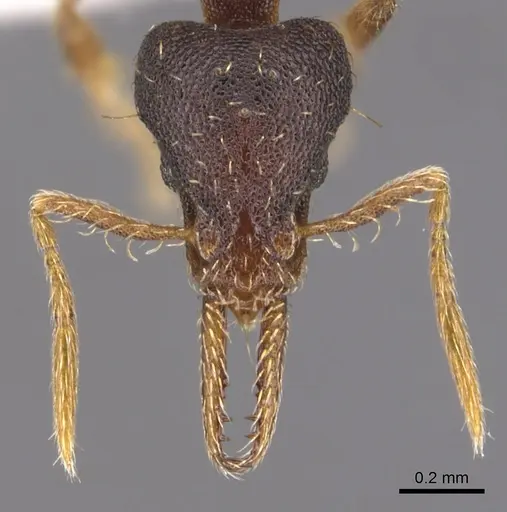
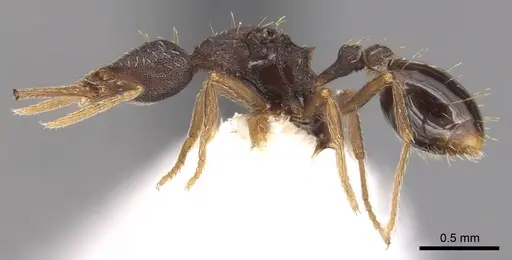
Strumigenys osellai is a tiny ant: workers measure just 2.5 mm and queens 2.8 mm . They belong to the gundlachi‑complex of the Strumigenys gundlachi‑group, with long mandibles that carry 5-7 preapical teeth and distinctive trigger hairs . Their body is brown; the mandibles, antennae, and tarsi are light testaceous, while the coxae, femurs, and tibiae are light brown . This species was discovered in the cloud forests of Ecuador, specifically in Pichincha province at Nanegalito,1560 m elevation . The type specimens were collected by sifting soil in “bosque nublado” (cloud forest), indicating a damp, shaded forest‑floor habitat . Like other Strumigenys, they are predators that hunt tiny soil invertebrates.
Quick Summary
- Difficulty: Hard
- Origin & Habitat: Ecuador, Pichincha province, Nanegalito (0°03′ N, 78°41′ W),1560 m elevation, cloud forest [1]
- Colony Type: Unknown, only a worker and a queen have ever been described [1]
- Size & Growth:
- Queen: 2.8 mm [1]
- Worker: 2.5 mm [1]
- Colony: Unknown, no colony data exist. Related species typically have small colonies (under 100 workers).
- Growth: Unknown
- Development: Unknown, no captive or wild data available (Based on similar Strumigenys, development may take several months, but this is unconfirmed.)
- Antkeeping:
- Temperature: Cool to moderate, cloud forest at 1560 m suggests 18-22 °C. Start in the low 20s and watch the colony, adjust if they avoid or crowd the heat source.
- Humidity: High, cloud forest origin means consistently damp substrate. Keep the nest material moist but not waterlogged. Provide a gradient with a drier area so the ants can choose.
- Diapause: Unknown, given the tropical origin, a true diapause is unlikely, but activity may drop during cooler periods. No specific data.
- Nesting: Nests naturally in soil [1]. In captivity, use a plaster or Y‑tong nest with small, tight chambers to match their tiny size. A naturalistic soil setup also works.
- Behavior: Predatory, they hunt small invertebrates with their long mandibles. Likely shy and non‑aggressive, they avoid confrontation. Their tiny size (under 3 mm) makes escape a constant risk, use fine mesh and seal all gaps. Workers forage alone, not in groups.
- Common Issues: tiny size makes escape easy without ultra‑fine mesh barriers, no captive breeding data, establishing a colony is experimental, high humidity can lead to mold if ventilation is poor, predatory diet can be hard to sustain, need a steady supply of live springtails or similar micro‑prey, almost never available in the hobby
Origin and Natural Habitat
Strumigenys osellai comes from the cloud forests of Ecuador, found only at Nanegalito in Pichincha province,1560 m elevation [1]. Cloud forests are misty, humid, and cool. The type specimens were sifted from soil on the forest floor, so these ants nest in the ground among leaf litter and organic matter [1].
The species was described in 2008 by Rigato and Scupola, making it a relatively new addition to ant science [1]. It belongs to the gundlachi‑complex of the Strumigenys gundlachi‑group, characterized by long mandibles, long trigger hairs, and two small intercalary denticles between the apical teeth [1]. The species name honors Professor Giuseppe Osella, one of the collectors [1].
Size and Appearance
This is a very small ant, workers are 2.5 mm long and queens 2.8 mm [1]. The mandibles are long and narrow, with multiple teeth: 7 on the left mandible and 5 on the right in workers, and 5/6 in queens [1]. The body is brown, mandibles, antennae, and tarsi are light testaceous, while the legs are light brown [1].
The postpetiole is noticeably wider than the petiole, and the gaster has a thin spongiform lamella at the front [1]. These details are best seen under magnification, the ants are too small for the naked eye to make out much detail.
Temperature and Heating
Based on their cloud forest home at 1560 m, these ants probably prefer cool‑to‑moderate temperatures, likely 18-22 °C [1]. Start around 20 °C and watch the colony. If they become sluggish, warm things up a bit, if they avoid the heated area, cool it down.
Use a heating cable on one side of the nest to create a temperature gradient. Always place the heating element on top of the nest, not underneath, to avoid drying out the substrate too quickly.
Humidity and Moisture
Coming from a cloud forest, Strumigenys osellai needs high humidity. Keep the nest substrate consistently damp, it should feel moist to the touch, but not waterlogged. In nature they experience constant mist and high ambient humidity.
In captivity, moisten the substrate regularly and use a lid that retains some moisture while still allowing air exchange. Aim for a balance: too much airflow dries things out, too little causes mold. A small water reservoir connected to the nest can help maintain stable humidity.
Feeding and Diet
Strumigenys are predators. They hunt tiny invertebrates like springtails, mites, and small fly larvae. For Strumigenys osellai, offer live springtails as the main food, they are the right size for these 2.5 mm workers.
Do not count on sugar‑water or honey, while some Strumigenys may occasionally take them, they are not a reliable food source. Provide live prey 2-3 times per week, and remove any uneaten prey after 24 hours to prevent mold.
Nesting Setup
In the wild they nest in soil [1]. For captivity, use a plaster or Y‑tong nest with very small, low chambers that match the ants’ tiny size. A naturalistic set‑up with moist soil also works well. Avoid tall open spaces, these ants prefer tight, enclosed crevices.
They are not strong excavators, so pre‑formed chambers are better than loose substrate. The nest material should hold moisture without becoming waterlogged. Cover the nest with a dark panel to give them security.
Behavior and Temperament
Strumigenys osellai is likely shy and non‑aggressive, preferring to hide rather than fight. Workers hunt alone, not in groups. Their long mandibles are used to catch tiny prey, not for defense.
They can sting (typical of myrmicine ants), but it is not medically significant and they are far too small to sting a human effectively. Their main defense is escape. Because of their tiny size, you must use very fine mesh (e.g.,0.1 mm) on ventilation holes and seal all cracks, they can squeeze through gaps you might not even see.
Frequently Asked Questions
How long does it take for Strumigenys osellai to go from egg to worker?
This is unknown, no one has raised a colony in captivity. Based on other small Strumigenys species, it could take several months, but there is no data for this species.
What do Strumigenys osellai eat?
They are predators. Feed them live springtails as the staple food. They may also take tiny fruit‑fly larvae and mites. Sugar sources are not reliable and should not be the main food.
Can I keep Strumigenys osellai in a test tube?
A test tube can work for starting a colony, but because of their high humidity needs and tiny size, a small plaster or soil nest with tight chambers is better long term. Make sure the test tube has a very small water reservoir and that the cotton plug is secure, these ants can easily slip through if there is any gap.
Are Strumigenys osellai good for beginners?
No, this species is unsuitable for beginners. There is no captive breeding data, they need very specific humidity, their tiny size makes them hard to house and feed, and they are almost never available. Stick with easier species first.
What temperature should I keep Strumigenys osellai at?
Based on their cloud forest origin at 1560 m elevation, aim for 18-22 °C [1]. Start in the low 20s and adjust based on colony activity. Provide a temperature gradient using a heating cable on one side of the nest.
Do Strumigenys osellai need hibernation?
Unknown. Since they come from close to the equator, a true winter diapause is unlikely, but they may slow down during cooler periods. If your colony becomes less active in winter, reduce feeding and keep them slightly cooler but above 15 °C.
How big do Strumigenys osellai colonies get?
Colony size is unknown. Only two individuals have ever been described [1]. Related Strumigenys species tend to have small colonies, often under 100 workers, so expect a modest size if you ever manage to establish one.
Why are my Strumigenys osellai dying?
Most likely causes: wrong humidity (too dry or too wet causing mold), incorrect temperature (too hot or cold), escape, or starvation (lack of appropriate live prey). Their tiny size makes them fragile, double‑check all setup details.
Where is Strumigenys osellai found?
Only known from Ecuador, Pichincha province, Nanegalito, at 1560 m elevation in cloud forest [1]. It was described in 2008 and remains very rarely collected.
Report an Issue
The current care sheet is based fully on literature. See inconsistencies, or something that's incorrect? Please , it will be resolved after review from an admin. Contributing to the blogs tab also helps providing information, to make us be able to further improve the caresheets. Thank you for your support!
References

Questa scheda di allevamento è concessa in licenza con CC BY-SA 4.0 .
Blog della comunità
CASENT0904564
Visualizza su AntWeb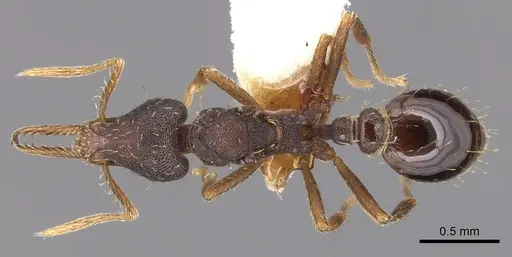
Letteratura
Caricamento mappa di distribuzione...Caricamento prodotti...