
Probolomyrmex vieti
- Nom. sci.
- Probolomyrmex vieti
- Tribù
- Probolomyrmecini
- Sottofamiglia
- Proceratiinae
- Autore
- Eguchi <i>et al.</i>, 2006
- Distribuzione
- Trovata in 0 paesi
Introduzione
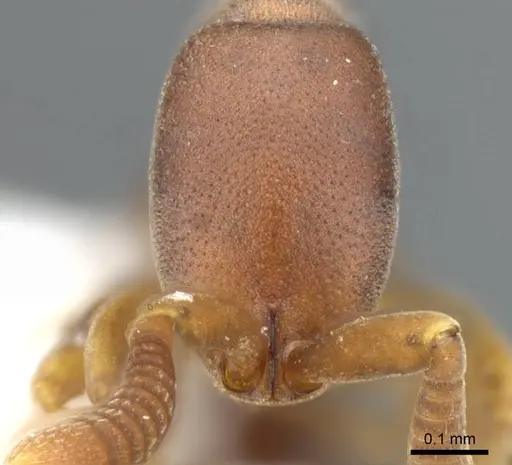
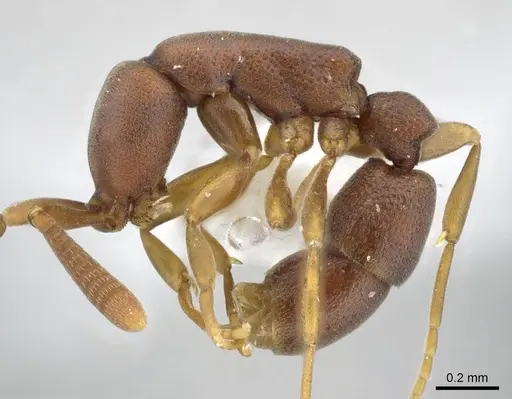
Probolomyrmex vieti is a tiny ant species from Southeast Asia. They are ferruginous brown and lack eyes, which is common for subterranean ants. The head has weakly convex sides, and the antennae are short. Queens are similarly small, and colonies are very small, with observed colonies having just 1-5 workers. This species is known from Vietnam, Thailand, Java, and Hainan, typically found in forested habitats under stones .
Quick Summary
- Difficulty: Expert
- Origin & Habitat: Southeast Asia, Vietnam, Thailand, Java (Indonesia), and Hainan Province, China. Found in tropical forests, specifically in Lagerstroemia forests on basalt soils in southern Vietnam and under stones in artificial forest settings like botanical gardens [2][4].
- Colony Type: Likely monogyne based on observed colonies with one queen and few workers [4]. Colony structure is poorly documented, but observed colonies are very small.
- Size & Growth:
- Queen: size data unavailable
- Worker: size data unavailable
- Colony: Up to 5 workers [4]
- Growth: Very slow
- Development: Unknown, no direct data exists. (No development data is available for this species.)
- Antkeeping:
- Temperature: Inferred from habitat: keep warm, around 24-28°C, based on tropical Southeast Asia [2][4].
- Humidity: Inferred: keep nest substrate consistently moist but not waterlogged, based on forest habitats [2][4].
- Diapause: Unknown, likely no diapause due to tropical origin [5].
- Nesting: Natural nesting under stones in humid forests. In captivity, use moist substrate nests like Y-tong or plaster [4].
- Behavior: Workers are blind and navigate using chemical cues. Temperament is not aggressive. Escape prevention is critical due to their tiny size, use fine mesh barriers. Foraging is likely predatory based on genus patterns.
- Common Issues: escape prevention is critical due to their tiny size, they can squeeze through small gaps., no known diet information makes feeding challenging, start with small live prey like springtails., very small colony size means slow growth and high vulnerability to disturbance., virtually no biological data exists, keepers are pioneering care for this species., low reproductive rate means colonies grow extremely slowly.
Discovery and Distribution
Probolomyrmex vieti was first described in 2006 based on specimens from Vietnam, Thailand, and Java [1]. The type locality is Dong Nai in South Cat Tien National Park, Vietnam. It has also been recorded in Hainan Province, China [3]. In southern Vietnam, this species is specific to Lagerstroemia forests on basalt soils [2].
Identification and Morphology
This species is barely separated from Probolomyrmex greavesi. Workers are distinguished by the anteroventral portion of the subpetiolar process projecting anteroventrad [1]. Workers are blind, with ferruginous brown coloration. Males have mandibles with two teeth in addition to the apical tooth and a broad ventrolateral concavity on the apical antennal segment [1].
Related Species Biology
Direct biological observations for P. vieti are limited. Studies on related species like Probolomyrmex okinawaensis show colonies under stones in botanical gardens, with 1 dealate queen and 1-5 workers [4]. Ovariole count is 2,indicating slow reproduction [4]. Proceratiinae are typically predatory, but specific prey preferences are undocumented.
Housing and Care
Given limited data, care is inferred from habitat. Keep temperatures warm (24-28°C) and humidity high with moist substrate [2][4]. Use naturalistic setups like digging containers or plaster nests. Escape prevention is key due to tiny size. Start with small live prey like springtails [4].
Challenges for Keepers
This species is challenging due to lack of captive care information. Colony sizes are tiny, growth is slow, and diet is unconfirmed. Only experienced keepers should attempt this species [4].
Frequently Asked Questions
How long does it take for Probolomyrmex vieti to produce first workers?
Unknown, no development data exists for this species.
Can I keep Probolomyrmex vieti in a test tube?
Yes, test tubes work well for founding colonies with humid conditions. Ensure excellent escape prevention due to tiny size.
What do Probolomyrmex vieti ants eat?
Not confirmed. Based on subfamily, they are likely predatory. Start with small live prey like springtails [4].
Are Probolomyrmex vieti good for beginners?
No, this is an expert-level species due to lack of data and slow growth.
How big do Probolomyrmex vieti colonies get?
Very small, up to 5 workers observed in wild colonies [4].
Do Probolomyrmex vieti ants sting?
Unknown, their tiny size likely makes any sting imperceptible.
Do Probolomyrmex vieti need hibernation?
Unlikely, as a tropical species, they probably do not require diapause [5].
Why are my Probolomyrmex vieti dying?
Common issues include stress, improper humidity, temperature extremes, escape, or starvation. Adjust conditions gradually.
When should I move Probolomyrmex vieti to a formicarium?
Move slowly when the colony has at least 20-30 workers and the test tube is crowded.
Can I keep multiple Probolomyrmex vieti queens together?
Not documented, observed colonies show single queens, so combining unrelated queens is not recommended [4].
Report an Issue
The current care sheet is based fully on literature. See inconsistencies, or something that's incorrect? Please , it will be resolved after review from an admin. Contributing to the blogs tab also helps providing information, to make us be able to further improve the caresheets. Thank you for your support!
References

Questa scheda di allevamento è concessa in licenza con CC BY-SA 4.0 .
Blog della comunità
CASENT0905887
Visualizza su AntWeb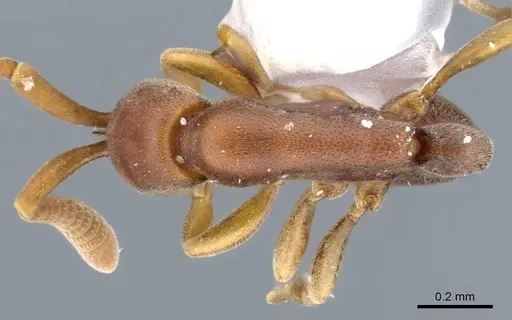
Letteratura
Caricamento mappa di distribuzione...Caricamento prodotti...