
Pheidole taurus
- Nom. sci.
- Pheidole taurus
- Tribù
- Attini
- Sottofamiglia
- Myrmicinae
- Autore
- Emery, 1906
- Distribuzione
- Trovata in 0 paesi
Introduzione
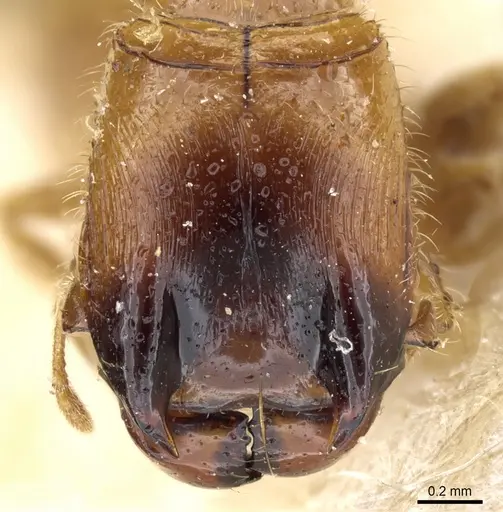
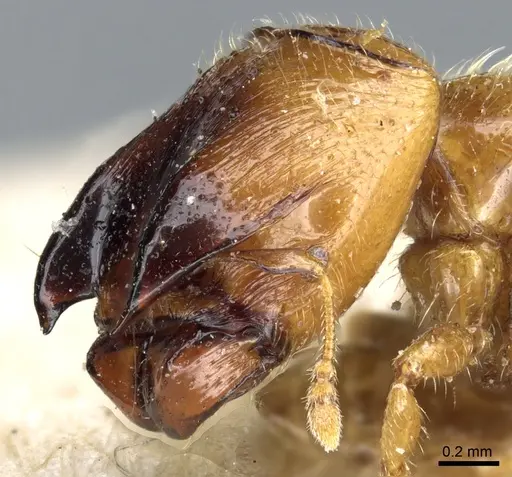
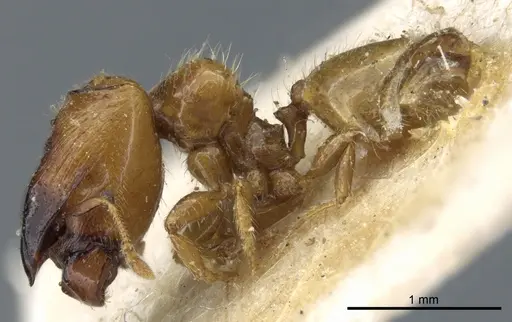
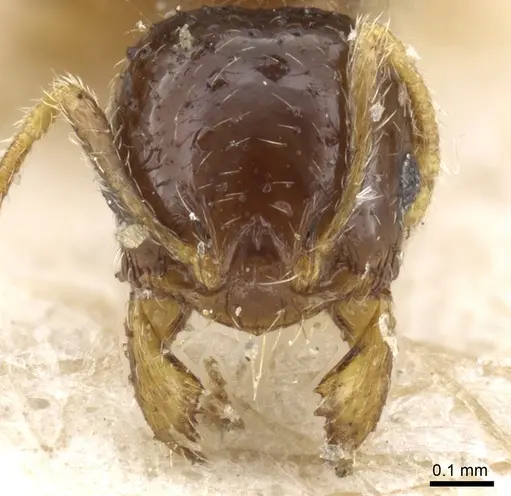
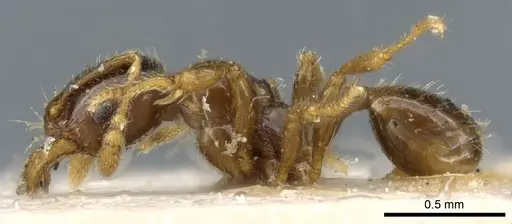
Pheidole taurus is a small ant species native to Argentina, specifically found in the Buenos Aires and Santa Fé regions . The most striking feature is the major workers (soldiers), which have distinctive horn-like frontal lobes that curve downward and inward, extending beyond the clypeus to overhang the mandibles - giving them a bull-like appearance that inspired the species name 'taurus' (Latin for bull) . Majors are bicolored with a reddish-yellow body, while the horn-like frontal lobes, frontal triangle, and vertex form a dark brown 'mask' across the head. Minor workers are much smaller, approximately 1.7-1.9 mm, and major workers are 3-3.2 mm . This species belongs to the Pheidole aberrans group and is considered one of the most unusual Pheidole species due to its distinctive head morphology. Unfortunately, almost nothing is known about the biology, colony structure, or captive care requirements of P. taurus - it remains one of the more mysterious New World Pheidole species .
Quick Summary
- Difficulty: Hard
- Origin & Habitat: Native to Buenos Aires and Santa Fé provinces in Argentina [1]. The limited collection data suggests they inhabit temperate to subtropical grassland regions of central Argentina.
- Colony Type: Unconfirmed, colony structure has not been documented in scientific literature
- Size & Growth:
- Queen: About 7.5 mm [2]
- Worker: Minor workers up to 1.9 mm, major workers up to 3.2 mm [2]
- Colony: Unknown, no colony size data exists
- Growth: Unknown, no development data exists
- Development: Unknown, no direct measurements exist. Based on typical Pheidole patterns, expect 6-10 weeks at warm temperatures, but this is entirely estimated. (Temperature dependency unknown.)
- Antkeeping:
- Temperature: Likely 20-26°C based on Argentine origin, start in the mid-range and observe colony behavior
- Humidity: Keep the nest substrate consistently moist but not waterlogged
- Diapause: Likely yes, Argentine temperate species probably require a winter rest period, but specific requirements are unconfirmed
- Nesting: No specific data exists. Based on typical Pheidole preferences, they likely accept test tubes, Y-tong nests, or plaster nests with moderate moisture
- Behavior: No specific behavioral observations have been documented. Based on Pheidole genus patterns, major workers likely defend the colony and process larger food items, while minor workers forage and care for brood. Aggression may be moderate when threatened. Escape prevention is critical given the small minor worker size (up to 1.9 mm).
- Common Issues: all care is experimental due to lack of documented biology, colony may fail without proper hibernation if they prove to be temperate species, escape prevention is critical given tiny minor worker size, diet acceptance is unconfirmed, start with standard ant foods and observe, founding behavior is unknown, queen may require specific conditions
Appearance and Identification
Pheidole taurus is immediately recognizable by its distinctive major workers. The soldiers have frontal lobes that extend forward into sharp, downward-curving horn-like projections that reach beyond the clypeus, these overhang the bases of the mandibles and give the ant a uniquely bull-like appearance. The body is bicolored: the major is reddish-yellow overall, but the horn-like frontal lobes, frontal triangle, and vertex are dark brown, creating a distinctive 'mask' across the anterior dorsal surface of the head [1]. Minor workers are much simpler in appearance, small at up to 1.9 mm, smooth, and lacking the dramatic head structures of the majors. Queens reach approximately 7.5 mm [2]. This species is part of the Pheidole aberrans group, which contains several unusual New World species with specialized head morphologies.
Distribution and Habitat
Pheidole taurus is known only from central Argentina, specifically the Buenos Aires and Santa Fé provinces [1]. The type locality is Santa Catalina, Núñez in Buenos Aires [2]. This region has a temperate to subtropical climate with distinct seasons. The species has been recorded in Santa Fe province and collected during April, May, and June in La Pampa, Argentina [3]. The limited distribution data suggests this is a localized species rather than a widespread one. Nothing is known about its specific microhabitat preferences or nesting sites in the wild.
Unknown Biology and Care Challenges
This is one of the most poorly documented Pheidole species in existence. Literally nothing has been published about the biology of Pheidole taurus, no one has ever observed their colony structure, founding behavior, diet preferences, development timeline, or seasonal patterns. The original description by Emery in 1906 remains the primary source of morphological information [1]. This presents a significant challenge for antkeepers: there is no established care protocol for this species. You will essentially be pioneering captive husbandry for this species.
Experimental Care Approach
Since no captive care data exists, you must rely on genus-level inference and careful observation. Start with standard Pheidole care: a test tube setup for founding colonies, moderate warmth (22-26°C), and consistent substrate moisture. Feed standard ant foods, protein sources like small insects and sugar sources like honey water. Observe your colony closely: if workers are active and foraging, your conditions are likely acceptable, if they cluster and are sluggish, try adjusting temperature up, if they avoid the water tube, try reducing humidity. The major workers (up to 3.2 mm) are larger than the minors (up to 1.9 mm), so ensure any barriers can contain the smaller workers. Given the Argentine origin, plan for a winter diapause period (reduced temperatures around 10-15°C for 2-3 months), though this is an educated guess rather than confirmed requirement.
Frequently Asked Questions
How do I care for Pheidole taurus ants?
No established care protocol exists, this species has never been documented in captivity. Start with standard Pheidole care: test tube setup,22-26°C, consistent substrate moisture. Feed protein (small insects) and sugar (honey water). Observe your colony and adjust conditions based on their behavior. You are essentially pioneering captive husbandry for this species [1].
What do Pheidole taurus eat?
Diet is unconfirmed, no feeding observations exist. As a Pheidole species, they likely accept standard ant foods: small live or dead insects for protein and sugar sources like honey water or sugar water. Start with these basics and observe what workers accept.
How big do Pheidole taurus colonies get?
Unknown, no colony size data has ever been documented. Most Pheidole species form colonies of several hundred to a few thousand workers. Expect similar, but this is purely estimated.
Do Pheidole taurus ants need hibernation?
Likely yes, based on their Argentine temperate origin. Plan for a winter rest period of 2-3 months at reduced temperatures (10-15°C). This is an educated guess, the actual diapause requirements are unconfirmed.
How long does it take for Pheidole taurus to develop from egg to worker?
Unknown, no development data exists for this species. Based on typical Pheidole patterns, expect 6-10 weeks at warm temperatures (around 24-26°C), but this is entirely estimated.
Are Pheidole taurus good for beginners?
No, this species is not recommended for beginners or even experienced keepers due to complete lack of documented care information. Every aspect of husbandry is experimental. Choose a better-documented species like Pheidole pallidula or Pheidole megacephala for your first Pheidole colony.
Can I keep multiple Pheidole taurus queens together?
Unknown, colony structure has never been documented. Most Pheidole are monogyne (single queen), but some are polygynous. Without data, combining unrelated queens is not recommended.
What makes Pheidole taurus special?
They have the most unusual head morphology of any Pheidole species, the major workers have horn-like frontal lobes that curve downward over their mandibles, giving them a distinctive bull-like appearance. They are also one of the least-studied ant species in the world in terms of biology [1].
Report an Issue
The current care sheet is based fully on literature. See inconsistencies, or something that's incorrect? Please , it will be resolved after review from an admin. Contributing to the blogs tab also helps providing information, to make us be able to further improve the caresheets. Thank you for your support!
References

Questa scheda di allevamento è concessa in licenza con CC BY-SA 4.0 .
Blog della comunità
CASENT0904313
Visualizza su AntWeb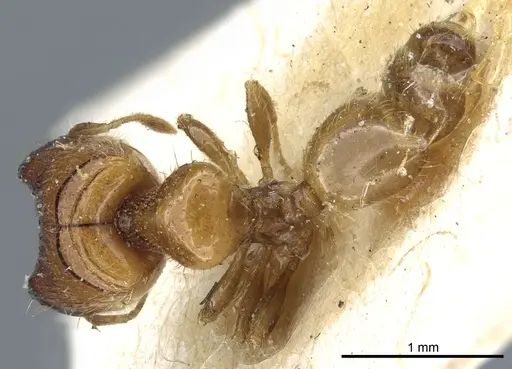
CASENT0904314
Visualizza su AntWeb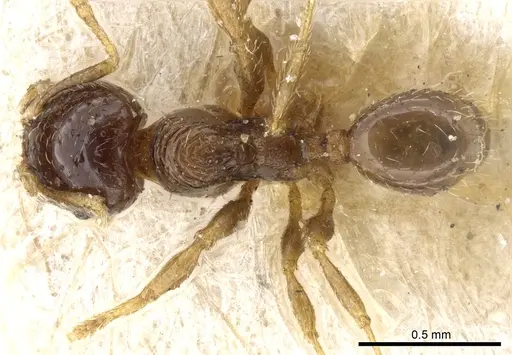
Letteratura
Caricamento mappa di distribuzione...Caricamento prodotti...