
Nesomyrmex zaheri
- Nom. sci.
- Nesomyrmex zaheri
- Tribù
- Crematogastrini
- Sottofamiglia
- Myrmicinae
- Autore
- Sharaf <i>et al.</i>, 2017
- Distribuzione
- Trovata in 0 paesi
Introduzione
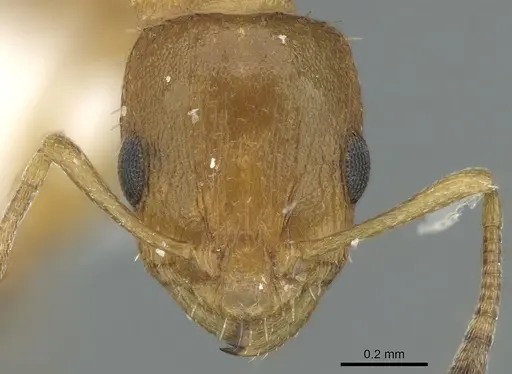
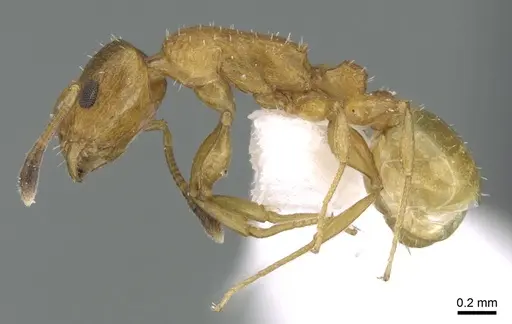
Nesomyrmex zaheri is a tiny ant species described in 2017 from a single worker specimen collected in southwestern Yemen near Aden . Workers are very small, with body part measurements indicating a total length around 3-4 mm. They have a uniformly light brown body with a darker head and lighter appendages . The head appears almost rectangular, with a well-developed petiolar node and a globular postpetiole . This species belongs to the Nesomyrmex angulatus group and is the third Nesomyrmex known from the Arabian Peninsula . Currently, nothing is known about its biology, nesting, or colony structure in the wild .
Quick Summary
- Difficulty: Unknown
- Origin & Habitat: Southwestern Yemen near Aden, along the coast of the Gulf of Aden (Indian Ocean) [1]. The type locality is Al Kawd, a warm coastal arid to semi-arid region with year-round high temperatures [1].
- Colony Type: Unknown. Colony structure has not been documented for this species [1].
- Size & Growth:
- Queen: Undescribed, no data available. Queens have not been collected, they are likely larger than workers based on typical Nesomyrmex patterns, but this is speculation [1].
- Worker: Around 3-4 mm total length (inferred from holotype body part measurements) [1].
- Colony: Unknown, no wild colonies have been studied [1].
- Growth: Unknown
- Development: Unconfirmed. Based on typical small Myrmicinae from warm climates, estimate 4-8 weeks at optimal temperature. (Development timeline has not been studied, this estimate is based on genus-level patterns for small tropical Myrmicinae.)
- Antkeeping:
- Temperature: Warm conditions expected. The species comes from a coastal region with year-round warmth. Start around 24-28°C and observe colony activity [1].
- Humidity: Low to moderate. Yemen has an arid to semi-arid climate. Keep nest substrate slightly moist but allow drying periods between waterings. Provide a humidity gradient so ants can choose their preferred zone [1].
- Diapause: Unknown. The species is from a tropical/subtropical coastal area where temperatures remain high year-round. A dormancy period may not be required, but this is unconfirmed [1].
- Nesting: Unknown in the wild. Based on related Nesomyrmex species and arid habitat, they likely nest in soil under stones or in small cavities. For captivity, start with a small test tube setup or Y‑tong nest with narrow chambers scaled to their tiny size [1].
- Behavior: Behavior is undocumented. Based on genus patterns, they are likely docile and non-aggressive. As a member of Myrmicinae tribe Crematogastrini, they have a 'smear' defense mechanism, a modified spatulate stinger used to wipe venom onto enemies. Their very small size (3-4 mm) makes escape prevention critical: use fine mesh barriers and tight-fitting lids. Foraging style is unknown, but they likely forage on the ground like other Nesomyrmex.
- Common Issues: completely unstudied biology means all care is experimental, start with conservative parameters., tiny size creates high escape risk, use excellent barrier methods and inspect regularly., no data on founding behavior, queen may be claustral like related species, but unconfirmed., unknown diet preferences, offer varied small foods and observe acceptance., no information on hibernation requirements, monitor for seasonal activity changes but do not force cooling.
Discovery and Identification
Nesomyrmex zaheri was described in 2017 by Sharaf, Akbar, and Hita Garcia based on a single worker specimen collected in Yemen [1]. The species was named to honor Sheikh Abdel-Azim Zaher, a famous Egyptian Qur'an reader [1]. The holotype was collected using a light trap in Al Kawd, southwestern Yemen, near the Indian Ocean coast [1]. It is the third Nesomyrmex species documented from the Arabian Peninsula [1]. Key identification features include the lack of a median clypeal carina, a reduced third mandibular tooth, and a distinctly wide and high postpetiole compared to the similar Nesomyrmex angulatus [1].
Natural History
Unfortunately, nothing is known about the biology or nesting behavior of Nesomyrmex zaheri in the wild [1]. The single known specimen was collected in September 2001 using a light trap, providing only limited ecological information [1]. Based on the collection location in southwestern Yemen, the species inhabits a warm coastal arid to semi-arid environment [1]. The Gulf of Aden region experiences hot temperatures year-round with low rainfall. Related Nesomyrmex species in the angulatus group are typically ground-nesting ants that form small colonies. Until more specimens are collected and studied, all information about their natural history remains speculative [1][2].
Housing and Nest Setup
Since nothing is known about their nesting preferences, you will need to experiment with setup options [1]. For their tiny worker size (around 3-4 mm), use test tubes with small water reservoirs or Y‑tong nests with narrow chambers scaled to their body size. The species is from a warm, relatively dry coastal region, so avoid overly humid conditions [1]. Keep the nest substrate slightly moist but not waterlogged, and allow it to dry partially between waterings. Provide a humidity gradient by placing a water source at one end of the setup so ants can self-regulate. Because of their very small size, excellent escape prevention is essential, use fine mesh barriers and ensure all connections are sealed tightly.
Feeding and Diet
Diet preferences are completely unstudied for this species [1]. Based on typical Nesomyrmex and small Myrmicinae, they likely are omnivorous, accepting small insects and sugary liquids. Start by offering small live prey like fruit flies or pinhead crickets, along with sugar water or honey. Observe which foods they accept and adjust accordingly. Because their colony size is unknown, feed conservatively, small amounts of protein twice weekly, with a constant sugar water source. Remove uneaten prey after 24-48 hours to prevent mold. If the colony accepts a variety of foods, you can broaden their diet over time.
Temperature and Seasonal Care
The species is from the Gulf of Aden region of Yemen, which has warm temperatures year-round [1]. Keep the nest in the low-to-mid 20s°C range (24-28°C) as a starting point. Observe colony behavior, if workers are active and foraging, the temperature is appropriate. If they seem sluggish, slightly increase heat, if they avoid a heated area, reduce it. Since nothing is known about diapause requirements, monitor for seasonal activity changes [1]. If your colony slows during winter months, they may benefit from a slight temperature reduction (a few degrees) for a rest period, but do not cool them dramatically since they are from a warm climate.
Colony Development Expectations
Since no one has successfully raised this species in captivity, you should expect slow progress and be prepared for experimentation [1]. Queens have not been described, so you may not be able to identify dealated queens if you attempt to catch them. If you obtain a founding queen, treat her as claustral (she seals herself in and lives off stored fat) based on typical Nesomyrmex patterns, though this is unconfirmed. Expect 4-8 weeks for first workers based on genus estimates for small warm-climate Myrmicinae. Nanitics (first workers) will likely be smaller than mature workers. Growth rate is unknown, small colony sizes are expected based on related species. Patience is essential with this unstudied species.
Frequently Asked Questions
How do I care for Nesomyrmex zaheri ants?
Care is experimental since nothing is known about this species [1]. Start with warm temperatures (24-28°C), slightly moist but not wet nest substrate, and small chambers scaled to their tiny 3-4 mm size. Offer small live prey and sugar sources. This species is for experienced antkeepers willing to experiment and document their findings.
What do Nesomyrmex zaheri eat?
Diet is unstudied. Based on related species, they likely accept small insects and sugar sources. Offer fruit flies, small crickets, and sugar water or honey. Start with small amounts and observe acceptance. Remove uneaten prey promptly [1].
How big do Nesomyrmex zaheri colonies get?
Colony size is unknown. Based on related Nesomyrmex species in the angulatus group, colonies are likely small, probably under 100 workers at maturity, but this is speculation [1].
Do Nesomyrmex zaheri ants sting?
They likely have a stinger, as with most Myrmicinae. Their defense mechanism is a 'smear' stinger that wipes venom rather than piercing. Because of their tiny size, the sting is not considered dangerous to humans. However, no direct observations exist for this species [1].
Where is Nesomyrmex zaheri found?
It is only known from southwestern Yemen near Aden, along the Gulf of Aden coast. The type locality is Al Kawd. This is the only documented location for the species [1].
Are Nesomyrmex zaheri good for beginners?
No. This is an extremely poorly studied species with no documented care information. It is not recommended for beginners. Only experienced antkeepers willing to experiment should attempt to keep this species [1].
How long does it take for Nesomyrmex zaheri to develop from egg to worker?
Unknown. Based on typical small Myrmicinae from warm climates, estimate 4-8 weeks at optimal temperature. This is an educated guess, actual development time may differ [1].
Do Nesomyrmex zaheri need hibernation?
Unknown and likely not required. The species is from a warm coastal region where temperatures remain high year-round. Monitor your colony for seasonal activity changes, but do not force a dramatic cooling period [1].
What size nest do I need for Nesomyrmex zaheri?
Use small setups scaled to their tiny worker size (around 3-4 mm). Test tubes with small water reservoirs or Y‑tong nests with narrow chambers work well. Ensure chambers are appropriately sized, too large spaces can stress small colonies [1].
Can I keep multiple Nesomyrmex zaheri queens together?
Unknown. Colony structure has not been documented for this species. Do not attempt combining unrelated queens without documented evidence that they tolerate multi-queen arrangements [1].
Report an Issue
The current care sheet is based fully on literature. See inconsistencies, or something that's incorrect? Please , it will be resolved after review from an admin. Contributing to the blogs tab also helps providing information, to make us be able to further improve the caresheets. Thank you for your support!
References

Questa scheda di allevamento è concessa in licenza con CC BY-SA 4.0 .
Blog della comunità
CASENT0906379
Visualizza su AntWeb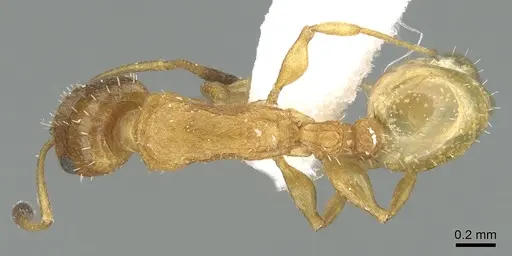
Letteratura
Caricamento mappa di distribuzione...Caricamento prodotti...