
Monomorium noualhieri
- Nom. sci.
- Monomorium noualhieri
- Tribù
- Solenopsidini
- Sottofamiglia
- Myrmicinae
- Autore
- Emery, 1895
- Distribuzione
- Trovata in 0 paesi
Introduzione
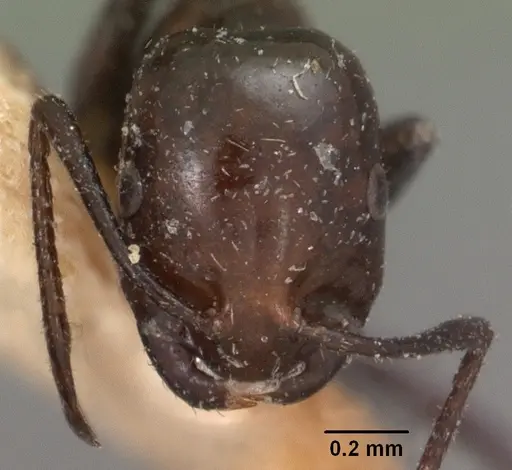
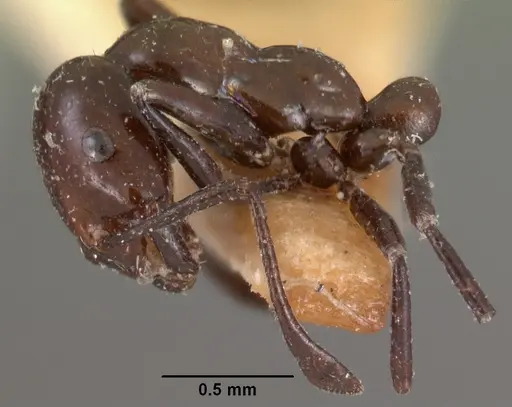
Monomorium noualhieri is a tiny, glossy brown-black ant measuring approximately 2.5mm in length . It belongs to the salomonis-group and is known only from Biskra in Algeria, making it one of the rarest ants . The species has reduced morphology: antenna segments are almost fused, the postpetiole is small, and the body is smooth with almost no hairs . It was collected inside a nest of Monomorium salomonis, suggesting it lives as a social parasite . The taxonomic history, including its original description as Phacota noualhieri, is documented in AntWiki . This species is not recommended for antkeeping due to its rarity and parasitic nature.
Quick Summary
- Difficulty: Expert
- Origin & Habitat: Only known from Biskra, Algeria, nesting in colonies of Monomorium salomonis [3][1][4].
- Colony Type: Socially parasitic, appears to require host colonies of M. salomonis to survive. Colony structure is unconfirmed.
- Size & Growth:
- Antkeeping:
- Temperature: Unknown, would need to match host species conditions
- Humidity: Unknown, likely adapted to dry conditions
- Diapause: Unknown
- Nesting: Lives within host colonies, in captivity, would require establishing a host colony first
- Behavior: Behavior is unstudied. Likely peaceful and integrated into host colonies. Escape risk is low due to tiny size, but irrelevant as species cannot be maintained independently.
- Common Issues: this species likely cannot found colonies independently and requires a host colony to survive, only known from a single collection in 1895,suggesting extreme rarity, no captive husbandry information exists, keeping this species would be experimental and likely unsuccessful, this species is vulnerable (VU) on the IUCN Red List, and capturing queens may be illegal in protected areas [5]
Why This Species Is Not Recommended for Antkeeping
Monomorium noualhieri is one of the most challenging and poorly understood ants, and it should not be kept in captivity. This species is known from only a single specimen collected over 125 years ago in Biskra, Algeria [2]. The worker was found inside a nest of Monomorium salomonis, indicating it lives as a social parasite that depends on host colonies [4][1]. Researchers suggest it may represent the degenerate worker of a permanently parasitic queen [5]. This means M. noualhieri likely cannot survive independently. There is no information on diet, temperature, humidity, or captive care. Attempting to keep this species would be irresponsible and almost certainly fail.
Taxonomy and Discovery
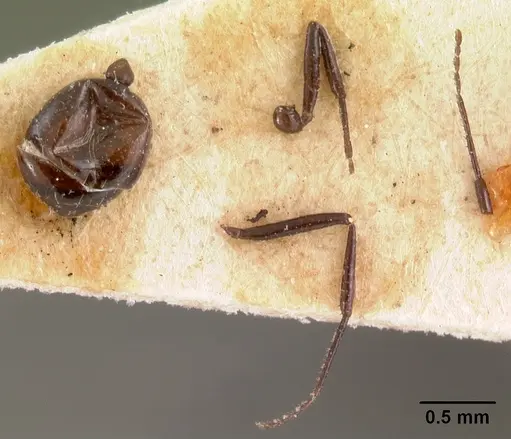
This species has a complicated taxonomic history. Carlo Emery first described it in 1895 from a single worker in Biskra, Algeria, naming it Monomorium noualhieri [2]. It was later moved to Monomorium [5]. The species belongs to the salomonis-group [5]. The type specimen is the only known example, suggesting it is extremely rare or possibly a one-time anomaly. Morphological examination confirms unusual features: almost fused antenna segments, a tiny postpetiole, and a smooth body with no standing hairs [1][2].
Relationship with Monomorium salomonis
The only confirmed ecological information is that M. noualhieri was collected within a nest of Monomorium salomonis in Algeria [1][4]. This host species is common in North Africa. The finding strongly suggests M. noualhieri is a social parasite that lives permanently within host colonies. Unlike temporary parasites, it likely integrates long-term without replacing the host queen. Related species like Monomorium santschii are also permanent inquilines of M. salomonis [5]. Whatever its exact relationship, M. noualhieri almost certainly cannot survive without its host.
Morphology and Identification
The worker is tiny at 2.5mm, with glossy brown-black coloration [1][2]. The body is smooth and shining with almost no erect hairs [2]. Antennae have 12 segments, but the funicular segments are nearly fused, making the club appear to have only 2 segments [1]. The petiole node is rounded with a short peduncle, and the postpetiole is reduced [1][2]. Legs are very long and slender [2]. These reductions are typical of social parasites.
Frequently Asked Questions
Can I keep Monomorium noualhieri in a test tube?
No. This species likely cannot survive independently and has never been maintained in captivity. It was found only once in 1895 inside a host colony, suggesting it is a permanent social parasite that requires a host to survive. There is no known method to keep this species.
How long until first workers with Monomorium noualhieri?
This cannot be answered. The species appears unable to produce workers independently and may be entirely dependent on host colonies. No one has ever raised this species in captivity.
How big do Monomorium noualhieri colonies get?
Unknown. The only known specimen is a single worker collected in 1895. If it is a social parasite, its population would be limited by the host colony, likely just a few individuals.
What do Monomorium noualhieri eat?
Unknown. As a likely social parasite, it would be fed by host workers rather than forage for itself. No feeding observations have been recorded.
What temperature do Monomorium noualhieri need?
Unknown. The host species M. salomonis likely prefers warm conditions typical of North African desert-edge habitats, but no specific requirements exist for this parasite.
Is Monomorium noualhieri good for beginners?
No. This species cannot be kept in captivity. It is known from a single specimen collected over 125 years ago, and its biology suggests it cannot survive without a host colony. This is a species for scientific study, not antkeeping.
Do Monomorium noualhieri need hibernation?
Unknown. The hibernation requirements have never been studied. If it is a permanent parasite of M. salomonis, it would likely follow the host colony's seasonal patterns.
Why are my Monomorium noualhieri dying?
This species cannot be maintained in captivity. If obtained, they would likely die quickly because they cannot survive without a host colony. There is no known captive husbandry method.
Report an Issue
The current care sheet is based fully on literature. See inconsistencies, or something that's incorrect? Please , it will be resolved after review from an admin. Contributing to the blogs tab also helps providing information, to make us be able to further improve the caresheets. Thank you for your support!
References

Questa scheda di allevamento è concessa in licenza con CC BY-SA 4.0 .
Blog della comunità
CASENT0102061
Visualizza su AntWeb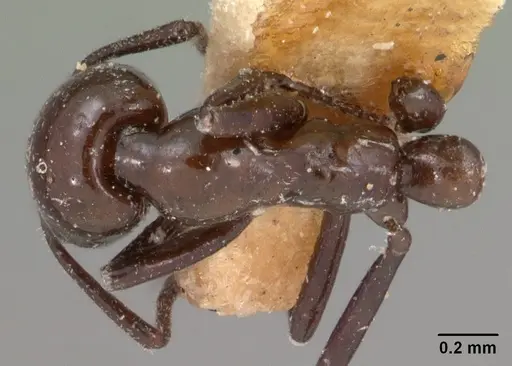
Letteratura
Caricamento mappa di distribuzione...Caricamento prodotti...