
Leptogenys pucuna
- Nom. sci.
- Leptogenys pucuna
- Tribù
- Ponerini
- Sottofamiglia
- Ponerinae
- Autore
- Lattke, 2011
- Distribuzione
- Trovata in 0 paesi
Introduzione
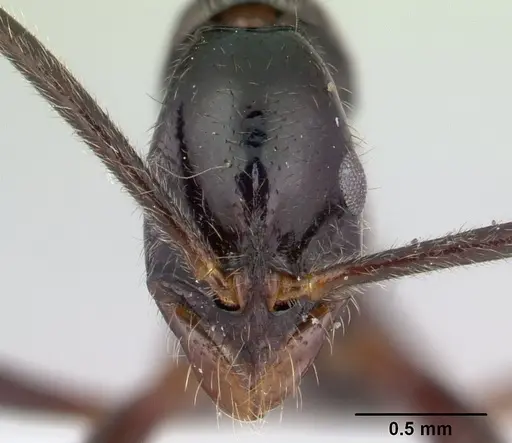
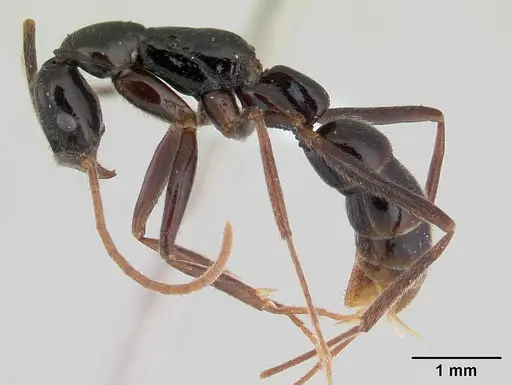
Leptogenys pucuna is a predatory ant from the Neotropics, native to montane forests of Ecuador. Workers have an almost entirely black body with blue iridescence on the head. The eyes are positioned relatively low, and the petiolar node is low and elongated. This species belongs to the luederwaldti species group within Leptogenys. Queens and males are unknown. In the wild, they are found exclusively in forest patches at around 1620 meters elevation in Pichincha province, Ecuador . Size data for workers is unavailable.
Quick Summary
- Difficulty: Expert
- Origin & Habitat: Ecuador (Pichincha, Maquipucuna) at 1620m elevation in ridge top montane forest [1][2]
- Colony Type: Unknown, queens and males have not been described
- Size & Growth:
- Queen: Unknown, queens have not been described
- Worker: Size data unavailable
- Colony: Unknown
- Growth: Unknown
- Development: Unknown, no development data exists (Based on typical Leptogenys patterns, development may take several weeks, but this is unconfirmed)
- Antkeeping:
- Temperature: Unconfirmed, based on montane forest habitat, likely prefers temperatures around 24-26°C. Start with these and observe [1]
- Humidity: Unconfirmed, likely requires high humidity. Keep substrate consistently moist but not waterlogged [1]
- Diapause: Unknown, from equatorial climate, likely no diapause required [1]
- Nesting: Unconfirmed, likely prefers humid, dark spaces. Y-tong or plaster nests are suitable starting points [1]
- Behavior: Leptogenys ants are predators, hunting small arthropods. Workers are non-aggressive toward humans but may defend the nest. Escape risk is moderate due to worker size, standard barriers should suffice. Defense mechanism is stinging, as typical for Ponerinae subfamily.
- Common Issues: lack of documented captive care means no established protocols exist for this species, no information on founding behavior makes it difficult to establish colonies from scratch, extremely limited distribution data means environmental requirements are largely unknown, only known from a single specimen in the wild, availability may be extremely limited
Appearance and Identification
Leptogenys pucuna workers are distinctive with an elongated build. The head has blue iridescence, and the body is mostly black with brownish coloration on the mandibles, legs, and gastral apex. The petiolar node is low and elongated, and there is a clear constriction between abdominal segments. Body lacks pubescence, with sparse hairs [1].
Distribution and Natural Habitat
This species is known only from the type locality in Maquipucuna, Pichincha province, Ecuador, at approximately 1620 meters elevation. The single known specimen was collected from a leaf litter sample in ridge top montane forest. Research in Neotropical coffee landscapes found only this individual, exclusively in forest patches [2]. This suggests they may be sensitive to habitat disturbance and require intact forest environments.
Known Biology and Research Gaps
Leptogenys pucuna is poorly documented because so little is known about it in the wild. The original description by Lattke in 2011 was based on a single worker specimen, and no queens, males, or colony observations have been published since. This means we know almost nothing about their colony structure, founding behavior, nuptial flight timing, or dietary preferences. What we can infer comes from general knowledge of the genus Leptogenys, these are typically predatory ants that hunt small arthropods like springtails [1].
Keeping an Undescribed Species
Keeping Leptogenys pucuna presents unique challenges since there are no established care protocols. You will be pioneering their husbandry. Start with conditions typical of other Leptogenys species: a warm, humid environment with temperatures around 24-26°C and high substrate moisture. Since they are likely predatory, offer small live prey like springtails or fruit flies. The nest should retain humidity well, Y-tong or plaster nests work for Leptogenys [1].
Feeding and Diet
Leptogenys ants are typically predators that hunt small soil-dwelling arthropods. In captivity, they likely accept small live prey such as springtails, isopods, fruit flies, and other micro-arthropods. They are primarily carnivorous and may not need sugar sources [1].
Temperature and Seasonal Care
This species comes from a montane tropical environment in Ecuador near the equator, so they likely do not experience cold winters. Temperatures around 24-26°C are probably ideal. Humidity should be high, think damp forest floor conditions. Since Ecuador's climate near the equator is relatively stable year-round, these ants likely do not require a diapause period [1].
Frequently Asked Questions
How do I care for Leptogenys pucuna ants?
Care for Leptogenys pucuna is not established since this species has never been documented in captivity. Based on typical Leptogenys requirements, provide warm temperatures around 24-26°C, high humidity with consistently moist substrate, and small live prey like springtails. This is an expert-level species requiring significant experimentation [1].
What do Leptogenys pucuna ants eat?
Leptogenys species are predatory ants. Offer small live prey such as springtails, fruit flies, tiny isopods, and other micro-arthropods. They are likely primarily carnivorous [1].
How big do Leptogenys pucuna colonies get?
Colony size is unknown, no colony data exists for this species.
Where is Leptogenys pucuna found?
This species is known only from Maquipucuna in Pichincha, Ecuador, at approximately 1620 meters elevation in montane forest [1][2].
What does Leptogenys pucuna look like?
Workers have an almost entirely black body with blue iridescence on the head. They have an elongated, elegant body with a low, elongated petiolar node [1].
Are Leptogenys pucuna good for beginners?
No, this species is not recommended for beginners. It has never been documented in captivity, queens are unknown, and no established care protocols exist. This is a species for experienced antkeepers [1].
How long does it take for Leptogenys pucuna to develop from egg to worker?
The development timeline is unknown, no research exists on this species. Based on typical Leptogenys patterns, development may take several weeks, but this is unconfirmed [1].
Can I keep multiple Leptogenys pucuna queens together?
Colony structure is unknown, queens have never been described. Do not attempt to combine unrelated queens since no data exists on their founding behavior.
What temperature do Leptogenys pucuna ants need?
Temperature requirements are unconfirmed. Based on their Ecuadoran montane forest origin, start around 24-26°C and observe colony behavior [1].
Do Leptogenys pucuna need hibernation?
Diapause requirements are unknown. Since they come from equatorial Ecuador with stable year-round temperatures, they likely do not require hibernation [1].
Is Leptogenys pucuna available for sale?
This species is extremely rare in the antkeeping hobby. It has only been collected once in the wild (the type specimen), and queens have never been described. Availability is likely nil outside of scientific collections [1].
Report an Issue
The current care sheet is based fully on literature. See inconsistencies, or something that's incorrect? Please , it will be resolved after review from an admin. Contributing to the blogs tab also helps providing information, to make us be able to further improve the caresheets. Thank you for your support!
References

Questa scheda di allevamento è concessa in licenza con CC BY-SA 4.0 .
Blog della comunità
CASENT0428596
Visualizza su AntWeb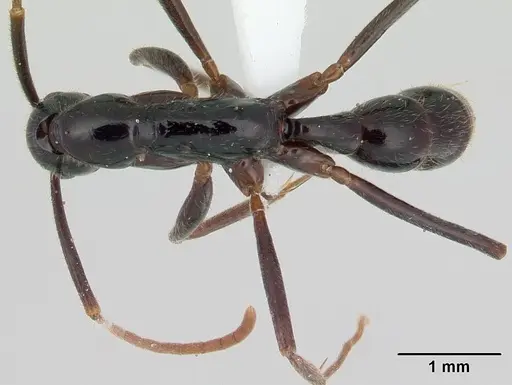
Letteratura
Caricamento mappa di distribuzione...Caricamento prodotti...