
Leptanilla laventa
- Nom. sci.
- Leptanilla laventa
- Tribù
- Leptanillini
- Sottofamiglia
- Leptanillinae
- Autore
- Griebenow <i>et al.</i>, 2022
- Distribuzione
- Trovata in 0 paesi
Introduzione
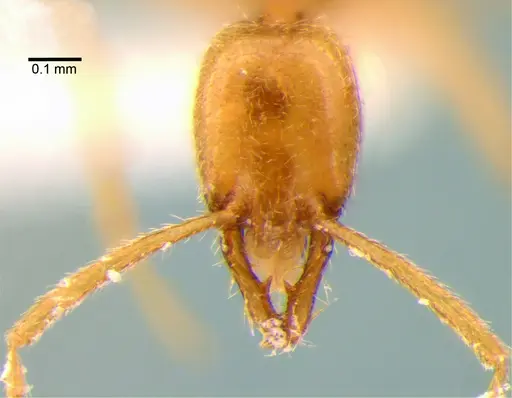
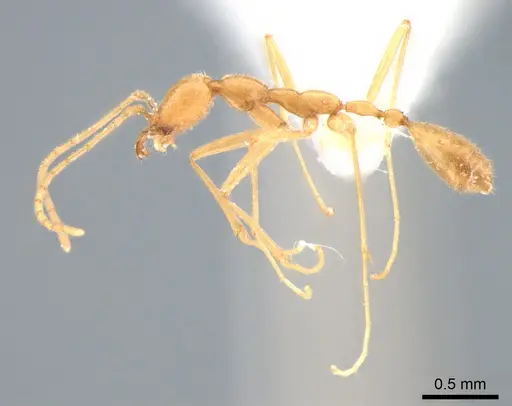
Leptanilla laventa is one of the rarest and most unusual ant species known. Workers are tiny - total body length unknown, but their mesosoma (middle body section) is only about 0.74-0.85 mm long. They have bizarrely elongated antennae, legs, and mandibles, adaptations for life in narrow underground cavities. They completely lack compound eyes, a classic cave-adapted (troglomorphic) trait. Their body is pale orangish-yellow . Originally described as Yavnella laventa in 2022 from only seven workers collected 60-100 cm below the surface in southern Iran, it is one of the very few troglomorphic ants in the world .
Quick Summary
- Difficulty: Expert
- Origin & Habitat: Southwestern Iran (Fārs province), Khoorab Salt Dome area. They live in the Milieu Souterrain Superficiel (MSS), a network of air-filled voids between rock fragments in scree deposits, at depths of 60-100 cm [1][3]. The habitat is a debris flow next to an ephemeral stream, with mean annual precipitation around 400 mm [1].
- Colony Type: Unknown, colony structure has not been documented.
- Size & Growth:
- Queen: Unknown, queens have never been described [1]
- Worker: Size data unavailable, only partial measurements (e.g., mesosoma length 0.74-0.85 mm) have been reported, not total body length [1][2]
- Colony: Unknown, only seven workers have ever been collected [1]
- Growth: Unknown, insufficient data to estimate
- Development: Unknown, no development data exists (Development timeline has not been studied. Related Leptanilla species typically develop in 4-8 weeks at warm temperatures, but this is a rough estimate with low confidence.)
- Antkeeping:
- Temperature: Unconfirmed, no captive data exists. Based on their warm Iranian origin, likely tolerates 22-28°C. Start around 24-26°C and observe.
- Humidity: Unconfirmed, they inhabit deep subterranean voids where humidity is likely stable and high. A nearby salt cave shows seasonal humidity from 50-80% [1]. Keep the nest substrate consistently moist but not waterlogged.
- Diapause: Unknown, no seasonal data. As a subterranean species from southern Iran with mild winters, they may have reduced activity periods rather than true hibernation.
- Nesting: Unknown, they naturally inhabit narrow underground cavities among rock fragments. In captivity, a tight, humid setup with very small chambers would be needed, possibly a small plaster or soil-based nest with chambers scaled to their minute size. Do not use acrylic nests. This is entirely speculative.
- Behavior: Virtually unknown. In the wild, their elongated appendages and lack of eyes indicate a completely subterranean lifestyle. They have a well-developed sting [1] and their mandibles show trap-jaw biology similar to Protanilla [3]. Given their tiny size (under 1 mm), escape prevention must be absolutely airtight, they could pass through standard mesh. They are likely slow-moving and docile. No aggression data exists.
- Common Issues: this species has never been kept in captivity, there is no established care protocol, extremely small size means standard ant keeping equipment may not work, no information on what they eat or how to feed them, no data on colony founding or queen behavior, escape prevention is critical due to their minute size, wild-caught colonies may be nearly impossible to obtain given their specialized habitat
Discovery and Rarity
Leptanilla laventa holds a special place in myrmecology as one of the most recently discovered and rarest ant species. Originally described as Leptanilla laventa in 2022,it was the first known worker of the genus Yavnella, previously only males had been described [1]. The species was identified through phylogenomic analysis using ultra-conserved elements, confirming its placement in Leptanillinae [1]. Only seven workers have ever been collected, all from a single location in southwestern Iran near the Khoorab Salt Dome. Finding them requires specialized subterranean pitfall traps placed 60-100 cm deep in the right habitat [1].
Troglomorphic Adaptations
This species is one of the very few truly troglomorphic (cave-adapted) ants known. Workers completely lack compound eyes, a hallmark adaptation to life in permanent darkness [1]. Their most striking feature is the extreme elongation of their appendages: antennae with an elongation index (SI) of 160-163,and a remarkably long petiole (PI = 29-32) [2]. These elongated extremities are consistent with confinement to narrow subterranean voids, not soil-dwelling behavior [1]. The sparseness of traction chaetae (tiny gripping hairs) on their legs suggests limited digging capability, they likely navigate existing cavities rather than excavating their own tunnels [1]. Their pale orangish-yellow coloration is also typical of cave-dwelling organisms that lack pigmentation from light exposure.
Natural History and Habitat
Leptanilla laventa lives in an extremely specialized microhabitat called the Milieu Souterrain Superficiel (MSS), a network of air-filled underground voids between rock and soil fragments in scree deposits [1]. They were collected at depths of 60-100 cm below the surface within a debris flow on the bank of an ephemeral stream adjacent to a salt diapir [1]. The Khoorab Salt Dome is one of approximately 130 salt diapirs in southern Iran, and it's possible the species occurs across this area in similar microhabitats [1]. The mean annual precipitation in this region is around 400 mm. While microclimatic conditions weren't directly measured in their tunnels, humidity in a nearby salt cave varied seasonally from 50-80%, the hygroscopic properties of salt may cause localized humidity drops [1]. This is a harsh, unstable environment compared to deeper caves.
Related Species and Taxonomy
This species was originally placed in the genus Yavnella but was transferred to Leptanilla in 2024 following systematic revision [3]. It is sister to Leptanilla argamani in phylogenetic analysis with maximal support [1]. Interestingly, it shows remarkable convergence with Leptanilla voldemort, a species described from Australia in 2024, both have extremely elongated antennae and petioles, representing independent evolution of similar gracile phenotypes in subterranean habitats [2]. However, L. voldemort has a smaller mesosoma (0.59-0.61 mm vs 0.74-0.85 mm) and a more elongated petiole shape [2]. There is speculation that Leptanilla escheri and L. judaica may actually be non-troglomorphic representatives of Yavnella (now Leptanilla), suggesting this group may be more widespread than currently known [1].
Keeping This Species - Practical Considerations
We need to be completely honest: there is no established captive care protocol for Leptanilla laventa. This species has never been kept in captivity by hobbyists or researchers. The seven known specimens were collected using specialized subterranean pitfall traps buried 60-100 cm belowground [2]. If you somehow obtained a colony, you would essentially be pioneering their care with no prior guidance. Based on their biology, they would likely need very small, tight chambers scaled to their minute size, high humidity consistent with subterranean conditions, and probably small live prey like springtails or other micro-arthropods given their predatory relatives in the Leptanilla genus. A heating cable on one side of the nest could create a temperature gradient. Their tiny size means escape prevention must be exceptional, even standard fine mesh may not contain them. This is strictly an expert-level species for advanced antkeepers with specialized equipment and the ability to conduct significant experimental care.
Frequently Asked Questions
Can I keep Leptanilla laventa as a pet ant?
No, this species has never been kept in captivity. Only seven workers have ever been collected, all from a single remote location in Iran. They require specialized subterranean pitfall traps at 60-100 cm depth to find. There is no established care protocol, and obtaining wild colonies would require both access to the remote habitat and specialized collection methods. This is not a species available to hobbyists.
How big are Leptanilla laventa workers?
Extremely tiny. Total body length hasn't been measured, but partial measurements give a sense: mesosoma length (middle body section) is 0.74-0.85 mm, head width about 0.35-0.36 mm, and antenna scape length 0.55-0.59 mm. Their antennae are longer than their head [1][2].
Do Leptanilla laventa ants have eyes?
No, they completely lack compound eyes, a classic cave-adapted (troglomorphic) trait for life in permanent darkness [1].
What do Leptanilla laventa eat?
Unknown, no feeding observations exist. Based on related Leptanilla species, they are likely predatory on small soil arthropods like springtails, mites, or other micro-arthropods. Their mandibles show trap-jaw biology similar to Protanilla [3]. In captivity, you would likely need to offer small live prey.
Where does Leptanilla laventa live?
Only from southwestern Iran (Fārs province) near the Khoorab Salt Dome. They live in underground cavities called the Milieu Souterrain Superficiel (MSS) at depths of 60-100 cm, within a debris flow adjacent to an ephemeral stream [1].
Are Leptanilla laventa dangerous?
They have a well-developed sting [1], but given their minute size (under 1 mm), they would be unable to penetrate human skin. They are completely harmless to keepers.
How many queens does Leptanilla laventa have?
Unknown, colony structure has never been documented. Queens have never been described for this species. The genus Leptanilla typically forms small colonies, but we have no specific data for L. laventa.
Do Leptanilla laventa need hibernation?
Unknown, no seasonal data exists. As a subterranean species from southern Iran with relatively mild winters, they may have reduced activity periods rather than true hibernation.
What makes Leptanilla laventa special?
They are one of the very few cave-adapted (troglomorphic) ant species known to science, with extreme body adaptations for subterranean life including no eyes, extremely elongated appendages, and pale coloration. They were also the first worker ever described for the genus previously known only from males [1].
Can beginners keep Leptanilla laventa?
Absolutely not. This is an expert-level species that has never been kept in captivity, has no established care protocol, and is essentially unavailable to hobbyists. Even experienced antkeepers would face significant challenges given their specialized habitat requirements and minute size.
Report an Issue
The current care sheet is based fully on literature. See inconsistencies, or something that's incorrect? Please , it will be resolved after review from an admin. Contributing to the blogs tab also helps providing information, to make us be able to further improve the caresheets. Thank you for your support!
References

Questa scheda di allevamento è concessa in licenza con CC BY-SA 4.0 .
Blog della comunità
CASENT0842746
Visualizza su AntWeb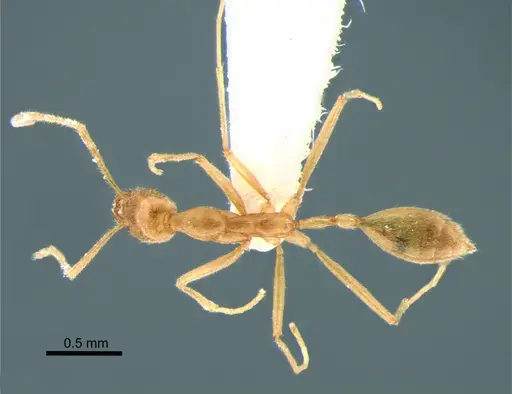
Letteratura
Caricamento mappa di distribuzione...Caricamento prodotti...