
Discothyrea maia
- Nom. sci.
- Discothyrea maia
- Tribù
- Proceratiini
- Sottofamiglia
- Proceratiinae
- Autore
- Hita-Garcia & Lieberman, 2019
- Distribuzione
- Trovata in 0 paesi
Introduzione
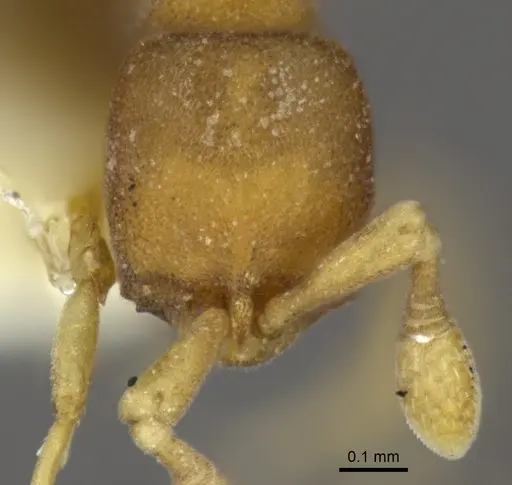
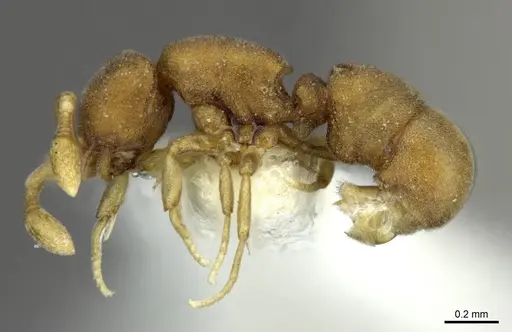
Discothyrea maia is an extremely tiny ant species from Zimbabwe. Workers are a uniform dull yellow color with slightly lighter appendages. This species is completely blind - they have no eyes at all - and navigate using their antennae and chemical senses. The propodeum has distinctive tooth-like denticles and a strongly concave declivity. The petiolar node is remarkably tall and thin. Currently known only from a single collection in Chishawasha, Zimbabwe at 1535m elevation, this species likely inhabits savanna woodland areas. The genus Discothyrea is highly specialized with unique morphology including a frontal lamella with a basal window (fenestra) - this is a sensory structure that helps them detect chemical signals.
Quick Summary
- Difficulty: Expert
- Origin & Habitat: Known only from Chishawasha, Zimbabwe at 1535m elevation in the Afrotropical region. Likely inhabits savanna woodland based on the collection region [1].
- Colony Type: Colony structure is unconfirmed. Only known from a single worker specimen. Related Discothyrea species typically have small colonies with single queens, but this species has not been studied in detail.
- Size & Growth:
- Queen: Unknown, no queen has been described yet.
- Worker: Workers are extremely tiny, approximately 1.5-2mm inferred from Discothyrea genus patterns [2].
- Colony: Unknown. Based on related species in the genus, colonies are likely small.
- Growth: Unknown, no colony development has been documented.
- Development: Unconfirmed, no direct observations of colony development exist for this species. (Development timeline is completely unknown. Related Discothyrea species likely develop relatively quickly given their small size, but specific timelines have not been studied.)
- Antkeeping:
- Temperature: Unknown for this specific species. Based on the Zimbabwe location (subtropical highland), they likely tolerate temperatures ranging from roughly 18-28°C. Start around 22-25°C and monitor colony activity.
- Humidity: Likely requires moderate to high humidity given their presumed leaf-litter habitat in savanna woodland. Keep nest substrate consistently moist but not waterlogged. Provide a humidity gradient so ants can choose their preferred zone.
- Diapause: Unknown, no seasonal data exists. Zimbabwe has mild winters, so a diapause may not be required.
- Nesting: No specific nesting data exists. Based on related species, they likely nest in leaf litter, shallow soil, or rotting wood. In captivity, a small test tube setup with moist cotton or a miniature naturalistic setup with small chambers works well. Their tiny size means they need very tight, scaled-down accommodations.
- Behavior: Behavior is essentially unstudied in the wild and completely unknown in captivity. The genus Discothyrea is known for being extremely cryptic, they are rarely seen and spend most of their time hidden in microhabitats. Workers are blind and navigate using antennae and chemical signals. They likely forage slowly and methodically rather than actively hunting. Their small size and lack of eyes make them extremely difficult to observe. Escape prevention is critical due to their minute size, they can squeeze through gaps invisible to the naked eye. Aggression levels are unknown but likely low given their cryptic lifestyle.
- Common Issues: extreme fragility, these ants are among the smallest in the ant-keeping hobby and can easily be injured or lost during transfers., escape prevention is critical, their tiny size means they can escape through standard barrier setups that work for larger ants., lack of available care information makes proper husbandry challenging, this species has never been kept in captivity to our knowledge., very slow colony growth is expected given their minute size and likely small colony sizes., difficulty observing behavior, their cryptic nature and tiny size make it hard to monitor colony health.
Why Discothyrea maia is an Expert-Only Species
Discothyrea maia is not a species for beginners. We know almost nothing about its care requirements because it has only ever been collected once, a single worker specimen in Zimbabwe in 1981. There are no published observations of its behavior, colony structure, queen, or any ecological data beyond its physical measurements. This means you will essentially be pioneering its husbandry with no established guidelines to follow. The genus as a whole is considered highly specialized and cryptic, with most species being rarely encountered in the wild. Keeping a species with zero captive husbandry history requires extensive experience with difficult ant species and a willingness to experiment carefully. If you manage to obtain a colony, expect a steep learning curve and be prepared to document your observations for the ant-keeping community. [2][1]
Understanding Their Unique Morphology
This species has several distinctive physical features that set it apart from more common ants. First, they are completely blind, the ocular index (OI) is 0, meaning no eyes whatsoever [2]. They navigate entirely through chemical and tactile senses, using their antennae to explore their environment. Their propodeum has well-developed denticles, small tooth-like projections, and a strongly concave declivity [2]. The petiolar node is remarkably attenuated, being about 3.6 times higher than it is long, giving them a distinctive tall, thin waist appearance. They have a frontal lamella with an elliptical basal fenestra, a window-like sensory structure that helps them detect chemical signals from other ants and their environment [2]. Workers are uniformly dull yellow with slightly lighter appendages, and their entire body is only a few millimeters long, making them among the smallest ants you could possibly keep.
Housing and Setup Recommendations
Since we have no direct experience keeping this species, recommendations must be based on what we know about related Discothyrea species and general principles for tiny ants. Use a test tube setup with a small water reservoir, the tube should be appropriately scaled to their minute size, meaning you may need to create custom mini-housing or use very small containers. Alternatively, a small naturalistic setup with moist soil and small hiding structures can work. Humidity should be moderate to high. Temperature should be stable in the low-to-mid 20s Celsius range. Escape prevention is absolutely critical, these ants are so small they can slip through gaps invisible to the human eye. Use fine mesh barriers and ensure all connections are sealed. Lighting should be minimal as they are blind and likely prefer dark conditions.
Feeding and Diet
The diet of Discothyrea maia is completely unstudied, but related species in the genus are believed to be predators or omnivores that forage for small invertebrates and likely tend aphids for honeydew. Based on genus patterns, you should offer tiny prey items, small live springtails, micro-arthropods, or freshly killed insects cut into appropriately small pieces. Sugar sources may be accepted occasionally, but their tiny size makes providing liquid sugar water risky. If you attempt to keep this species, offer a variety of tiny protein sources and observe carefully what they accept. Do not overfeed, excess food can mold and kill colonies in small setups.
The Challenge of Working With Data-Poor Species
This species represents a significant challenge in the ant-keeping hobby: it is a completely data-poor species. We do not know its colony structure, founding behavior, development timeline, temperature preferences, humidity needs, or anything about its natural history beyond physical measurements. The only specimen known to science was collected in 1981 from Chishawasha, Zimbabwe, and no additional specimens or ecological observations have been published since. This means any attempt to keep Discothyrea maia is essentially pioneering work. You will need to make educated guesses based on related species, document your observations meticulously, and be prepared for trial and error. [2][1]
Frequently Asked Questions
Is Discothyrea maia suitable for beginners?
No. This is an expert-only species. We have essentially no information about its care requirements since it has only ever been collected once (a single worker in 1981). There are no established husbandry guidelines, and keeping it requires extensive experience with difficult, data-poor ant species.
How big do Discothyrea maia colonies get?
Unknown, no colony has ever been documented. Based on related species patterns, colonies are likely small.
What do Discothyrea maia eat?
Unconfirmed. Based on genus patterns, they likely accept tiny live prey and may occasionally take sugar sources. No direct observations of their diet exist.
Do Discothyrea maia ants sting?
Unknown. Given their extremely small size, any sting would likely be imperceptible to humans. The genus does not have a reputation for stinging.
What temperature should I keep Discothyrea maia at?
No specific data exists. Based on their Zimbabwe location (subtropical highland at 1535m), start around 22-25°C and monitor colony behavior.
Do they need hibernation or diapause?
Unknown. Zimbabwe has mild winters, so a diapause may not be required, but this has never been studied.
How do I prevent Discothyrea maia from escaping?
Use excellent escape prevention. Their extreme tiny size means they can slip through gaps invisible to the eye. Use fine mesh barriers, seal all connections, and ensure lids fit tightly. Standard ant barriers will not work for this species.
Can I keep multiple queens together?
Unknown. Colony structure has never been documented for this species. Related Discothyrea species typically have single-queen colonies, but we have no data for Discothyrea maia specifically.
How long does it take for eggs to become workers?
Unconfirmed. No development timeline has been documented for this species.
Where does Discothyrea maia come from?
Only known from a single location: Chishawasha, Zimbabwe at 1535m elevation in the Afrotropical region. It may inhabit savanna woodland based on the collection region.
Why do they have no eyes?
Discothyrea maia is completely blind (ocular index = 0). This is a genus-level trait, they navigate using their antennae and chemical senses rather than vision. This is common among cryptic leaf-litter ant species that live in dark, confined microhabitats.
Is this species available in the ant-keeping hobby?
Extremely unlikely. This species is known from a single specimen collected in 1981 and has never been found again. It is not in commercial cultivation and is unlikely to be available from any supplier.
Report an Issue
The current care sheet is based fully on literature. See inconsistencies, or something that's incorrect? Please , it will be resolved after review from an admin. Contributing to the blogs tab also helps providing information, to make us be able to further improve the caresheets. Thank you for your support!
References

Questa scheda di allevamento è concessa in licenza con CC BY-SA 4.0 .
Blog della comunità
CASENT0790541
Visualizza su AntWeb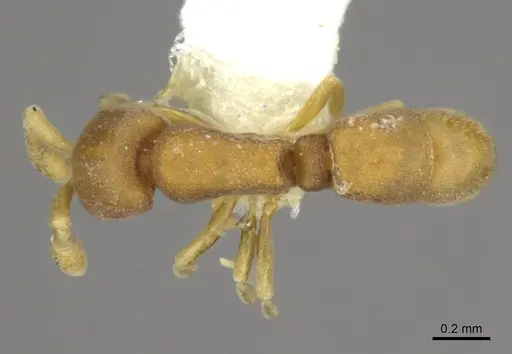
Letteratura
Caricamento mappa di distribuzione...Caricamento prodotti...