
Cephalotes patei
- Nom. sci.
- Cephalotes patei
- Tribù
- Attini
- Sottofamiglia
- Myrmicinae
- Autore
- Kempf, 1951
- Distribuzione
- Trovata in 0 paesi
Introduzione
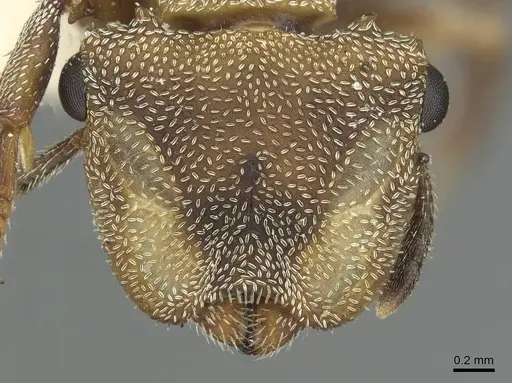
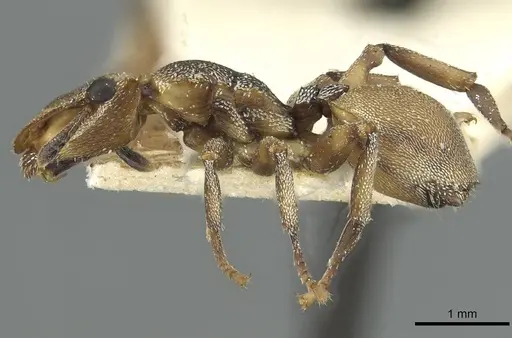
Cephalotes patei is one of the rarest ant species in the world. Workers measure about 5.7mm and soldiers about 7.3mm, with queens reaching 8-9mm. They are entirely black with ferruginous coloration on leg tips and antennae. This species belongs to the patei clade and is endemic to Colombia, known only from specimens intercepted at U.S. plant quarantine stations on imported Cattleya orchids - it has never been collected in its natural habitat . The species is categorized as vulnerable due to its extreme rarity and limited distribution .
Quick Summary
- Difficulty: Expert
- Origin & Habitat: Endemic to Colombia in the Neotropical region. Known only from the Pacific lowlands of Cauca department at elevations of 5-180m [2][1]. All specimens have been intercepted on imported orchids, suggesting they may nest in epiphytic plants. The type specimens were collected from Cattleya orchids imported to New Jersey from Colombia [3].
- Colony Type: Unknown, no wild colonies have ever been documented. The species is known only from isolated specimens intercepted in quarantine.
- Size & Growth:
- Antkeeping:
- Temperature: Unknown, no thermal data exists. Based on lowland Colombian habitat (5-180m elevation), likely prefers warm conditions. Start around 24-28°C and observe colony activity.
- Humidity: Unknown, no humidity data exists. Given their likely association with orchids and epiphytic habitats, they probably prefer moderate to high humidity. Keep substrate consistently moist but not waterlogged.
- Diapause: Unknown, no seasonal data exists. As a tropical lowland species from Colombia, they likely do not require diapause.
- Nesting: No nesting data exists. Based on related Cephalotes species that nest in plant cavities and rotting wood, they likely prefer humid, dark spaces like Y-tong or plaster nests with narrow chambers.
- Behavior: No behavioral observations exist for this species. Based on genus-level patterns, turtle ants are typically docile, slow-moving, and form small colonies. They have a soldier caste for colony defense. Workers are 5-7mm so standard barriers should work, but their flattened body shape may allow them to squeeze through small gaps.
- Common Issues: no captive colonies exist, this species has never been kept in captivity, all biological data is unknown, no information on founding, development, diet, or colony structure, specimens only known from quarantine interceptions, no natural history observations, vulnerable species status, ethical concerns about collecting from the wild, no established care protocols, any keeping would be entirely experimental
Species Rarity and Conservation Status
Cephalotes patei is perhaps the most poorly known ant species in the world. It has never been collected in its natural environment, all known specimens were intercepted at U.S. plant quarantine stations on imported orchids from Colombia [1]. The species is categorized as vulnerable due to its extremely limited distribution and the fact that no wild populations have ever been documented [1]. This makes it essentially impossible to obtain for antkeeping, as no established colonies exist in captivity and no wild collections have ever been made. The entire scientific knowledge of this species comes from fewer than 30 specimens that arrived as stowaways on orchid imports between 1946 and the present [3]. WARNING: This species is protected as vulnerable in Colombia. It is illegal to collect queens or disturb colonies in this country. Any attempt to keep this species would require addressing significant ethical and practical challenges.
Taxonomy and Identification
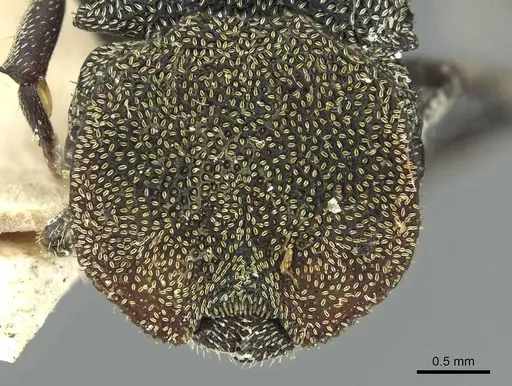
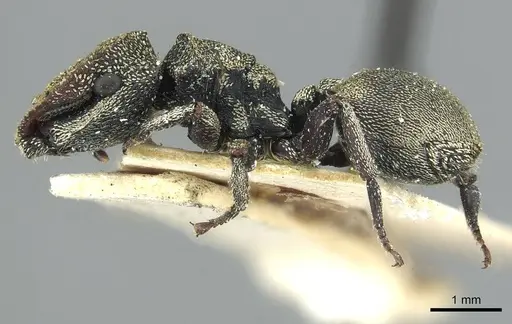
Cephalotes patei is the sole member of the patei clade, making it easily distinguishable from other Cephalotes species [4]. It can be identified by its lack of vertexal denticles and the complete absence of colored spots on the gaster in all three female castes, workers, soldiers, and queens [5]. Workers are entirely black with some ferruginous coloration on leg tips and antennae. The soldier caste is notably larger than workers and features a distinctive flattened head disc used for blocking nest entrances, this is the characteristic that gives turtle ants their common name. The species was originally described as Paracryptocerus (Harnedia) patei by Kempf in 1951 and later moved to the genus Cephalotes by de Andrade and Baroni Urbani in 1999 [3].
Distribution and Habitat
This species is endemic to Colombia, known specifically from the Cauca department in the Pacific region [2][1]. The altitudinal range is extremely narrow at just 5-180 meters above sea level, placing it in the tropical lowland zone [1]. The only specimens ever collected were found on orchids of the genus Cattleya, suggesting a potential association with epiphytic plants. This is consistent with some other Cephalotes species that nest in plant cavities, hollow stems, or under bark. However, since no natural nesting observations exist, this remains speculative. The type locality is recorded simply as Colombia, with the specimens having been intercepted in quarantine at Hoboken, New Jersey, USA, on imported Cattleya orchids in 1946 [3].
Keeping Considerations
It must be emphasized that Cephalotes patei cannot be legitimately obtained for antkeeping. No captive colonies exist anywhere in the world, and the species has never been observed in the wild by researchers. All biological aspects of this species, from founding behavior to colony size, temperature requirements, humidity preferences, and diet, remain completely unknown. Any care information would be pure speculation based on genus-level patterns. For antkeepers interested in Cephalotes species, more commonly available species like Cephalotes varians or Cephalotes texanus would be far more appropriate choices with established care protocols. If you somehow obtained specimens (which would require them to be intercepted from an orchid import), keeping them would be entirely experimental with no guarantee of success. Additionally, the vulnerable conservation status of this species raises serious ethical concerns about any collection attempts.
Frequently Asked Questions
Can I keep Cephalotes patei ants?
No. This species has never been kept in captivity and cannot be obtained. All known specimens were intercepted on imported orchids, no wild colonies have ever been documented, and no captive breeding populations exist anywhere in the world.
What does Cephalotes patei look like?
Workers are about 5.7mm and entirely black with some rusty brown coloration on leg tips and antennae. Soldiers are larger at 7.3mm with a distinctive flattened head disc. Queens reach 8-9mm. Unlike many Cephalotes species, they have no colored spots on the abdomen.
Where is Cephalotes patei found?
This species is endemic to Colombia, specifically the Cauca department in the Pacific lowland region at elevations of 5-180m. It is one of the rarest ant species in the world, known only from specimens intercepted on imported orchids.
How big do Cephalotes patei colonies get?
Unknown. No wild colonies have ever been documented, so colony size data does not exist. Related Cephalotes species typically form colonies of a few hundred to a few thousand workers.
What do Cephalotes patei eat?
Unknown. No feeding observations exist for this species. Based on genus patterns, they likely forage for honeydew and small insects, but this is entirely speculative.
Are Cephalotes patei good for beginners?
No. This species is completely unsuitable for antkeeping. No biological data exists, no captive colonies exist, and the species is conservation-vulnerable. Beginners should look at more commonly available species with established care protocols.
Do Cephalotes patei need hibernation?
Unknown. As a tropical lowland species from Colombia, they likely do not require a diapause period, but this has never been studied. No seasonal data exists for this species.
Report an Issue
The current care sheet is based fully on literature. See inconsistencies, or something that's incorrect? Please , it will be resolved after review from an admin. Contributing to the blogs tab also helps providing information, to make us be able to further improve the caresheets. Thank you for your support!
References

Questa scheda di allevamento è concessa in licenza con CC BY-SA 4.0 .
Blog della comunità
CASENT0912612
Visualizza su AntWeb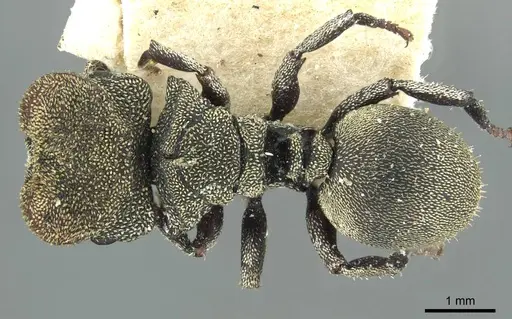
CASENT0912613
Visualizza su AntWeb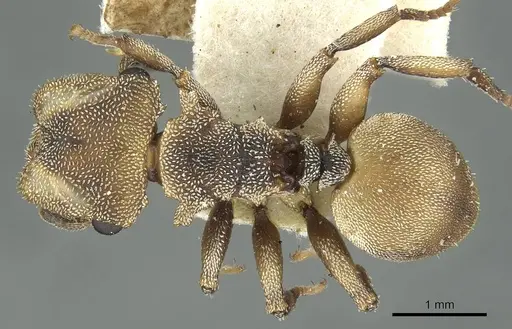
Letteratura
Caricamento mappa di distribuzione...Caricamento prodotti...