
Camponotus conulus
- Nom. sci.
- Camponotus conulus
- Sottogenere
- Myrmobrachys
- Tribù
- Camponotini
- Sottofamiglia
- Formicinae
- Autore
- Mayr, 1870
- Distribuzione
- Trovata in 0 paesi
Introduzione
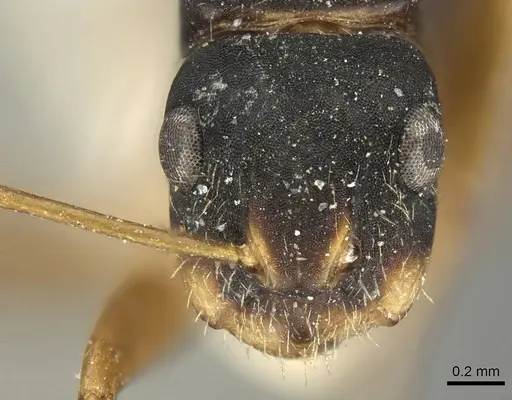
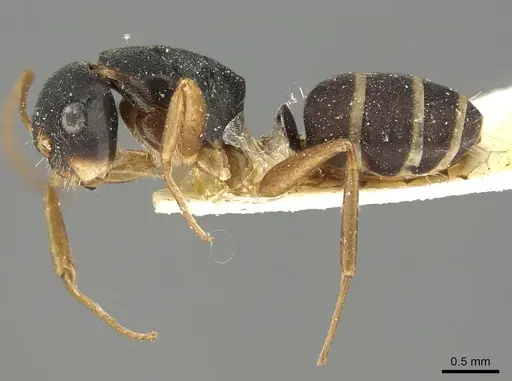
Camponotus conulus is a small Neotropical carpenter ant native to Colombia, with workers measuring 4.2-4.5mm . The workers are predominantly black and opaque with distinctive yellow markings on the mandibles, anterior borders of the cheeks, part of the clypeus, and borders of the frontal carinae . This species belongs to the subgenus Myrmobrachys and is closely related to Camponotus sphenoidalis, which is slightly larger - the two may potentially be the same species . Only the minor worker caste has been documented for this species .
Quick Summary
- Difficulty: Unknown, biology unstudied
- Origin & Habitat: Neotropical species from Colombia, with some records from Argentina and Paraguay. Specific habitat requirements are unknown due to limited collection data [2][3].
- Colony Type: Colony structure is unconfirmed. No documented information exists on queen number or colony organization.
- Size & Growth:
- Antkeeping:
- Temperature: Unconfirmed, no thermal studies exist. As a Neotropical species from Colombia, may prefer warm conditions. Start around 24-28°C and observe colony activity.
- Humidity: Unconfirmed. Based on Neotropical carpenter ant patterns, moderate humidity is likely appropriate. Provide a water source and allow the colony to self-regulate.
- Diapause: Unknown, no seasonal studies exist. Neotropical species may not require true hibernation.
- Nesting: In nature, Camponotus species typically nest in rotting wood, under bark, or in soil cavities. In captivity, a Y-tong (AAC) nest, plaster nest, or test tube setup works well. Provide damp substrate but avoid waterlogging.
- Behavior: Behavior is unstudied. As a Camponotus species, they are likely moderate foragers with typical carpenter ant behavior, not highly aggressive but will defend the nest. Their small size means escape prevention should be taken seriously, use fine mesh barriers.
- Common Issues: biology is completely unstudied, no care information exists in scientific literature, only minor workers are known, queen and major workers have never been described, colony may have specific requirements that are unknown due to lack of research, escape prevention is important due to small worker size, wild-caught colonies may carry unknown parasites or diseases
Species Identification and Taxonomy
Camponotus conulus was originally described by Gustav Mayr in 1870 from specimens collected in Colombia (then known as New Granada) [1]. The species belongs to the subgenus Myrmobrachys, a group of Neotropical carpenter ants [2]. Workers are small at 4.2-4.5mm and are predominantly black and opaque with distinctive yellow markings on the mandibles, anterior cheeks, clypeus, and frontal carinae [2][1]. The species is very similar to Camponotus sphenoidalis, which is slightly larger, and some researchers believe they may be the same species [2]. Only the minor worker caste has been documented, the queen and any major workers remain undescribed.
Distribution and Habitat
This species is known primarily from Colombia, with some older records mentioning Argentina and Paraguay [3][2]. The exact localities are unknown because the original type specimens were collected without specific location data [2]. As a Neotropical species, it likely inhabits tropical or subtropical environments. The lack of detailed collection data means we know nothing about its specific microhabitat preferences, nesting sites, or elevation range.
Current State of Knowledge
Camponotus conulus is one of the least studied ant species. Its biology is essentially unknown, we have no information on colony size, founding behavior, development timeline, diet preferences, temperature requirements, or seasonal activity patterns [2]. The only documented specimens are minor workers collected decades ago. This represents both a challenge and an opportunity for antkeepers: there is significant room for careful observation and documentation of captive behavior. Any successful colony husbandry would add valuable information to our understanding of this species.
Housing and Care Recommendations
Since specific care requirements are unknown, recommendations must be based on what works for related Neotropical Camponotus species. Use a test tube setup for founding colonies, transitioning to a Y-tong (AAC) or plaster nest as the colony grows. Maintain temperatures in the low-to-mid 20s Celsius and moderate humidity. Provide a constant water source and offer protein foods like small insects alongside sugar sources. Due to their small size, use fine mesh or fluon barriers to prevent escapes. Start with conservative conditions and adjust based on colony health and activity.
Potential for Antkeepers
While this species lacks documented care information, it may prove rewarding for experienced antkeepers interested in documenting new species behavior. The genus Camponotus is generally manageable in captivity, and this species' small size makes it suitable for compact setups. Keepers should document everything: founding behavior, development times, preferred foods, temperature preferences, and any unique behaviors. Such observations could contribute significantly to our knowledge of this poorly understood Neotropical ant.
Frequently Asked Questions
How do I care for Camponotus conulus ants?
Specific care is unconfirmed since this species has never been studied. Based on related Neotropical Camponotus, keep at 24-28°C with moderate humidity, provide protein and sugar sources, and use secure housing due to their small size.
What do Camponotus conulus ants eat?
Diet is unconfirmed. Based on typical Camponotus behavior, they likely accept small insects (protein) and sugar sources (honey or sugar water).
How long does it take for Camponotus conulus to develop from egg to worker?
Development timeline is unknown, this species has never been studied.
What temperature do Camponotus conulus ants need?
Temperature requirements are unconfirmed. As a Neotropical species from Colombia, they may prefer warm conditions around 24-28°C.
Are Camponotus conulus good for beginners?
This species is not recommended for beginners due to completely unstudied biology. There is no established care information, so keeping this ant successfully requires experience with related species and careful observation skills.
How big do Camponotus conulus colonies get?
Colony size is unknown, no colony data exists for this species.
Can I keep multiple Camponotus conulus queens together?
Colony structure is unconfirmed. No information exists on whether this species is single-queen or multi-queen. Until documented, it is not recommended to combine unrelated queens.
What size nest do Camponotus conulus need?
Specific nesting requirements are unknown. Use standard Camponotus housing, test tubes for founding, Y-tong or plaster nests for established colonies. Their small size means narrow passages work well.
Where is Camponotus conulus found?
This species is known from Colombia, with older records mentioning Argentina and Paraguay. Specific localities are unknown due to poor collection data.
Why is Camponotus conulus so rare in the antkeeping hobby?
This species is rarely kept because it has never been scientifically studied and no established care protocols exist. Only minor workers have ever been described, and the queen remains unknown.
Is Camponotus conulus a difficult species to keep?
Difficulty level cannot be determined, the species has never been kept successfully in captivity according to documented sources. The lack of any biological study makes it an experimental species for advanced antkeepers only.
Report an Issue
The current care sheet is based fully on literature. See inconsistencies, or something that's incorrect? Please , it will be resolved after review from an admin. Contributing to the blogs tab also helps providing information, to make us be able to further improve the caresheets. Thank you for your support!
References

Questa scheda di allevamento è concessa in licenza con CC BY-SA 4.0 .
Blog della comunità
CASENT0915790
Visualizza su AntWeb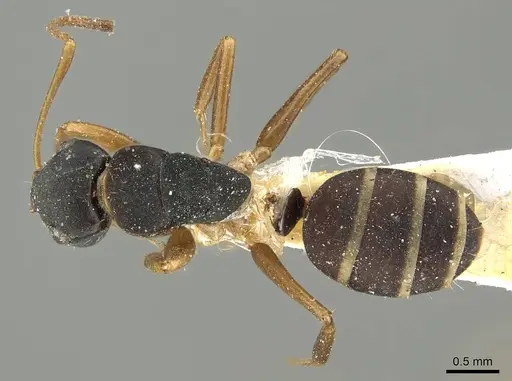
Letteratura
Caricamento mappa di distribuzione...Caricamento prodotti...