
Aenictus rixator
- Nom. sci.
- Aenictus rixator
- Sottofamiglia
- Dorylinae
- Autore
- Forel, 1901
- Distribuzione
- Trovata in 0 paesi
Introduzione
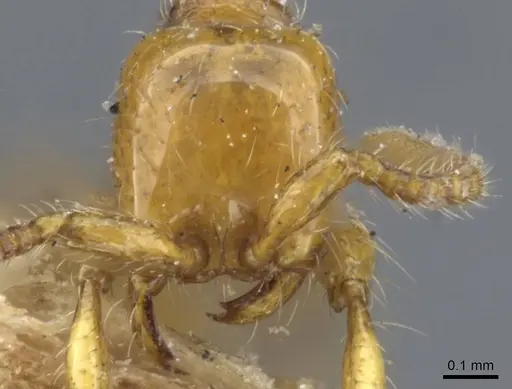
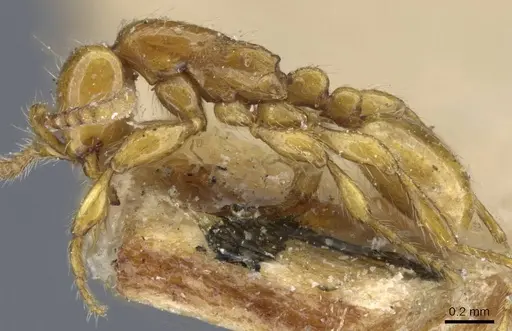
Aenictus rixator is a tiny army ant known only from a single worker collected in Natal, South Africa in 1915 . Workers are yellow to light brown with reddish coloring on the pronotum, featuring linear mandibles with three teeth and a clearly defined ridge on the propodeum . This species is one of the smallest Afrotropical Aenictus, though exact size measurements are not available . This ant remains essentially unknown to science. Only one worker has ever been found, meaning we have no information about queens, colonies, behavior, or any aspect of their biology . They belong to the army ant subfamily Dorylinae, but whether they share the nomadic raiding lifestyle typical of army ants is completely unconfirmed.
Quick Summary
- Difficulty: Expert
- Origin & Habitat: South Africa (Natal province). Known from a single specimen collected in July 1915 [1][2].
- Colony Type: Unknown. Only the worker caste has been described [2].
- Size & Growth:
- Antkeeping:
- Temperature: Unknown. Based on the subtropical climate of Natal, South Africa, they likely prefer warm conditions, but this is unconfirmed.
- Humidity: Unknown. Likely moderate to high based on the humid subtropical habitat in Natal, but unconfirmed.
- Diapause: Unknown
- Nesting: Unknown. Army ants typically form temporary bivouacs rather than permanent nests, but this is unconfirmed for this species.
- Behavior: Unknown. As a member of the army ant subfamily Dorylinae, they may be nomadic predators, but this is unconfirmed [2].
- Common Issues: species is known from a single specimen, captive keeping is impossible and unethical., no queen caste has been described, colony reproduction is a mystery., extreme rarity means any collection would be scientifically devastating., tiny size would require specialized equipment if keeping were possible.
Taxonomic Status and Extreme Rarity
Aenictus rixator is one of the least known ants in the world. Scientists have only ever found one individual, a worker collected in Natal, South Africa in July 1915 by R.C. Wroughton [1][2]. This single specimen, housed in the Natural History Museum of Geneva (MHNG), represents our entire knowledge of the species [1]. No living colonies have ever been observed, no queens have been described, and no behavioral studies exist [2]. For antkeepers, this means the species exists only as a scientific curiosity, not a candidate for captive keeping.
Morphology and Identification
The single known worker is tiny even by army ant standards. The head is slightly longer than wide, with short antennae that barely reach past the middle of the head [1]. The mandibles are long and linear with only three teeth, unlike related species that have more complex mandibles [1]. The body is yellow to light brown with reddish coloring on the pronotum, and the entire body appears smooth and glassy under magnification [1]. A distinct ridge runs across the propodeum [1]. If you encountered this ant in the wild, you would need a microscope to identify it properly.
Army Ant Biology (Inferred)
While we know nothing specific about Aenictus rixator, we can make educated guesses based on its subfamily. Aenictus belongs to Dorylinae, the true army ants [2]. Most army ants are nomadic and do not build permanent nests. Instead, they form temporary structures called bivouacs using their own bodies. They are typically specialized predators of other social insects like termites or other ants. However, these are merely guesses for Aenictus rixator. The species might break all the rules, we simply do not know.
Conservation and Ethics
You should not attempt to keep Aenictus rixator. With only one specimen known to science, any collection could represent the removal of the only existing individual or the destruction of the only known colony [2]. The species may be extinct, or it may be extremely rare and localized. If you are interested in keeping army ants, consider other Aenictus species with known biology and established captive protocols.
Frequently Asked Questions
Can I keep Aenictus rixator in captivity?
No. This species is known from a single specimen collected in 1915. No living colonies have ever been found, and keeping it would be scientifically unethical and likely impossible [2].
How big do Aenictus rixator colonies get?
Unknown. Scientists have only ever seen one worker, so colony size, structure, and population are complete mysteries [2].
What do Aenictus rixator eat?
Unknown. No dietary data exists for this species.
Do Aenictus rixator have a queen?
Unknown. Only the worker caste has been described. No queens or males are known [2].
How long does Aenictus rixator take from egg to worker?
Unknown. No biological data exists for this species [2].
Are Aenictus rixator dangerous?
Unknown, but unlikely given their extremely small size.
Can I buy Aenictus rixator?
No. This species is not available in the pet trade and should never be collected [2].
Report an Issue
The current care sheet is based fully on literature. See inconsistencies, or something that's incorrect? Please , it will be resolved after review from an admin. Contributing to the blogs tab also helps providing information, to make us be able to further improve the caresheets. Thank you for your support!
References

Questa scheda di allevamento è concessa in licenza con CC BY-SA 4.0 .
Blog della comunità
CASENT0907030
Visualizza su AntWeb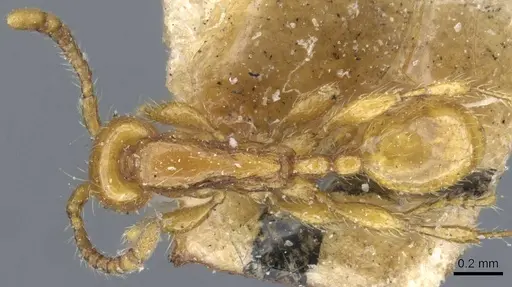
Letteratura
Caricamento mappa di distribuzione...Caricamento prodotti...