
Aenictus mauritanicus
- Nom. sci.
- Aenictus mauritanicus
- Sottofamiglia
- Dorylinae
- Autore
- Santschi, 1910
- Distribuzione
- Trovata in 0 paesi
Introduzione
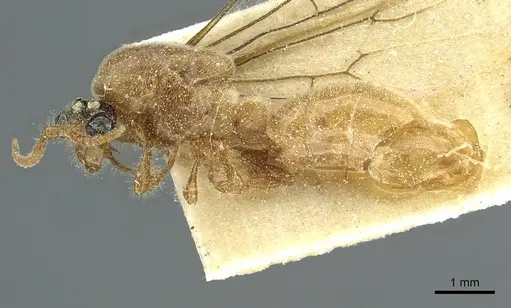
Aenictus mauritanicus is a rarely encountered army ant from the Atlantic edge of the Sahara Desert. Only the males have been formally described by scientists - they measure approximately 6.5mm and show a distinctive pattern of yellowish bodies with darker heads and two lengthwise stripes on the dorsal mesonotum . These ants were first collected in 1908 near Timamaten in Mauritania, with additional records from Morocco . As members of the Dorylinae subfamily (army ants), these ants likely share the nomadic, predatory lifestyle typical of Aenictus species. However, because nobody has described the workers or queens, every aspect of their basic biology - colony size, diet, behavior, and queen number - remains completely unknown . This makes them impossible to keep in captivity with current knowledge.
Quick Summary
- Difficulty: Expert
- Origin & Habitat: Atlantic coast of the Sahara (Mauritania) and Morocco [3][2].
- Colony Type: Unconfirmed, colony structure unknown.
- Size & Growth:
- Queen: Size data unavailable, queens have not been scientifically described.
- Worker: Size data unavailable, workers have not been described. Males measure approximately 6.5mm [1].
- Colony: Size data unavailable, likely large based on typical Aenictus patterns, but unconfirmed.
- Growth: Unknown.
- Development: Unknown, timeline unconfirmed. (Development timeline has never been documented for this species.)
- Antkeeping:
- Temperature: Unknown, collected in Saharan region suggests warm conditions, but specific requirements unconfirmed.
- Humidity: Unknown, likely prefers dry to moderate conditions given Saharan distribution, but specifics unconfirmed.
- Diapause: Unknown, likely not required given tropical/subtropical distribution, but unconfirmed.
- Nesting: Unknown, army ants typically form temporary bivouacs and do not build permanent nests.
- Behavior: Likely nomadic with intensive foraging based on army ant biology, but specific temperament unconfirmed. Escape risk unknown.
- Common Issues: complete lack of captive care data makes keeping them experimental and likely fatal for the colony., army ants require massive foraging spaces impossible to provide in standard formicaria., unknown dietary needs, likely specialized predators requiring specific prey not available commercially., unidentified environmental needs may cause sudden colony collapse.
Why This Species Is Not Suitable for Captivity
You should not attempt to keep Aenictus mauritanicus. Only the males of this species have ever been described by scientists, meaning we do not know what the workers or queens look like, how large the colonies grow, or what they eat [1]. Without this basic information, providing proper care is impossible.
Additionally, this is an army ant. Army ants live in massive colonies and do not stay in one place. They require enormous foraging areas and constant access to prey. Standard ant farms, test tubes, and formicaria cannot accommodate their biological needs. Any attempt to keep them will almost certainly result in the colony dying.
What the Type Specimens Tell Us
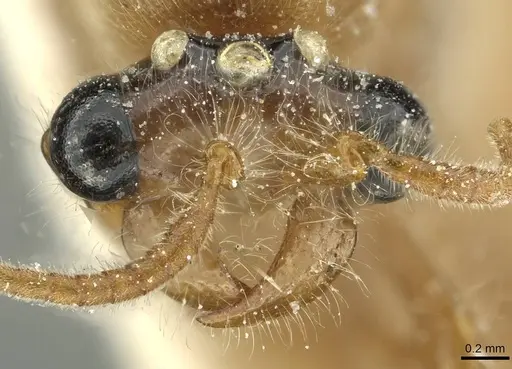
The only scientific description comes from specimens collected in 1908 at Timamaten on the Atlantic coast of the Sahara [2][1]. The males measure 6.5mm and have a testaceous (reddish-yellow) coloration with a lighter yellow gaster. Their heads are darker behind the ocelli, and they carry two distinct lengthwise stripes on the dorsal mesonotum [1].
The original specimens are stored in the Natural History Museum in Basel and the Museum of Natural History in Paris [2]. No one has collected and described the workers or queens since this initial discovery over a century ago, leaving the basic biology of this species completely unknown.
Army Ant Biology and Keeping Challenges
Aenictus mauritanicus belongs to the army ant group, which means they likely live like other Aenictus species. These are subterranean army ants that live in large colonies and move frequently. They do not build permanent nests like other ants. Instead, they form temporary bivouacs and emigrate regularly to new hunting grounds.
In captivity, this nomadic lifestyle creates impossible challenges. You cannot provide the square meters of foraging space they need. Their diet likely consists almost entirely of other ants or termites, which you cannot sustainably supply. They also require specific humidity and temperature gradients that we can only guess at for this species. [3]
Finding Aenictus mauritanicus in the Wild
If you want to observe these ants, you would need to travel to the Atlantic coastal regions of Mauritania or Morocco [3]. The type locality is Timamaten (also spelled Tinamaten) in Mauritania, collected near the Atlantic coast of the Sahara in 1908 [2][1].
Given the lack of recent records, they may be extremely rare, cryptic, or simply overlooked due to their subterranean habits. Army ants often emerge from the soil only during emigrations or raids, making them difficult to spot even where they are common. If you do encounter them in the field, observe them in their natural habitat rather than attempting collection.
Frequently Asked Questions
Can I keep Aenictus mauritanicus in a test tube?
No. Test tubes are completely unsuitable for this species. They are army ants that likely require massive foraging areas and specific prey. Only the males have been scientifically described, so we do not even know what the workers or queens need to survive [1].
How long until Aenictus mauritanicus gets its first workers?
Unknown. The development timeline for this species has never been documented.
What do Aenictus mauritanicus eat?
Unknown. As army ants, they likely prey on other ants, termites, or soil arthropods, but the specific diet of this species has never been documented.
How big do Aenictus mauritanicus colonies get?
Unknown. Army ants typically have thousands of workers, but the colony size for this specific species has never been documented [1].
Do Aenictus mauritanicus need hibernation?
Unknown. They come from the Saharan region which suggests they may not require hibernation, but this has never been confirmed.
Are Aenictus mauritanicus dangerous?
Unknown. While many army ants can bite, we do not know the defensive capabilities of this specific species. Given their small size (males are approximately 6.5mm), they are unlikely to be dangerous to humans, but they should not be handled [1].
What is the best nest for Aenictus mauritanicus?
There is no suitable captive nest for this species. Army ants do not use permanent nests and require huge foraging areas. No commercial or DIY formicarium can meet their biological needs.
Why are my Aenictus mauritanicus dying?
If you somehow obtained these ants and they are dying, this is expected. We do not know their temperature, humidity, dietary, or spatial requirements. They are not a species that can be kept alive with current antkeeping knowledge and equipment.
Can I keep multiple Aenictus mauritanicus queens together?
Unknown. The colony structure of this species has never been documented. Combining unrelated queens has never been studied and would likely result in fighting.
Are Aenictus mauritanicus good for beginners?
Absolutely not. They are unsuitable for keepers of any experience level because their basic biology is unknown. Only the males have been described by scientists [1]. Beginners should start with well-documented species like Lasius niger or Camponotus species.
Report an Issue
The current care sheet is based fully on literature. See inconsistencies, or something that's incorrect? Please , it will be resolved after review from an admin. Contributing to the blogs tab also helps providing information, to make us be able to further improve the caresheets. Thank you for your support!
References

Questa scheda di allevamento è concessa in licenza con CC BY-SA 4.0 .
Blog della comunità
CASENT0911434
Visualizza su AntWeb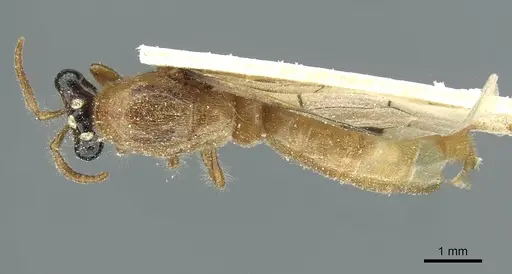
Letteratura
Caricamento mappa di distribuzione...Caricamento prodotti...