
Bigfoot Ant
Stigmatomma trigonignathum
- Nama Ilmiah
- Stigmatomma trigonignathum
- Tribe
- Amblyoponini
- Subfamili
- Amblyoponinae
- Penulis
- Brown, 1949
- Nama Umum
- Bigfoot Ant
- Distribusi
- Ditemukan di 0 negara
Pendahuluan
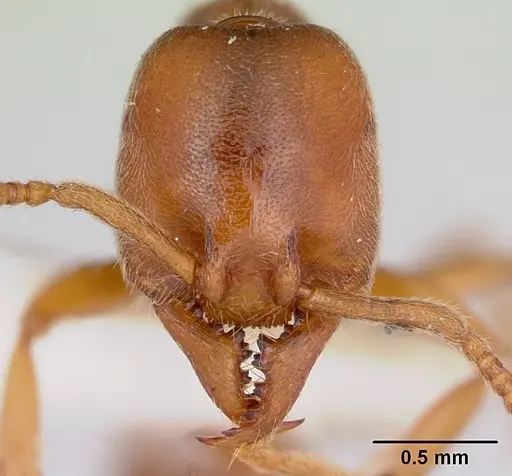
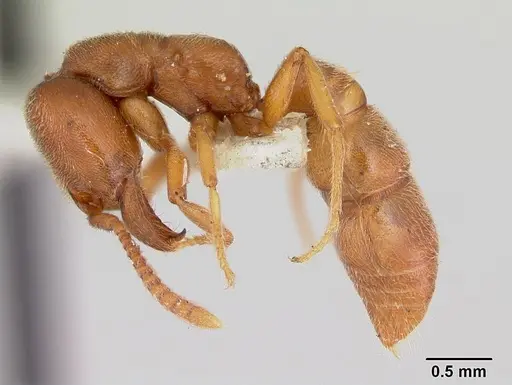
Stigmatomma trigonignathum is one of the rarest ant species in the world, known only from a handful of specimens collected in the Piedmont region of North Carolina. Workers are approximately 6mm long (holotype 6.12mm excluding sting) with unique mandibles that have two enlarged blunt teeth fused at their base - a feature not seen in any other North American ant . The head is slender with reduced "amblyoponine teeth" at the corners, and the body is a uniform rusty brown color. This species is distinguished from the only other eastern Stigmatomma (S. pallipes) by its triangulate basal mandibles and the double-tooth structure . What makes this species extraordinary is its extreme rarity - described from a single worker in 1948 and not seen again until 2008,when a second worker was found in Cary, North Carolina . That 60-year gap shows how little we know about this ant. As a member of the Amblyoponinae subfamily, it belongs to an ancient lineage sometimes called "Dracula ants" because some relatives feed on fluid from their own larvae.
Quick Summary
- Difficulty: Expert
- Origin & Habitat: Endemic to the Piedmont Plateau of North Carolina, USA. Workers have been collected from leaf litter and under rocks during cooler months (October and January) [3][4].
- Colony Type: Unknown, only worker specimens have been collected. No queens or males have been described. Related Amblyoponinae species typically have single-queen colonies, and some can reproduce through worker gamergates.
- Size & Growth:
- Queen: Unknown, queen has never been described [3]
- Worker: Approximately 6mm (holotype measured at 6.12mm excluding sting) [3]
- Colony: Unknown, only single workers have ever been collected
- Growth: Unknown
- Development: Unknown, no breeding colony has ever been documented (This species has never been kept in captivity. All development data is completely unknown.)
- Antkeeping:
- Temperature: Unknown, no captive data exists. Based on related Amblyoponinae and North Carolina climate, room temperature (20-24°C) is a reasonable starting point. Monitor colony activity for guidance.
- Humidity: Likely requires moderate to high humidity, similar to other Amblyoponinae, these are forest-floor ants that prefer damp conditions. Keep the nest substrate consistently moist but not waterlogged.
- Diapause: Likely, related temperate Amblyoponinae typically need a winter rest period. A 2-3 month diapause at 10-15°C is probably appropriate based on genus patterns.
- Nesting: No captive data exists. Wild workers have been found in leaf litter and under rocks, suggesting nests in humid, shaded soil or rotting wood. A naturalistic setup with moist substrate or a plaster nest with high humidity would be the best starting point.
- Behavior: No behavioral observations from captive colonies exist. Based on related Amblyoponinae species, these ants are likely predatory on small arthropods. Workers may be nocturnal or crepuscular foragers. Escape risk is moderate, workers around 6mm are not tiny but can still squeeze through small gaps.
- Common Issues: this species has never been kept in captivity, there is no established care protocol, only single workers have ever been found, colony structure and size are completely unknown, no queen has ever been described, making captive breeding essentially impossible, wild-caught specimens may have parasites that could kill them in captivity, the extreme rarity means virtually no hobbyist will ever encounter this species
Rarity and Collection History
Stigmatomma trigonignathum is one of the rarest ant species on the planet. The species was described in 1949 by Brown from a single worker collected by D.L. Wray in Concord, North Carolina [3]. For sixty years, no more specimens were found, leading some to wonder if the species had gone extinct or was just incredibly elusive.
In 2008,a second worker was discovered in Cary, Wake County, this rediscovery confirmed the species is still alive and appears to be endemic to the Piedmont region of North Carolina [4]. Both specimens were collected during cooler months (October and January), suggesting this species may be active mainly in winter or is easiest to find during cooler periods when workers forage on the surface [3].
With only two workers ever collected and no queens, males, or colonies ever documented, virtually nothing is known about its social structure, reproduction, or lifecycle.
Identification and Distinguishing Features
Identifying Stigmatomma trigonignathum requires close examination of the mandibles and clypeus. The most distinctive feature is the two enlarged blunt teeth at the basal/apical border of each mandible, these teeth are massive, double, and fused at their bases [1][2]. The basal half of each mandible forms an obtuse triangle, giving the head a unique profile from above.
The clypeus has small, regular teeth and an almost straight (not strongly convex) anterior margin [3]. The "amblyoponine teeth", the projections at the anterolateral corners of the head found in many Amblyoponinae, are reduced to small, bluntly rounded tubercles often hidden in dense hair [3].
This species can be told apart from the only other eastern Stigmatomma (S. pallipes) by: the triangulate basal half of mandibles, the small regular clypeal teeth, the almost straight clypeal margin, and the lack of conspicuous sharp projections at the outer bases of the mandibles [3]. The mandibles are also about twice as thick from top to bottom as in S. pallipes.
Related Species and Subfamily Context
Stigmatomma belongs to the Amblyoponinae subfamily, an ancient ant lineage sometimes called the "Dracula ants" because of a unique behavior seen in some related species: workers make small wounds in their own larvae and feed on the hemolymph (larval hemolymph feeding).
The genus Stigmatomma was resurrected in 2012 when molecular studies showed that the former subgenus Amblyopone (Stigmatomma) was actually a distinct lineage separate from Amblyopone [3]. This highlights how unusual these ants are, they represent an ancient split from other ant lineages.
Related species like Stigmatomma pallipes are more widespread in eastern North America and have been kept in captivity, providing some general guidance [3]. But S. trigonignathum appears to be a distinct species with unique features, so any care recommendations from relatives should be treated as educated guesses.
Why This Species Is Not Recommended for Keepers
It must be emphasized that Stigmatomma trigonignathum is NOT a species for antkeepers. Here's why:
First, no queen has ever been described. Without a queen, captive breeding is impossible. Any antkeeper hoping to start a colony would need a mated queen, but we don't even know what the queen looks like, let alone how to find or house her.
Second, only two workers have ever been collected in 70+ years of searching. This species is so rare that professional myrmecologists have only encountered it twice. The odds of collecting or buying this species are essentially zero.
Third, even if a colony were somehow found, we have no information about its care needs. Temperature, humidity, diet, nesting preferences, development time, all completely unknown. Any attempt to keep this species would be pure guesswork.
Finally, this species appears to have an extremely limited range and may be endangered. Collecting it would be ethically questionable.
For antkeepers interested in Amblyoponinae, much better options exist, Stigmatomma pallipes is more common and has documented care requirements, and other Amblyoponinae like Amblyopone species are more readily available [3].
Frequently Asked Questions
Can I keep Stigmatomma trigonignathum ants?
No. This species has never been kept in captivity and likely never will be. Only two workers have ever been collected in over 70 years, no queen, no males, no colonies. Even if a colony were somehow found, we have no information about its care requirements. The species is essentially unavailable to antkeepers.
What does Stigmatomma trigonignathum look like?
Workers are approximately 6mm long with distinctive features including triangulate basal mandibles with two massive blunt teeth fused at their base, small regular clypeal teeth, reduced "amblyoponine teeth" at the head corners, and a uniform rusty brown color. The mandibles are unusually thick compared to related species.
Where does Stigmatomma trigonignathum live?
This species is endemic to the Piedmont region of North Carolina, USA. It has been found only in Cumberland and Wake counties. Both specimens were collected from leaf litter or under rocks during cooler months (October and January).
How rare is Stigmatomma trigonignathum?
It is one of the rarest ant species in the world. Only two workers have ever been collected, one in 1948 (the type specimen) and another in 2008. That 60-year gap and the limited geographic range make it one of the most sought-after and mysterious ant species in North America.
Do Stigmatomma trigonignathum ants sting?
Amblyoponinae ants have functional stingers, so S. trigonignathum likely can sting. However, no sting observations have been documented from the extremely limited specimens. Related species in this subfamily can deliver painful stings.
What do Stigmatomma trigonignathum eat?
Unknown, no feeding observations exist. Based on related Amblyoponinae species, they are likely predatory on small arthropods. Some relatives have unusual feeding behaviors including larval hemolymph feeding, but this has not been documented for S. trigonignathum.
How big do Stigmatomma trigonignathum colonies get?
Unknown. Only single workers have ever been collected. Related Amblyoponinae species typically have small colonies, but we have no data for this specific species.
Can I find Stigmatomma trigonignathum in the wild?
Extremely unlikely. This species has been found only twice in over 70 years of ant collecting in North Carolina. Both specimens were collected during winter months (October and January) from leaf litter or under rocks. Even professional entomologists rarely encounter this species.
What is the difference between Stigmatomma and Amblyopone?
Stigmatomma was formerly a subgenus of Amblyopone but was elevated to genus rank in 2012 based on molecular studies. Both genera belong to the Amblyoponinae subfamily. Stigmatomma trigonignathum was originally described as Stigmatomma trigonignathum before being moved to Stigmatomma.
Are there similar ants I can keep instead?
Yes. Stigmatomma pallipes is the only other eastern Stigmatomma species and is much more common across eastern North America. It has documented care requirements and is occasionally available from ant sellers. Other Amblyoponinae like Amblyopone species are also better candidates for antkeepers.
Report an Issue
The current care sheet is based fully on literature. See inconsistencies, or something that's incorrect? Please , it will be resolved after review from an admin. Contributing to the blogs tab also helps providing information, to make us be able to further improve the caresheets. Thank you for your support!
References

Lembar perawatan ini dilisensikan di bawah CC BY-SA 4.0 .
Blog Komunitas
CASENT0172801
Lihat di AntWeb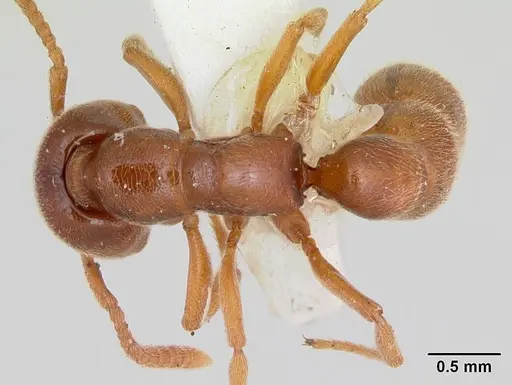
Literatur
Memuat peta distribusi...Memuat produk...