
Solenopsis andina
- Nama Ilmiah
- Solenopsis andina
- Tribe
- Solenopsidini
- Subfamili
- Myrmicinae
- Penulis
- Santschi, 1923
- Distribusi
- Ditemukan di 0 negara
Pendahuluan
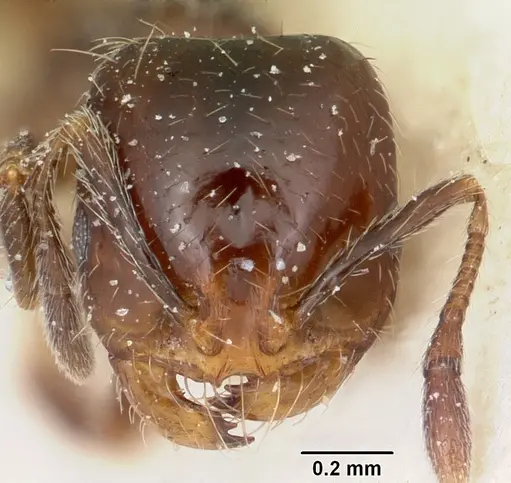
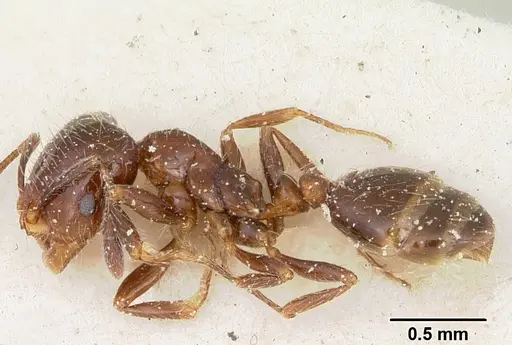
Solenopsis andina is a tiny thief ant belonging to the Solenopsis nigella species complex . Workers measure just 2.56-2.75 mm in total length, making them one of the smallest ant species you'll encounter . They are brown, have large eyes with 45-55 ommatidia, and a nearly square (quadrate) head that is only slightly longer than wide . The species was described by Santschi in 1923 and is known only from a handful of workers collected at 3700 m elevation in Jujuy, Argentina - one of the highest elevations ever recorded for a Solenopsis . This ant remains poorly studied: only the worker caste has ever been found; queens and males are still unknown . The high‑elevation Andean habitat hints at a preference for cool conditions. As a thief ant, it probably hunts small invertebrates and may raid the nests of other ant species, but its specific behavior in captivity is unconfirmed.
Quick Summary
- Difficulty: Expert
- Origin & Habitat: Known only from Cueva d'Iturbe in Jujuy, Argentina, at 3700 m in the high Andes [1][2]. Related specimens from Venezuela were collected in humid tropical forest at 650-1280 m elevation in forest litter [3].
- Colony Type: Colony structure is unconfirmed, only workers have been collected, and queens and males remain unknown [2]. Based on related Solenopsis, colonies are likely single‑queen, but this is speculative.
- Size & Growth:
- Queen: Unknown, queen caste has not been described [2]
- Worker: 2.56-2.75 mm total length [1][2]
- Colony: Unknown, no colony size data exists
- Growth: Unknown, no development data available
- Development: Unknown, but estimated 4-8 weeks based on similar small Solenopsis species (This estimate is entirely speculative. Related Solenopsis species typically develop from egg to worker in 4-8 weeks depending on temperature. No direct data exists for this species.)
- Antkeeping:
- Temperature: The 3700 m elevation suggests tolerance for cool conditions. Start around 18-22 °C and watch colony behavior. No specific thermal studies exist for this species [1].
- Humidity: No specific data, but related Venezuelan specimens were found in humid tropical forest litter [3]. Keep the nest substrate moderately moist but not waterlogged, aim for a damp substrate with some drier areas available.
- Diapause: Unknown, no seasonal data exists. The high‑elevation habitat likely stays cool year‑round. You could try a slight winter cooling period (around 15-18 °C) with reduced feeding, but this is speculative [1].
- Nesting: No specific nesting data exists. In captivity, small test tubes or Y‑tong (AAC) nests with narrow chambers work well for their tiny size. Provide moist substrate for brood care.
- Behavior: As a thief ant, it likely hunts small invertebrates and may raid other ant nests. Workers are under 3 mm, so escape prevention is critical, they can squeeze through very tiny gaps. Aggression level is unknown, but related Solenopsis can be defensive when threatened. Like other Myrmicinae in the tribe Solenopsidini, they possess a functional stinger.
- Common Issues: only a handful of specimens exist, captive colonies are extremely difficult to start because nuptial flights have never been observed, tiny size means escapes are very likely without fine mesh barriers and tight‑fitting lids, no captive husbandry information exists, this is an expert‑only species for experienced keepers willing to experiment, queen and male castes are unknown, so you cannot reliably obtain mated queens, the high‑elevation origin suggests unusual temperature requirements that differ from typical tropical ants
Species Identification and Background
Solenopsis andina is a member of the Solenopsis nigella species complex, a group of small thief ants from South America [1]. It was described by Santschi in 1923 from workers collected in Jujuy, Argentina, at 3700 m elevation, one of the highest altitudes ever recorded for a Solenopsis [1][2]. The type specimens remain the only known individuals, making it one of the rarest ants to study.
Workers measure just 2.56-2.75 mm in total length, placing them among the smaller ants you'll keep [1]. You can identify them by their brown colour, large eyes with 45-55 ommatidia, and a quadrate (square‑ish) head that is only slightly longer than wide. Distinctive features include vertical striae (grooves) in front of the eyes and a well‑developed subpeduncular tooth [1][2]. The closely related Solenopsis nigella and Solenopsis gensterblumi occur in the same general region, and with more collections they might turn out to be the same polymorphic species [1].
Distribution and Habitat
Solenopsis andina is known only from its type locality: Cueva d'Iturbe, Jujuy Province, Argentina, at 3700 m elevation in the high Andes [1][2]. This extreme elevation is unusual for Solenopsis, most species occur at much lower altitudes. Records from Venezuela at 650-1280 m in humid tropical forest [3] suggest the genus can tolerate a wide elevation range when suitable microhabitats exist.
In the wild, this species would experience cool, relatively stable conditions compared to lowland tropical ants. The high Andes have significant temperature drops at night and during winter, which may influence cold tolerance. Humidity is likely moderate to high given the forest litter collection methods used for related specimens [3]. For captive care, aim to replicate these cool, moderately humid conditions rather than typical tropical warmth.
Housing and Nest Setup
Because workers are under 3 mm [1], you need appropriately scaled housing. Use test tubes with small water reservoirs or Y‑tong (AAC) nests with narrow chambers and passages. The nest material should retain moisture well, plaster or AAC setups work better than wooden formicariums for maintaining humidity. Provide a small outworld for foraging since these are active hunters.
Escape prevention is critical due to their tiny size. Standard test‑tube cotton can be insufficient, use tight‑fitting stoppers and consider applying fluon to the rim. If you use a formicarium, seal all connections and cover any ventilation holes with fine mesh (at least 0.5 mm or smaller). Gaps that would not concern larger ants can let these escape artists slip through.
Feeding and Diet
As a thief ant, Solenopsis andina probably preys on small invertebrates and may raid the brood of other ant species. In captivity, offer small live prey such as fruit flies, pinhead crickets, and small mealworms. They may also accept protein gels or crushed insects. Sugar sources like honey water or sugar water are typically accepted by Solenopsis species, though this is unconfirmed for this species.
Feed small amounts every 2-3 days and remove any uneaten prey after 24 hours to prevent mold. Because of their tiny size, even portions that seem small to you may be excessive. Watch worker behavior, if they ignore food for extended periods, reduce portion sizes. Always provide fresh water.
Temperature and Seasonal Care
The 3700 m elevation of this species [1] suggests they prefer cooler conditions than most tropical ants. Start with temperatures in the 18-22 °C range and observe colony behavior. If workers cluster near heat sources, slightly increase temperature, if they avoid heated areas, reduce it. Avoid overheating, this species likely has limited heat tolerance.
No specific diapause requirements have been documented. However, the high‑elevation Andean habitat experiences seasonal temperature variation, so you might consider providing a cooler period during winter (around 15-18 °C) with reduced feeding. This is speculative but matches the natural history of high‑elevation species [1].
Challenges and Expert‑Only Status
Solenopsis andina is NOT a species for beginners. This is an expert‑only ant for several reasons: only a handful of workers have ever been collected, the queen and male castes remain undescribed [2], no captive husbandry information exists, and establishing a colony may be nearly impossible without access to wild‑caught founding queens (which requires field collection in Argentina).
Before attempting to keep this species, make sure you have extensive experience with other Solenopsis or small Myrmicinae. Be prepared to experiment with temperature and humidity and to document your observations. Consider this species a research project rather than a typical pet, your observations could contribute valuable knowledge. Do not purchase this species from sellers unless you can verify that they have legitimately collected founding queens, since the species is not commercially bred.
Frequently Asked Questions
How big do Solenopsis andina ants get?
Workers are tiny, just 2.56-2.75 mm total length [1]. That makes them one of the smallest ant species kept in captivity. The queen caste has not been described, so queen size is unknown.
Where is Solenopsis andina found in the wild?
It is known only from Cueva d'Iturbe in Jujuy, Argentina, at 3700 m elevation in the high Andes [1][2]. It is one of the highest‑elevation Solenopsis species ever recorded.
Can I keep Solenopsis andina as a pet ant?
No, this is not recommended for beginners. Solenopsis andina is an expert‑only species because only workers have ever been found, queens and males remain unknown, and no captive husbandry information exists [2]. Establishing a colony may require field collection in Argentina, and no commercial breeding operations exist.
What do Solenopsis andina ants eat?
As a thief ant, it probably preys on small invertebrates and may raid other ant colonies for brood. In captivity, offer small live prey like fruit flies, pinhead crickets, and small mealworms. It may accept sugar sources like honey water, though this is unconfirmed for this species.
What temperature do Solenopsis andina ants need?
No specific thermal studies exist, but their high‑elevation origin (3700 m) suggests they prefer cooler conditions than typical tropical ants. Start around 18-22 °C and adjust based on colony behaviour. Avoid overheating.
How long does it take for Solenopsis andina to develop from egg to worker?
No development timeline has been documented for this species. Based on similar small Solenopsis species, estimate 4-8 weeks from egg to first worker at optimal temperature. This is entirely speculative.
Are Solenopsis andina ants aggressive?
Aggression level is not documented. Related Solenopsis species can be defensive when threatened, and as a thief ant it may be predatory toward small invertebrates. Their tiny size means any aggression is scaled accordingly.
Can I find Solenopsis andina queens for sale?
Queens are not commercially available and are probably not bred in captivity. Only workers have ever been collected and described, the queen and male castes remain unknown to science [2]. Any seller claiming to have S. andina queens should be treated with extreme scepticism.
Do Solenopsis andina need hibernation?
No seasonal data exists. However, the high‑elevation Andean habitat experiences cooler temperatures year‑round with seasonal variation. You could try a slight winter cooling period (around 15-18 °C) with reduced feeding, though this is speculative [1].
What makes Solenopsis andina different from other Solenopsis?
This species is unique for being one of the highest‑elevation Solenopsis ever recorded, at 3700 m in the Argentine Andes [1]. It belongs to the Solenopsis nigella species complex and can be distinguished by its large eyes (45-55 ommatidia) and quadrate head shape [1][2]. Only a handful of worker specimens exist, making it one of the rarest ant species.
Is Solenopsis andina invasive anywhere?
No introduction records exist. It is known only from its type locality in the high Andes of Argentina [1][2]. Unlike some invasive Solenopsis relatives (e.g., the red imported fire ant Solenopsis invicta), there are no concerns about this species establishing outside its native range.
Report an Issue
The current care sheet is based fully on literature. See inconsistencies, or something that's incorrect? Please , it will be resolved after review from an admin. Contributing to the blogs tab also helps providing information, to make us be able to further improve the caresheets. Thank you for your support!
References

Lembar perawatan ini dilisensikan di bawah CC BY-SA 4.0 .
Blog Komunitas
CASENT0103212
Lihat di AntWeb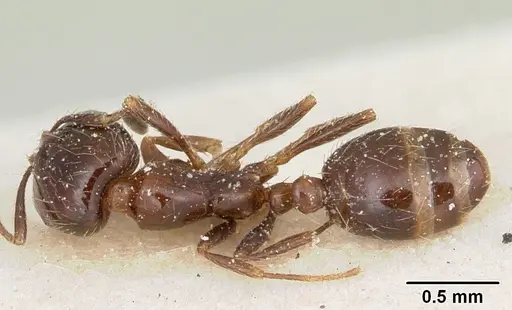
Literatur
Memuat peta distribusi...Memuat produk...