
Rhopalothrix amati
- Nama Ilmiah
- Rhopalothrix amati
- Tribe
- Attini
- Subfamili
- Myrmicinae
- Penulis
- Fiorentino <i>et al.</i>, 2022
- Distribusi
- Ditemukan di 0 negara
Pendahuluan
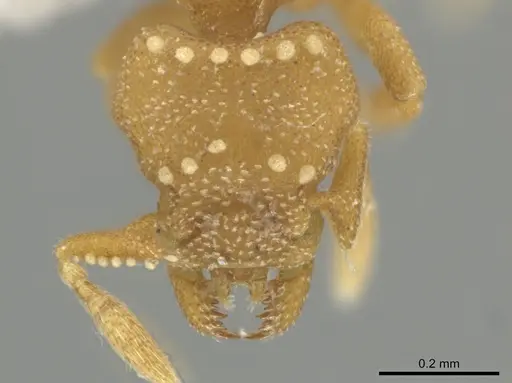
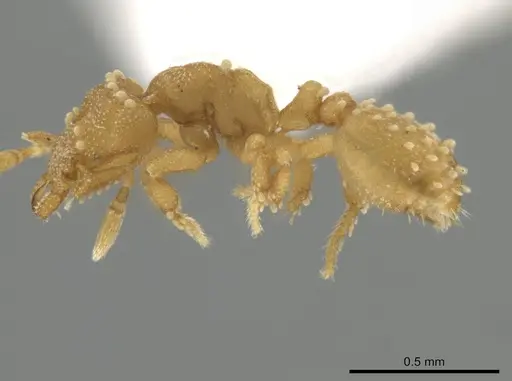
Rhopalothrix amati is an exceptionally rare tiny ant, one of the smallest in its genus, with workers measuring about 2-3 mm in total length . Originally described in 2022 as Eurhopalothrix amati, it was transferred to the genus Rhopalothrix in 2024 after re-examining its mandible structure . These ants have a striking appearance with 12 specialized pompon-like setae on their face arranged in two rows, minute eyes with only 3-4 fused ommatidia, and reduced propodeal spines that appear as broad translucent lamellae rather than acute spines . The entire body is densely covered in foveolate (pitted) sculpture, giving them a distinctive texture. They are named in honor of Germán Amat, a Colombian entomologist known for his work on scarabaeid beetles . This species is known only from the West Andes of Colombia at high elevations above 1800 m, where it lives in forest floor litter and rotting wood . As a member of the tribe Attini (fungus-growing ants), its exact dietary habits within this group are unclear, but related Rhopalothrix species are small leaf litter predators . The queen and male castes remain unknown, making captive breeding impossible .
Quick Summary
- Difficulty: Expert
- Origin & Habitat: West Andes of Colombia, high elevations 1800-1965 m in Risaralda, Caldas, and Antioquia departments. Found in both dry forest and second-growth wet forest habitats, living in forest floor litter and rotting wood [1][3][4].
- Colony Type: Unknown colony structure. Only 7 workers have ever been collected across 5 nearby localities. The queen caste has not been described [1].
- Size & Growth:
- Queen: Unknown, queen caste has not been described [1]
- Worker: ~2-3 mm total length, inferred from Rhopalothrix genus patterns [1][2]
- Colony: Unknown, only 7 workers ever collected [1]
- Growth: Unknown
- Development: Unknown, no breeding has been documented in captivity or in studies [1] (Development timeline unconfirmed. Based on related tiny leaf litter ants, development likely takes several months at optimal temperatures.)
- Antkeeping:
- Temperature: Likely prefers cool to moderate temperatures reflecting their high-elevation cloud forest origin. Based on similar Colombian litter ants, aim for 18-22°C. Avoid overheating, these ants come from environments that rarely exceed these temperatures [1].
- Humidity: Requires high humidity consistent with forest floor conditions. Keep substrate consistently moist but not waterlogged. They have been found in both dry and wet forest, so provide a humidity gradient with one moist area and allow drier spots [1].
- Diapause: Unknown, no studies on seasonal behavior. Given their high-elevation origin in the Andes, they likely experience cooler temperatures seasonally and may require a slight cool period. More research needed.
- Nesting: In nature, they live in forest floor litter and rotting wood. In captivity, a small test tube setup with fine substrate would be best. They are tiny and require very small chambers. Keep nesting material humid and provide a small water reservoir.
- Behavior: Behavior is unstudied in captivity. Based on related species, they are likely cryptic leaf litter foragers that move slowly and methodically through their environment. Their minute eyes suggest they rely more on chemical cues than vision. Escape prevention is critical due to their extremely small size, they can squeeze through the tiniest gaps. They possess a functional stinger, but their venom is not medically significant to humans (based on subfamily/tribe characteristics).
- Common Issues: Extremely rare in the hobby, virtually no captive colonies exist., Queen caste unknown, making colony founding impossible from wild-caught queens., Only 7 workers have ever been documented in scientific collections., Tiny size makes escape prevention extremely difficult., No established care protocols exist for this species., High-elevation cloud forest requirements may be difficult to replicate.
Discovery and Taxonomy
Rhopalothrix amati was first described in 2022 from workers collected in the West Andes of Colombia, originally placed in the genus Eurhopalothrix [1]. In 2024,Guerrero and colleagues transferred it to the genus Rhopalothrix after re-examining its mandible structure, which more closely matches Rhopalothrix species [3]. The misclassification occurred because the triangular shape of its mandible resembled Eurhopalothrix, but the actual tooth arrangement (7-10 teeth) and the subapical tooth being larger than the apical one are characteristic of Rhopalothrix [3]. The species was named to honor Germán Amat, a Colombian entomologist who contributed extensively to the study of Colombian insects [1].
Natural History
This is one of the rarest ant species in the world, known only from 7 workers collected across 5 nearby localities in Colombia [1]. All collections have occurred at elevations above 1800 m in the West Andes, specifically in Risaralda (El Otún Quimbaya, La Suiza), Caldas (Aranzazu), and Antioquia (Támesis) [1][3]. They inhabit both dry forest and second-growth wet forest, living in forest floor litter and rotting wood [1]. Researchers collected them using Winkler and Berlese extraction methods, which sift through leaf litter to extract tiny invertebrates [1]. The queen and male castes remain completely unknown, which is unusual for a described ant species and limits our understanding of their colony structure and biology [1].
Identification and Morphology
Rhopalothrix amati is the smallest known species in its genus, with workers measuring about 2-3 mm in total length [1][2]. The most distinctive features include 12 specialized spatulate (spoon-shaped) setae on the face arranged in two rows of 6,minute eyes with only 3-4 fused ommatidia, and reduced propodeal spines appearing as broad translucent lamellae rather than acute spines [1]. The mandible is triangular with a row of 7-10 teeth, and the subapical tooth is notably larger than the apical one [3]. The entire body is densely covered in foveolate (pitted) sculpture, and the specialized setae have a pompon-like appearance [1]. They are similar to Eurhopalothrix bruchi but can be distinguished by their triangular head shape (vs. bilobed in Eurhopalothrix bruchi), abundant specialized setae, and smaller size [1].
Keeping This Species
Rhopalothrix amati is not recommended for antkeepers. This species has never been kept in captivity and no established care protocols exist. The fundamental challenge is that the queen caste has never been described, meaning no wild queens can be collected to start colonies [1]. Additionally, their extreme rarity (only 7 workers ever documented) makes them a species of scientific importance rather than one for hobbyist keeping. If a colony were to become available through scientific channels, care would need to be extrapolated from related Rhopalothrix species: high humidity (moist but not waterlogged), cool temperatures (18-22°C), tiny foraging chambers, and likely small live prey items. These ants are part of the Rhopalothrix genus-group of small leaf litter predators that typically range 2-5 mm in total length [2]. For antkeepers interested in similar tiny ants, established species in the genus Strumigenys or Basiceros would be more suitable alternatives with known care requirements.
Frequently Asked Questions
Can I keep Rhopalothrix amati ants?
No, this species is not available in the antkeeping hobby and cannot be legally or practically kept. Only 7 workers have ever been documented in scientific literature, and the queen caste has never been described. There are no captive colonies in existence [1].
Where does Rhopalothrix amati live?
They are found only in the West Andes of Colombia at elevations above 1800 m, specifically in Risaralda, Caldas, and Antioquia departments. They live in forest floor litter and rotting wood in both dry forest and second-growth wet forest habitats [1][3].
How big are Rhopalothrix amati workers?
Tiny, workers have a total length of about 2-3 mm, making them one of the smallest species in their genus [1][2].
What do Rhopalothrix amati ants eat?
Their exact diet is unknown, but as members of the tribe Attini (fungus-growing ants), they likely have specialized dietary needs. Related Rhopalothrix species are small leaf litter predators [2]. The Attini tribe includes fungus growers, but Rhopalothrix is in a different subgroup and may be predatory on tiny invertebrates.
How many queens does Rhopalothrix amati have?
Unknown. The queen caste has never been described, so we have no information about their colony structure or whether they are single-queen (monogyne) or multi-queen (polygyne) [1].
Are Rhopalothrix amati good for beginners?
No. This species is completely unsuitable for beginners or even experienced antkeepers. No captive colonies exist, the queen is unknown, and they are among the rarest ants in the world with only 7 workers ever collected [1].
What temperature do Rhopalothrix amati ants need?
Based on their high-elevation cloud forest origin in the Colombian Andes, they likely prefer cool to moderate temperatures around 18-22°C. This is speculative since no captive observations exist [1].
Why is Rhopalothrix amati so rare?
This species was only described in 2022 and has been collected exactly 7 times across 5 nearby localities. They live in tiny microhabitats within forest floor litter that are difficult to sample, and their extremely small size makes them hard to detect. Additionally, their geographic range is limited to high elevations in one region of Colombia [1].
Can I find Rhopalothrix amati in the wild?
Extremely unlikely. They have only been found in specific protected areas in the West Andes of Colombia (El Otún Quimbaya and surrounding areas) using specialized extraction methods (Winkler and Berlese traps) by researchers. The species is of scientific importance and should not be collected [1][3].
Report an Issue
The current care sheet is based fully on literature. See inconsistencies, or something that's incorrect? Please , it will be resolved after review from an admin. Contributing to the blogs tab also helps providing information, to make us be able to further improve the caresheets. Thank you for your support!
References

Lembar perawatan ini dilisensikan di bawah CC BY-SA 4.0 .
Blog Komunitas
IAVH55005
Lihat di AntWeb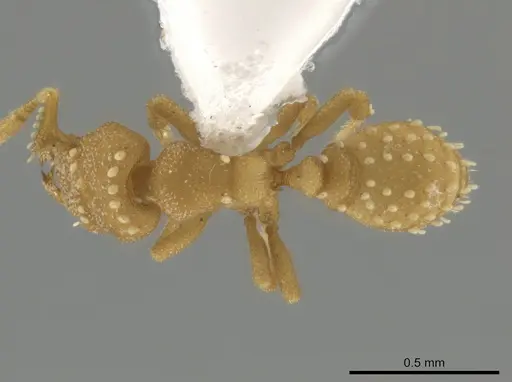
Literatur
Memuat peta distribusi...Memuat produk...