
Protanilla flamma
- Nama Ilmiah
- Protanilla flamma
- Tribe
- Leptanillini
- Subfamili
- Leptanillinae
- Penulis
- Baidya & Bagchi, 2020
- Distribusi
- Ditemukan di 0 negara
Pendahuluan
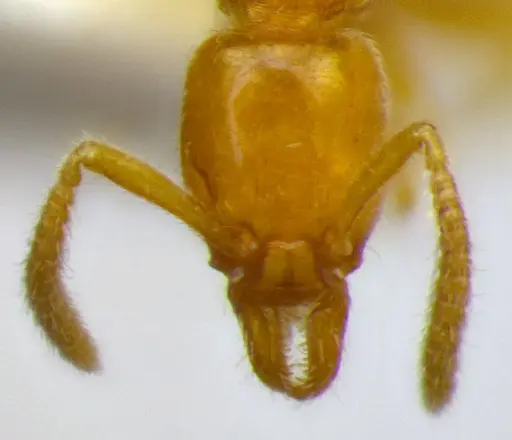
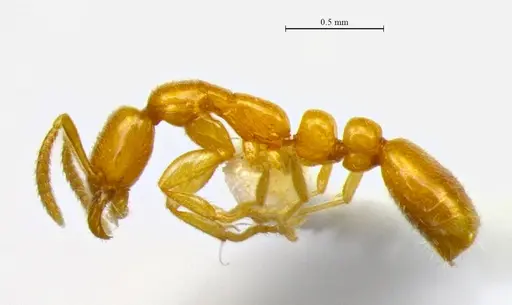
Protanilla flamma is an extremely rare ant species recently described from the Western Ghats of Goa, India. These are tiny ants, workers measuring just 2.45-2.5mm in total length, with a bright yellow and shiny body . They belong to the Leptanillinae subfamily, a group of cryptic subterranean ants that are rarely encountered. The most striking feature is their complete lack of eyes - these ants are blind, navigating and hunting entirely through touch and chemical senses . Their mandibles have around 10 peg-like teeth designed for seizing small prey . Only two specimens have ever been collected, making this one of the rarest ants in the world to keep. They are predatory, solitary foragers that hunt beneath the soil surface .
Quick Summary
- Difficulty: Expert
- Origin & Habitat: Netravali Wildlife Sanctuary, Goa, India (Western Ghats foothills) at 445m elevation. Found in moist-deciduous forest with thick canopy, in wet soil 2-3cm below the surface during post-monsoon season [1][3].
- Colony Type: Unknown, only two specimens have ever been collected. No data on colony structure exists.
- Size & Growth:
- Antkeeping:
- Temperature: Keep warm, roughly 24-28°C, based on their tropical habitat [1].
- Humidity: Keep substrate consistently moist but not waterlogged, as they live in wet forest soil [1].
- Diapause: Unknown, likely no diapause due to tropical origin, but no data exists.
- Nesting: Nesting preferences are unknown, but small chambers in Y-tong or plaster nests may be suitable for these tiny ants. Keep the nest dark and humid.
- Behavior: These ants are completely blind and rely on chemical and tactile cues. They are solitary foragers, hunting individually rather than in groups [2]. As small-bodied specialist predators, they likely hunt micro-arthropods in the soil [2]. Their sting is well-developed [1]. They are extremely cryptic and will spend most of their time hidden in the nest or moving through substrate tunnels. Escape risk is moderate, their small size means they can slip through small gaps, but they are not strong climbers.
- Common Issues: only two specimens have ever been collected, wild colonies are virtually impossible to obtain., completely blind ants are extremely sensitive to light and vibration, keep nesting area dark and quiet., solitary foraging means they may have low prey capture success, requires constant availability of tiny live prey., no data on founding behavior makes colony establishment extremely challenging., dry conditions quickly fatal, they require consistently moist substrate.
Discovery and Rarity
Protanilla flamma was only described in 2020,making it one of the newest ant species to science. The entire known distribution consists of just two workers collected from Netravali Wildlife Sanctuary in Goa, India [1]. This represents only the 13th valid species in the genus Protanilla worldwide and only the second record of this genus from India [1]. The species name 'flamma' (meaning flame in Latin) was chosen because the ant's bright yellow color resembles the glow of a flame, and it was named in honor of a professor whose name means 'eminence like the glow of a flame' in Sanskrit [1]. For antkeepers, this means that obtaining a colony will be extraordinarily difficult, these ants are not available from any commercial source and would require specialized collecting trips to their tiny known range.
Identification and Morphology
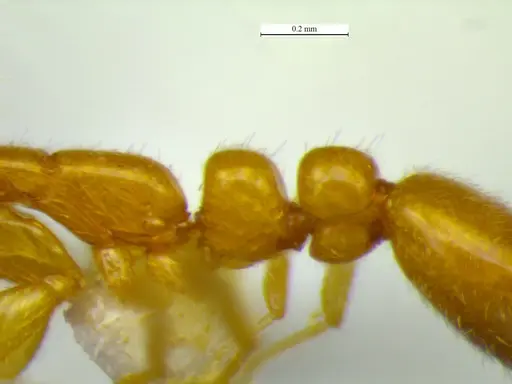
These are tiny ants, workers measuring just 2.5mm in total length [1]. Their most distinctive feature is the complete absence of eyes, they are completely blind [1]. The body is uniformly bright yellow and shiny [1]. The head is longer than broad with prominent antero-lateral corners, and the posterior margin is gently concave [1]. The mandibles are elongated and strongly down-curved at the tip, with approximately 10 peg-like teeth along the masticatory margin [1]. The antennae have 12 segments, and the scape is notably short and does not exceed the posterior margin of the head, this is a key identification feature that distinguishes them from similar species like Protanilla lini [1][4]. They have a well-developed sting [1]. The petiole and post-petiole nodes are roughly comparable in size, and the gaster is oval and constricted anteriorly [1].
Natural History
Protanilla flamma is behaviorally cryptic, solitary-foraging, and predatory [2]. They belong to Functional Group 2: small-bodied specialist predators that are subterranean nesters [2]. The only specimens were collected by disturbing the top 2-3 cm of soil in a moist-deciduous forest during the post-monsoon season [1]. The forest floor was still wet from recent monsoons, and the collection site had a thick forest canopy [1]. They were found at an elevation of 445m above sea level [1]. The area coordinates are approximately 15.599° N,74.240° E [1]. This habitat information suggests they prefer stable, humid conditions underground in shaded forest environments. Their blindness indicates a fully subterranean lifestyle where light is irrelevant.
Housing and Nesting
Nesting preferences are unknown for this species, but for tiny subterranean ants, small chambers in Y-tong or plaster nests are commonly used. Keep the nest area dark and humid to mimic their natural soil environment. Because they are solitary foragers, they need space to hunt individually, so a foraging area with a thin layer of moist soil or substrate is beneficial. Escape prevention should be moderate, while small, they are not particularly strong climbers and standard barriers should suffice.
Feeding and Diet
As small-bodied specialist predators, these ants hunt and consume small invertebrates. Their mandibles with peg-like teeth are designed for seizing small, soft-bodied prey [1]. In captivity, offer tiny live prey such as springtails, small mites, fruit fly larvae, and other micro-arthropods. Because they are solitary foragers, each ant must be able to find prey independently, this means prey must be constantly available in the foraging area. They likely do not consume nectar or honeydew to any significant degree, as this is not typical for Leptanillinae. Do not offer sugar water or honey, their diet appears strictly predatory. Feed small prey items every 2-3 days, adjusting based on consumption rates. Remove any uneaten prey to prevent mold.
Temperature and Environmental Conditions
Keep them warm, roughly 24-28°C, based on their tropical habitat [1]. A slight temperature gradient allowing cooler areas is advisable so the ants can self-regulate. Heating should be gentle, a heating cable on one side of the nest, placed on top to warm rather than dry, works well. High humidity is critical, their natural habitat is a moist-deciduous forest with wet soil from recent monsoons. Keep the substrate consistently damp. There is no data on diapause requirements, and given their tropical origin, they likely do not require a winter rest period. They may reduce activity during dry seasons in the wild.
Frequently Asked Questions
How rare is Protanilla flamma?
Extremely rare, only two worker specimens have ever been collected, both from a single location in Goa, India. This is one of the rarest ant species in the world to keep, and colonies are not available from any commercial source.
What do Protanilla flamma ants eat?
They are predatory ants that hunt small invertebrates. In captivity, feed tiny live prey like springtails, small mites, and fruit fly larvae. They do not typically consume sugar sources. Their solitary foraging behavior means prey must be constantly available.
Do Protanilla flamma ants have eyes?
No, they are completely blind with no eyes at all. This is typical for subterranean Leptanillinae ants. They navigate using chemical and tactile senses instead of vision.
How big do Protanilla flamma colonies get?
Unknown, only two workers have ever been documented. Based on related species in the genus, colonies are likely small, possibly under 100 workers. Their subterranean, solitary-foraging lifestyle suggests they do not form large colonies.
What temperature do Protanilla flamma ants need?
Keep them at roughly 24-28°C, based on their tropical habitat. A gentle temperature gradient allowing cooler areas is advisable.
Are Protanilla flamma good for beginners?
No, this species is absolutely not suitable for beginners. They are one of the rarest ants in the world with virtually no available care information. Only two specimens have ever been collected, and no colony has ever been established in captivity. This species is for expert antkeepers with specialized knowledge and access to wild-caught specimens.
What is the best nest type for Protanilla flamma?
Nesting preferences are unknown, but small chambers in Y-tong or plaster nests may be suitable for these tiny ants. Keep the nest dark and humid.
Do Protanilla flamma ants sting?
Yes, they have a well-developed sting [1]. However, given their tiny size, the sting is unlikely to penetrate human skin or cause any pain to humans.
How long does it take for Protanilla flamma to develop from egg to worker?
Unknown, no data exists on their development timeline.
Can I keep multiple queens together?
Unknown, no data exists on their colony structure. Only two workers have ever been documented, and no queen has ever been described. Do not attempt combining unrelated queens without evidence they can coexist.
Report an Issue
The current care sheet is based fully on literature. See inconsistencies, or something that's incorrect? Please , it will be resolved after review from an admin. Contributing to the blogs tab also helps providing information, to make us be able to further improve the caresheets. Thank you for your support!
References

Lembar perawatan ini dilisensikan di bawah CC BY-SA 4.0 .
Blog Komunitas
CESM-198516
Lihat di AntWeb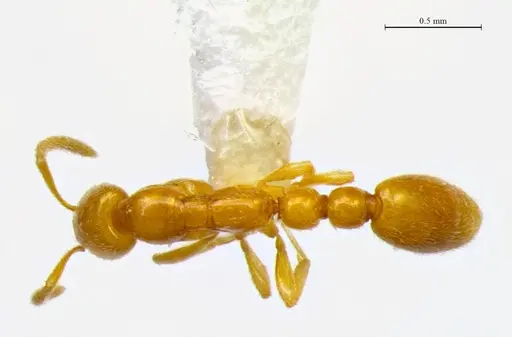
Literatur
Memuat peta distribusi...Memuat produk...