
Parasyscia fossulata
- Nama Ilmiah
- Parasyscia fossulata
- Subfamili
- Dorylinae
- Penulis
- Forel, 1895
- Distribusi
- Ditemukan di 0 negara
Pendahuluan
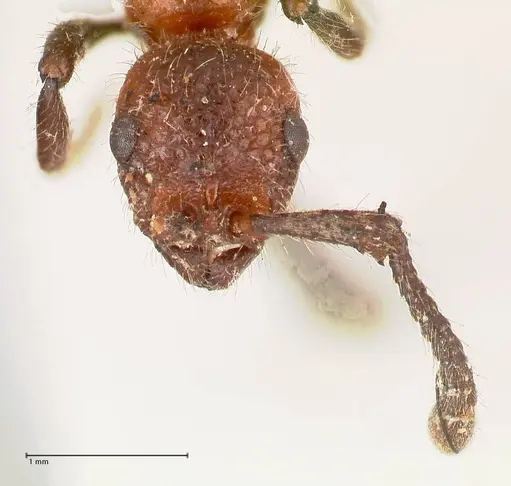
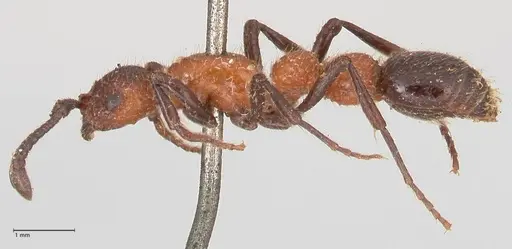
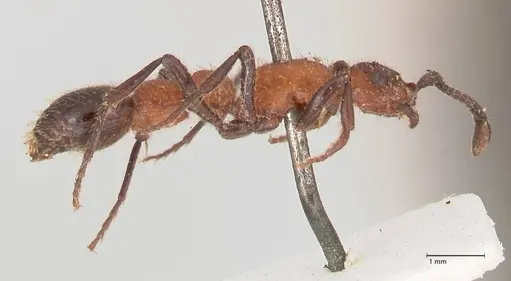
Parasyscia fossulata is a small, shiny ant species originally described from Sri Lanka . Workers measure 6.8-7 mm and have 11-segmented antennae and large, prominent eyes . The body is covered with large, round, shallow pits (fossettes) and is reddish-brown to yellowish, with a bicolored abdomen . This species is Critically Endangered in Sri Lanka's wet zone primary forests . This ant is a habitat specialist restricted to primary forest and has never been found in secondary forest or rubber plantations . Previous records from China and Myanmar were misidentified and belong to other species . Due to its endangered status, keeping this species requires ethical considerations and should only be done by experienced keepers .
Quick Summary
- Difficulty: Expert
- Origin & Habitat: Sri Lanka wet zone primary forest, critically endangered, habitat specialist [7][5][4]
- Colony Type: Unconfirmed
- Size & Growth:
- Antkeeping:
- Temperature: Temperature needs are unclear, start around 24-28°C and observe, based on tropical habitat.
- Humidity: Keep nest substrate consistently moist but not waterlogged, similar to wet zone forest conditions.
- Diapause: Unknown, Sri Lanka has no true winter, but diapause is not confirmed.
- Nesting: Prefer naturalistic setups with moist substrate. Y-tong or plaster nests with consistent moisture are suitable.
- Behavior: Behavior is poorly documented. As a Dorylinae member, they are likely predatory on small invertebrates. Escape prevention is important due to their 7 mm size. Temperament is unknown.
- Common Issues: Critically endangered status means wild collection is unethical and potentially illegal, captive colonies are extremely rare [4]., Habitat specialist requires primary forest conditions that are difficult to replicate [5]., No established captive breeding protocols exist, this is not a species for beginners., Very limited availability means most keepers cannot obtain this species ethically., Unknown specific humidity and temperature requirements make care challenging.
Conservation Status and Ethical Considerations
Parasyscia fossulata is listed as Critically Endangered (CR) under Sri Lanka's National Red List with criteria B2ab(iii) [4]. This means the species faces an extremely high risk of extinction in the wild. The primary threats are habitat loss through deforestation, this ant is a strict primary forest specialist that has never been found in secondary growth or agricultural areas [5].
Because of this conservation status, keeping Parasyscia fossulata carries significant ethical responsibilities. Wild collection should be avoided, these ants should only be kept by experienced breeders working with captive-propagated colonies. If you encounter this species for sale, verify that the seller has propagated it ethically rather than harvesting from the wild. Supporting captive breeding helps conserve this species rather than contributing to its decline.
Natural History and Distribution
Parasyscia fossulata was originally described from Sri Lanka (then Ceylon) by Forel in 1895 [1]. It is endemic to Sri Lanka's wet zone, meaning it is found only in the southwestern region of the island where rainfall is highest [7]. The species was also historically reported from China (Yunnan and Tibet) and Myanmar, but recent taxonomic revisions have shown these specimens were misidentified, they belong to other species, primarily Syscia guizhouensis [3][6].
This ant is a habitat specialist, it lives only in primary (old-growth) forest. Studies in Xishuangbanna, China found it occupied only 4 regions in primary forest and was completely absent from secondary forest or rubber plantations [5]. This extreme habitat specialization makes the species particularly vulnerable to deforestation and habitat fragmentation.
Identification and Morphology
Workers of Parasyscia fossulata measure 6.8-7 mm in length, making them a medium-sized ant [1]. The most distinctive features are the 11-segmented antennae and the large, prominent eyes positioned toward the middle of each side of the head [2][3]. The eyes are notably protruding, their maximum diameter is more than twice the width of the basal funicular segment [3].
The body surface is entirely shiny and covered with large, round, shallow pits called fossettes that appear as if cut with a hole punch [1]. The body coloration is reddish-brown to yellowish, with the legs and antennae being dark brown. The abdomen shows a bicolored pattern, the segments are black except for yellowish borders [1][3]. The petiole is cubical-rounded, and the metanotum has a distinctive half-circle ridge [1].
Housing and Nesting
Since no specific housing data exists for Parasyscia fossulata, based on general Dorylinae knowledge, provide a naturalistic setup with moist substrate. Use Y-tong or plaster nests with consistent moisture to mimic forest floor conditions. Maintain high humidity, but avoid waterlogging. Escape prevention is important due to their 7 mm size, standard barriers and fine mesh on ventilation holes are recommended.
Feeding and Diet
No feeding studies exist for this species. Based on Dorylinae classification, they are likely predatory on small invertebrates. Offer live prey such as springtails and fruit flies. Sugar sources are unlikely to be accepted. Remove uneaten prey after 24-48 hours to prevent mold.
Temperature and Seasonal Care
Based on tropical Sri Lankan habitat, maintain temperatures around 24-28°C. Avoid temperatures below 20°C. No diapause is required, but activity may reduce during dry seasons. A temperature gradient can be provided using a heating cable on one side of the nest.
Frequently Asked Questions
Is Parasyscia fossulata a good ant for beginners?
No. This species is absolutely not recommended for beginners. It is critically endangered in the wild, requires specific primary forest conditions that are difficult to replicate, and almost no captive breeding information exists. This is an expert-only species that should only be kept by experienced antkeepers committed to conservation [4].
Where does Parasyscia fossulata come from?
This species is endemic to Sri Lanka's wet zone, the southwestern region of the island [7]. It was previously reported from China and Myanmar, but these records were misidentified [3]. It is found only in primary (old-growth) forest and never in secondary growth or plantations [5].
How big do Parasyscia fossulata workers get?
Workers measure 6.8-7 mm in length [1]. They have distinctive large, prominent eyes and 11-segmented antennae. The body is shiny with a pitted texture from large round fossettes.
What do Parasyscia fossulata eat?
Based on their Dorylinae classification, they are likely predatory on small invertebrates. Offer live springtails, fruit flies, and small insects. Sugar sources are unlikely to be accepted. This is speculative as no feeding studies exist for this species.
What temperature do Parasyscia fossulata need?
Based on their tropical Sri Lankan habitat, aim for 24-28°C. Avoid temperatures below 20°C. A gentle temperature gradient allows the colony to self-regulate.
Do Parasyscia fossulata need hibernation?
No. Sri Lanka has no winter, so this species likely does not require a diapause period. You may see reduced activity during dry seasons, but this is not true hibernation.
Can I keep multiple queens together?
This has not been studied. Colony structure is unconfirmed for this species. Based on typical Dorylinae patterns, they likely have single-queen colonies, but this is uncertain. Do not attempt combining unrelated queens.
Why is Parasyscia fossulata so rare in captivity?
The species is critically endangered and restricted to primary forest habitats [4]. Wild collection is unethical and potentially illegal. Additionally, the specific conditions needed make captive breeding extremely difficult. Captive colonies are virtually nonexistent in the antkeeping hobby [5].
How long does it take for Parasyscia fossulata to develop from egg to worker?
This is unknown, no development studies exist for this species. Based on typical Dorylinae development patterns, estimate 6-10 weeks from egg to first worker at optimal temperature. This is a rough guess, not a confirmed timeline.
Report an Issue
The current care sheet is based fully on literature. See inconsistencies, or something that's incorrect? Please , it will be resolved after review from an admin. Contributing to the blogs tab also helps providing information, to make us be able to further improve the caresheets. Thank you for your support!
References

Lembar perawatan ini dilisensikan di bawah CC BY-SA 4.0 .
Blog Komunitas
FOCOL0797
Lihat di AntWeb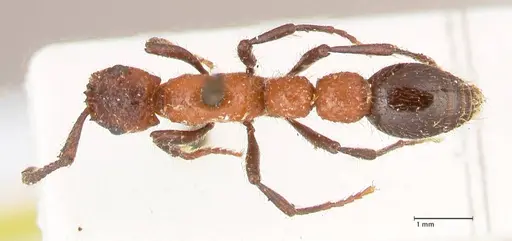
Literatur
Memuat peta distribusi...Memuat produk...