
Myrmecia apicalis
- Nama Ilmiah
- Myrmecia apicalis
- Tribe
- Myrmeciini
- Subfamili
- Myrmeciinae
- Penulis
- Emery, 1883
- Distribusi
- Ditemukan di 0 negara
Pendahuluan
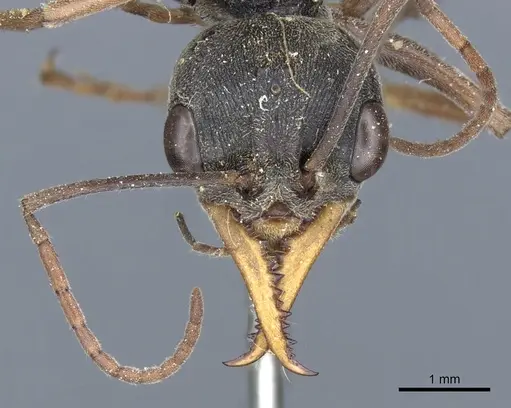
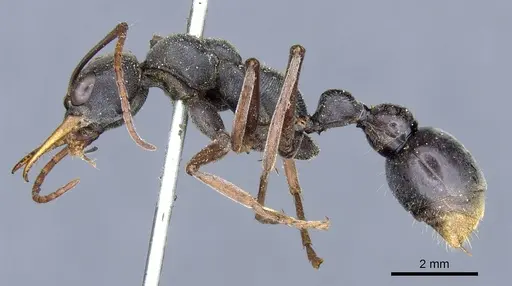
Myrmecia apicalis is a rare bulldog ant endemic to New Caledonia, making it the only extant Myrmecia species found outside Australia . Workers are large at 13mm, with a black body, yellow mandibles and labrum, ferruginous antennae and legs, and yellowish apical abdominal segments . This species diverged from its Australian relatives during the Miocene around 14 million years ago after dispersing across 1,300km of ocean from Australia to New Caledonia . It has been proposed as its own monotypic species group due to its distinct evolutionary position . This ant forages on the ground and in vegetation, including climbing small trees, and returns to its nest at dusk . It is predatory, with documented foraging on caterpillars . The species nests in soil at the base of small trees . Only a handful of specimens have ever been collected, making this one of the rarest Myrmecia species. Its rarity is typical for Myrmecia species living in heavily timbered country, where many species are known from only single specimens found at long intervals .
Quick Summary
- Difficulty: Expert
- Origin & Habitat: Endemic to New Caledonia, specifically found on the Isle of Pines and the main island. Inhabits tropical forest environments, nesting in soil at the base of small trees [1][2].
- Colony Type: Unknown colony structure. Only worker specimens have been collected, no queens or reproductive castes have been documented [2].
- Size & Growth:
- Antkeeping:
- Temperature: Likely 24-28°C based on New Caledonia's tropical climate. Provide a warm area around 26°C with a slight gradient.
- Humidity: Moderate to high, forest floor conditions. Keep substrate moist but not waterlogged.
- Diapause: Unlikely, New Caledonia is tropical with no cold winter. No diapause data exists for this species.
- Nesting: Soil-nesting species. Provide a naturalistic setup with soil substrate or a plaster nest with soil chambers. Nests at base of small trees in nature, so include plants or vertical elements in the outworld.
- Behavior: Active foragers that hunt prey including caterpillars both on the ground and in vegetation [2]. They return to the nest at dusk [2]. As a Myrmecia species, they likely have decent vision and may exhibit typical bulldog ant alertness and defensive behavior. Escape prevention is important given their larger size, standard formicarium barriers should suffice. Their sting is likely potent like other Myrmecia species, though this species has not been specifically documented stinging.
- Common Issues: extreme rarity means virtually no captive husbandry information exists, this is a species for advanced keepers only, no documented colony founding or queen behavior exists, captive breeding may be impossible without wild-caught colonies, only known from a handful of specimens in over a century of collecting, availability is extremely limited, no development or growth data exists, keepers must experiment with conditions, wild-caught colonies may have parasites or disease with no established treatment protocols
Rarity and Collection History
Myrmecia apicalis is one of the rarest ants in the world, known from only two collections spanning over a century. The original type specimens were collected many years ago when the species was first described by Emery in 1883. The species was then recollected on the Isle of Pines (a small island southeast of New Caledonia's main island) in 2011,confirming it as a genuine native rather than a mislabeled Australian specimen [1][2]. Dr. Emery himself expressed doubt about whether the species had truly been captured in New Caledonia, as Myrmecia is typically an Australian genus. However, its rediscovery on the Isle of Pines and its absence from nearby Australia confirm it as a true New Caledonian endemic [2]. This level of rarity is not unusual for Myrmecia species living in heavily timbered country, where single specimens of several species have been found at long intervals [2].
Phylogenetic Significance
This species holds special evolutionary significance as the only extant Myrmecia species occurring outside Australia [1]. Phylogenomic analysis has revealed that M. apicalis diverged from its Australian relatives during the Miocene approximately 14 million years ago (95% HPD: 9-18 Ma), likely through long-distance dispersal across the 1,300km ocean gap between Australia and New Caledonia [1]. Previously, it was considered part of the pilosula species group, but genetic analysis showed this grouping to be polyphyletic (artificial). The species is now proposed to belong to its own monotypic apicalis species group to reflect its unique phylogenetic position and origin [1]. It serves as sister to a diverse clade containing members of several other species groups, making it important for understanding Myrmecia evolution [1].
Natural History and Foraging
In its natural habitat, Myrmecia apicalis is an active forager that hunts both on the ground and in vegetation, including climbing small trees [2]. Unlike some bulldog ants that are strictly ground-foragers, this species shows arboreal tendencies. It has been observed foraging on caterpillars, indicating a predatory diet on soft-bodied insects [2]. The species returns to its nest at dusk, suggesting diurnal foraging behavior with evening return times [2]. Nests are located in soil at the base of small trees [1], which provides protection and access to both ground-level and arboreal hunting grounds. This combination of ground-nesting and tree-climbing behavior is relatively unusual among Myrmecia species.
Housing and Care Recommendations
Since no captive husbandry information exists for this species, care recommendations must be inferred from related Myrmecia species and knowledge of its natural habitat. Provide a naturalistic setup with a soil-filled nest chamber or a plaster nest with soil-compatible chambers. The nest should be placed at the base of the outworld, mimicking its natural nesting at the base of small trees [1]. Include live plants or vertical structures in the outworld to support its arboreal foraging behavior. Temperature should be kept warm at 24-28°C, reflecting New Caledonia's tropical climate. Humidity should be moderate to high, mimicking forest floor conditions, keep the substrate damp but avoid standing water. As a predatory species, offer live insects such as caterpillars, mealworms, and other small invertebrates. Sugar water or honey may be accepted but protein prey should be the primary food source.
Legal and Ethical Considerations
Myrmecia apicalis is endemic to New Caledonia, a French overseas territory. Any collection or export would be subject to French environmental regulations and potentially CITES appendices. Given the extreme rarity of this species, with only a handful of specimens known in over 140 years, any wild collection would be highly unethical and potentially illegal. The species should not be kept in captivity by hobbyists as no established captive populations exist. Those interested in studying or preserving this species should contact professional entomologists or the natural history museums that hold the existing specimens (MSNG and MNHN) [2]. This species represents a significant conservation priority due to its limited distribution and extreme rarity.
Frequently Asked Questions
Can I keep Myrmecia apicalis as a pet?
No. This species is not suitable for antkeeping. It is extremely rare, known from only two collections in over 140 years, and no captive breeding populations exist. Additionally, it is endemic to New Caledonia where collection would likely be illegal or highly unethical. This is a species for professional researchers only.
How big do Myrmecia apicalis colonies get?
Unknown. Only single workers have ever been collected, so no colony size data exists.
What do Myrmecia apicalis eat?
They are predatory. They have been observed foraging on caterpillars in the wild [2]. In captivity, they would likely accept live insects like other Myrmecia species do. Sugar sources may also be accepted but protein prey should form the primary diet.
Where does Myrmecia apicalis live?
This species is endemic to New Caledonia, a French island in the South Pacific Ocean about 1,300km east of Australia [1]. It has been found on the Isle of Pines and the main island of New Caledonia. It nests in soil at the base of small trees in forested areas.
Does Myrmecia apicalis have a queen?
Unknown. Only worker specimens have ever been collected, no queens (whether winged or ergatoid) have been documented [2]. The colony structure and reproductive biology of this species remain completely unknown.
How long does it take for Myrmecia apicalis to develop from egg to worker?
Unknown. No development or breeding data exists for this species.
Can I find Myrmecia apicalis in the wild to catch?
Extremely unlikely. This is one of the rarest ants in the world, with only a handful of specimens collected in over a century. The species lives in New Caledonia, and any collection would be subject to local environmental laws and highly unethical given its conservation status. Do not attempt to collect this species.
Do Myrmecia apicalis need hibernation or diapause?
Unlikely. New Caledonia has a tropical climate with no cold winter season. No diapause behavior has been documented for this species, and it likely remains active year-round like other tropical ants.
What makes Myrmecia apicalis special compared to other Myrmecia?
It is the only extant Myrmecia species found outside Australia, making it geographically unique [1]. It also has its own monotypic species group due to its distinct phylogenetic position, having dispersed from Australia to New Caledonia approximately 14 million years ago [1]. Its extreme rarity, known from only a handful of specimens, adds to its scientific significance.
Report an Issue
The current care sheet is based fully on literature. See inconsistencies, or something that's incorrect? Please , it will be resolved after review from an admin. Contributing to the blogs tab also helps providing information, to make us be able to further improve the caresheets. Thank you for your support!
References

Lembar perawatan ini dilisensikan di bawah CC BY-SA 4.0 .
Blog Komunitas
CASENT0903788
Lihat di AntWeb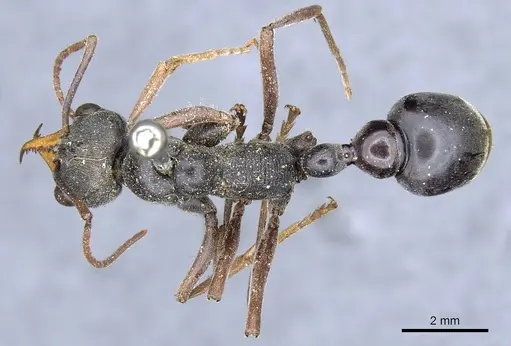
Literatur
Memuat peta distribusi...Memuat produk...