
Gesomyrmex spatulatus
- Nama Ilmiah
- Gesomyrmex spatulatus
- Tribe
- Gesomyrmecini
- Subfamili
- Formicinae
- Penulis
- Cole, 1949
- Distribusi
- Ditemukan di 0 negara
Pendahuluan
Gesomyrmex spatulatus is a rare arboreal ant from the Formicinae subfamily, known only from India (Assam) and Singapore . These ants are distinctive for their yellowish-brown body color with brown markings on the head, mesonotum, and gaster. Major workers reach about 5 mm total length, while minor workers are smaller . They have unique spatulate (spoon-shaped) hairs on the clypeus and mandibles, which help distinguish them from related species. The genus Gesomyrmex is adapted to arboreal life, and G. spatulatus nests in old beetle borings in twigs of parasitic fig trees .
Quick Summary
- Difficulty: Expert
- Origin & Habitat: India (Assam, Jorhat) and Singapore. Found in tropical arboreal habitats – they nest in old cerambycid (beetle) mines in live terminal twigs of parasitic fig trees, and have been observed running on tree trunks in sunny areas beside rice paddies [1][2]. Endemic to India, with a new record from Singapore [4][2].
- Colony Type: Colony structure is unconfirmed. The type series included 2 major workers,15 intermediate workers, and 7 minor workers, which suggests a single-queen colony with multiple worker castes, but no direct evidence exists [3].
- Size & Growth:
- Queen: Unknown – queen has not been described in scientific literature.
- Worker: Major workers: about 5.09 mm total length [3]. Minor workers are smaller, but exact total length has not been published.
- Colony: Unknown – only small numbers have been collected, the type series had 25 workers [3].
- Growth: Unknown – no development data available.
- Development: Unknown – no direct measurements exist. Estimated 6-10 weeks at optimal temperature based on related tropical Formicinae, but highly uncertain. (No published data on development time.)
- Antkeeping:
- Temperature: Estimated: keep warm around 24-28°C based on tropical origin [1][2]. Use a heating cable on one side of the nest to create a gentle gradient.
- Humidity: Keep the nest substrate consistently moist but not waterlogged. Provide high ambient humidity by misting regularly and using a water tube. These ants live in tree hollows in humid tropical environments [2].
- Diapause: No – this is a tropical species from consistently warm climates, no hibernation needed [1][2].
- Nesting: Arboreal setup essential. In the wild they nest in old beetle borings in tree twigs [2]. Use narrow tubes or small chambers that mimic twig hollows. A Y-tong (AAC) nest with small chambers or a custom 3D-printed twig-style formicarium works. Provide branches and structures for climbing. Avoid deep soil-filled nests.
- Behavior: Very agile and fast-moving ants with a distinctive jerky motion [1]. They are strictly arboreal, spending most of their time climbing on branches and twigs. Their small size and speed make them excellent escape artists – capable of squeezing through tiny gaps. They may spray formic acid if threatened but are not known to be aggressive toward keepers.
- Common Issues: escape prevention is critical – they are tiny and extremely fast, easily squeezing through small gaps., very limited availability – this species is rarely available in the antkeeping hobby., no established feeding protocols – their exact dietary needs in captivity are unknown., high humidity requirements can lead to mold if ventilation is poor., tropical temperature needs mean room-temperature keeping may be insufficient without heating.
Natural History and Distribution
Gesomyrmex spatulatus is an extremely rare arboreal ant endemic to the Indomalaya region. It was first described from India (Assam, Jorhat) and later recorded from Singapore [1][2]. The original type series of 25 workers was collected from a tall tree in a sunny area beside a rice paddy, where they were observed running swiftly up and down the trunk with a distinctive jerky motion [1]. In Singapore, specimens were found nesting in old cerambycid (longhorn beetle) mines or borings in live terminal twigs of a parasitic fig tree (Ficus sp.) on a large fallen tree. Some individuals were also seen running under sunlight on the same tree [2]. This species is listed as a valid taxon and is considered endemic to India [5][4].
Identification and Morphology
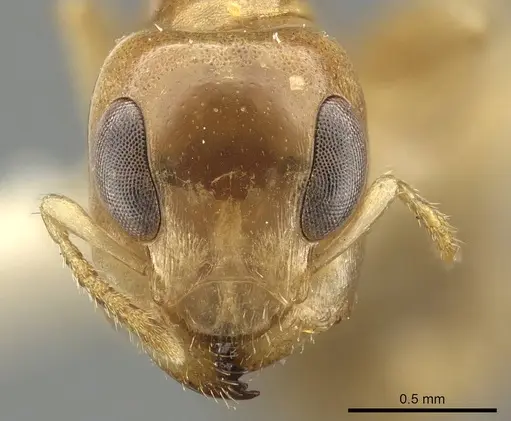
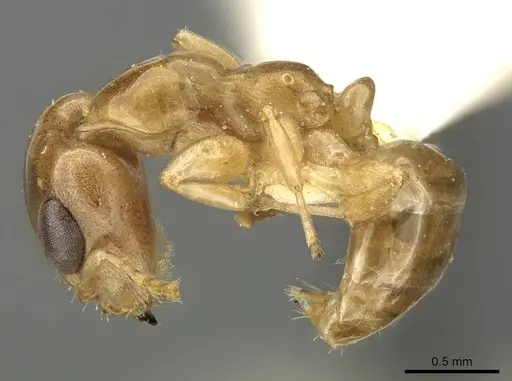
Major workers have unique spatulate (spoon-shaped) hairs on the clypeus and upper surface of the mandibles. These hairs are yellowish, long, and have broadened tips. The mandibles have five teeth, typical of the genus [6][7]. The body color is yellowish-brown, with a brown semicircle across the posterior head margin extending into the upper eye margins. The mesonotum, episternum, and dorsum of gaster are also brown. Major workers reach about 5.09 mm total length, while minor workers are smaller and lack the spatulate hairs [3]. The thorax is long and slender, the petiolar node is high with a distinctly notched (emarginate) superior border.
Housing and Nest Setup
Because Gesomyrmex spatulatus is strictly arboreal, you need a setup that matches their natural nesting preferences. In the wild they nest in old beetle borings inside tree twigs – narrow, enclosed spaces [2]. For captivity, use a naturalistic arboreal setup: provide narrow tubes or small chambers that mimic twig hollows. A Y-tong (AAC) nest with tight, small chambers can work, though you may need to adjust it to create narrower passages. Include climbing branches, twigs, or other vertical structures. Avoid deep soil-filled nests – they are not suitable. The nest should be placed in a warm, humid area of the setup, with a water tube for humidity without flooding the small chambers.
Temperature and Humidity Requirements
As a tropical species from India and Singapore, Gesomyrmex spatulatus needs warm, humid conditions. Maintain the nest area at around 24-28°C – use a heating cable on one side of the nest to create a gentle gradient if your room is cooler. Place the heating above the nest (not underneath) to avoid drying it out too much. Keep the nest substrate consistently moist but not waterlogged, and provide high ambient humidity – mist the outworld regularly. Balance humidity with good ventilation to prevent mold. Monitor condensation, some is fine, but too much can cause problems. These recommendations are based on their tropical origin, as no specific data exist [1][2].
Feeding and Diet
No direct feeding studies exist for this species. Based on related Formicinae ants and their arboreal lifestyle, offer small live prey like fruit flies, small crickets, or springtails as protein 2-3 times per week. Provide a constant source of sugar: sugar water, honey, or diluted maple syrup on a piece of cotton or in a small dish. Given their tree-dwelling nature, they may also tend aphids or scale insects for honeydew if available. Adjust amounts based on what they accept, and remove uneaten food within 24-48 hours to avoid mold. These are best guesses – observe and adapt.
Behavior and Handling
These ants are very agile and fast-moving, with a distinctive jerky motion when running [1]. As arboreal ants, they are excellent climbers and will readily move on branches, twigs, and any textured surfaces. Their small size and speed make them challenging to handle and require excellent escape prevention – even tiny gaps will be exploited. They are not known to be aggressive, but may spray formic acid or show defensive behavior if the nest is disturbed. When working with them, move slowly and avoid sudden vibrations that could stress the colony.
Frequently Asked Questions
How long does it take for Gesomyrmex spatulatus to produce first workers?
The development time is unknown – no scientific data exists. Based on related tropical Formicinae, an estimate is 6-10 weeks at warm temperatures (24-28°C), but this is a rough guess. Be patient, as growth may be slow.
Can I keep Gesomyrmex spatulatus in a test tube setup?
A standard test tube is not ideal because they are arboreal and prefer narrow twig-like spaces. For founding colonies, a small test tube with a water reservoir can work temporarily if it has very small chambers, but a naturalistic setup with twig-mimicking tubes is better [2].
Are Gesomyrmex spatulatus good for beginners?
No – this species is not suitable for beginners. They are extremely rare, require specialized arboreal housing, need high humidity and warm temperatures, and are fast-moving escape artists. No established care protocols exist. Only experienced keepers with proper conditions should attempt to keep them.
What do I feed Gesomyrmex spatulatus?
Based on related Formicinae, offer small live prey (fruit flies, small crickets, springtails) 2-3 times per week as protein. Provide constant access to sugar sources like sugar water or honey. They may also accept honeydew from aphids if available. Start with small amounts and remove uneaten food within 24-48 hours.
How big do Gesomyrmex spatulatus colonies get?
Maximum colony size is unknown. The largest collection recorded is 25 workers (the type series) [3]. Based on related arboreal Formicinae, colonies might reach a few hundred workers at most, but this is speculative.
Do Gesomyrmex spatulatus need hibernation?
No – this is a tropical species from consistently warm climates in India and Singapore. They do not require diapause. Keep them warm year-round at 24-28°C [1][2].
Why are my Gesomyrmex spatulatus escaping?
These ants are extremely small and fast. Check for any tiny gaps in the setup. Use tight-fitting lids, fine mesh, and apply Fluon to outworld edges. Never leave the setup open unattended. Their speed and agility make escape prevention critical [1].
Can I keep multiple queens together?
The colony structure is unconfirmed – no data exists on whether this species is monogyne (single queen) or polygyne (multiple queens). Do not attempt to combine unrelated queens, as this has not been studied and could lead to fighting.
Where can I get Gesomyrmex spatulatus?
This species is extremely rare in the antkeeping hobby and not commonly available from commercial sellers. If any specimens appear, they would likely come from specialized breeders or rare imports. Be cautious about purchasing wild-caught colonies, as the species is known from very few specimens [3].
Report an Issue
The current care sheet is based fully on literature. See inconsistencies, or something that's incorrect? Please , it will be resolved after review from an admin. Contributing to the blogs tab also helps providing information, to make us be able to further improve the caresheets. Thank you for your support!
References

Lembar perawatan ini dilisensikan di bawah CC BY-SA 4.0 .
Blog Komunitas
CASENT0915746
Lihat di AntWeb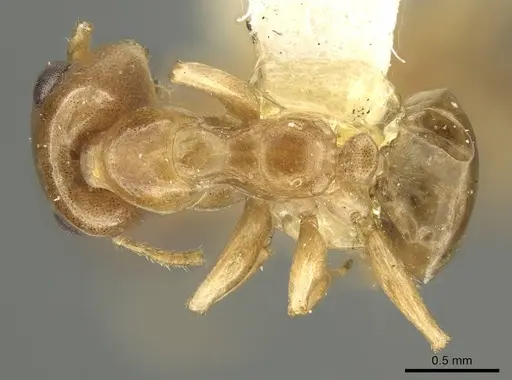
Literatur
Memuat peta distribusi...Memuat produk...