
Cylindromyrmex darlingtoni
- Nama Ilmiah
- Cylindromyrmex darlingtoni
- Subfamili
- Dorylinae
- Penulis
- Wheeler, 1937
- Distribusi
- Ditemukan di 2 negara
Pendahuluan
Cylindromyrmex darlingtoni is a medium-sized predatory ant native to the Greater Antilles, specifically Cuba and the Dominican Republic. Workers measure 5.6-6mm and are almost entirely black with reddish-brown tips on their antennae, legs, and abdomen tip. They have distinctive mandibles with 9-10 denticles and longitudinal striations across their head and body. Queens are larger at 7.5-8mm and have much larger eyes. This species is the northernmost member of its genus and is endemic to high-elevation wet forests in Cuba's Sierra Maestra mountain range and the Dominican Republic, where they nest in decaying wood and rotten logs . What makes Cylindromyrmex darlingtoni special is their exclusivity to pristine pluviforest (rainforest) habitats at elevations between 960-3000 feet. They are one of the rarest ants in the hobby due to their limited native range. As Dorylinae army ants, they are predatory hunters, though their specific hunting behaviors remain unstudied .
Quick Summary
- Difficulty: Expert
- Origin & Habitat: Endemic to the Sierra Maestra mountains in eastern Cuba and high-elevation wet forests in the Dominican Republic (960m). They live exclusively in pluviforest (rainforest) habitats and nest in decaying wood and rotten downed logs [4][1][2][3].
- Colony Type: Colony structure is unconfirmed. No research documents whether they are single-queen (monogyne) or multi-queen (polygyne) colonies. The genus Cylindromyrmex is poorly studied in terms of social structure.
- Size & Growth:
- Queen: 7.5-8mm [1]
- Worker: 5.6-6mm [1]
- Colony: Unknown, no colony size data exists in scientific literature
- Growth: Unknown, no development data exists
- Development: Unknown, no development studies have been conducted on this species (Development timeline is unconfirmed. Temperature-dependent development is typical for ants but has not been studied in this species.)
- Antkeeping:
- Temperature: Unconfirmed. Based on their high-elevation rainforest origin (960-3000 ft), they likely prefer moderate temperatures in the range of 20-26°C. Start around 22-24°C and observe colony activity.
- Humidity: High humidity required. In the wild they inhabit wet rainforest environments with decaying wood. Keep nest substrate consistently moist but not waterlogged, damp rotting wood feel is ideal.
- Diapause: Unknown, no research on seasonal behavior. Their tropical Caribbean distribution suggests they may not require true hibernation, but related species in Dorylinae may have reduced activity periods.
- Nesting: In nature they nest in decaying wood and rotten logs in humid forest settings. Captive suggestions: rotten wood pieces, Y-tong nests with high humidity chambers, or naturalistic setups with damp wood substrate. Avoid dry conditions entirely.
- Behavior: Behavior is unstudied in captivity. As Dorylinae, they are likely predatory and may hunt small invertebrates. Their small eyes (workers) and large eyes (queens) suggest some light sensitivity. Escape risk is moderate, workers at 6mm are not tiny but can still squeeze through small gaps. Use standard formicarium barriers. Temperament is unknown but Dorylinae are typically predatory and may be defensive when guarding brood.
- Common Issues: no captive husbandry information exists, this species has never been successfully kept in captivity, extremely limited native range makes wild collection difficult and ethically questionable, high humidity requirements may be difficult to maintain consistently, predatory diet needs may be challenging to meet with appropriate live prey, endemic status means they are protected in their native range and should not be collected
Natural History and Distribution
Cylindromyrmex darlingtoni is one of the rarest ant species in the world, with an extremely limited distribution restricted to the Sierra Maestra mountains in eastern Cuba and high-elevation wet forests in the Dominican Republic. This species represents the northernmost extent of the genus Cylindromyrmex, which otherwise ranges further south into South America [1].
They are exclusively associated with pluviforest (rainforest) habitats at elevations between 960-3000 feet. The type specimens were collected in June 1936 from decaying wood in the Gran Piedra Range of Oriente Province, Cuba. In the Dominican Republic, a dealate queen was found in a rotten downed log in a high-elevation wet forest, and a male was captured in a flight intercept trap [2][3].
This species is endemic to these islands, meaning it is found nowhere else on Earth. It is listed as endemic in Cuban ant surveys, and its rarity is reflected in the very few specimens ever collected [4][5].
Identification and Morphology
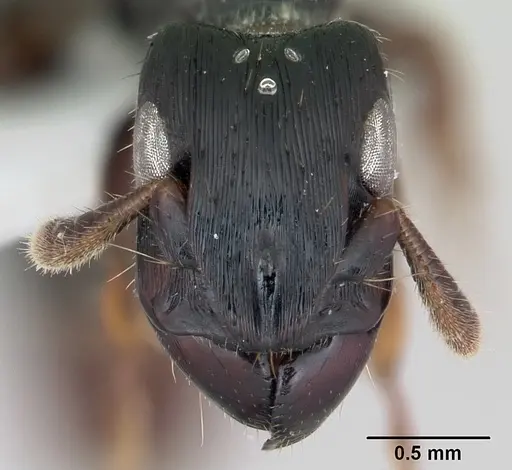
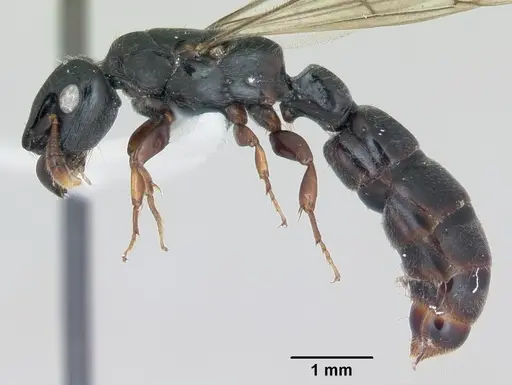
Workers of Cylindromyrmex darlingtoni measure 5.6-6mm in length and are distinctively black with reddish-brown tips on their antennae (funiculi), legs, and the tip of their abdomen (pygidium). Their femora are dark brown. The most diagnostic features include mandibles with 9-10 denticles (teeth) along the masticatory margin, and frontal carinae (ridges above the antennae) that surpass the anterior border of the clypeus (the plate above the mandibles) [1].
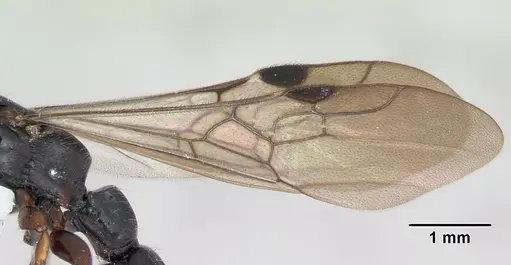
The head, mesosoma, petiole, and postpetiole are covered with fine longitudinal striations. The eyes are small and flat, positioned in the posterior two-fifths of the head. Queens are larger at 7.5-8mm and have much larger, more prominent eyes, as well as short wings (5mm) [1].
This species can be distinguished from its closest relatives Cylindromyrmex brevitarsus and Cylindromyrmex electrinus by the combination of frontal carinae length, mandible denticle count, and the shape of the hind basitarsi (foot segments) [1].
Housing and Nesting
In nature, Cylindromyrmex darlingtoni nests exclusively in decaying wood and rotten logs within humid rainforest environments. This is a critical care requirement, they will not survive in dry conditions [2][3].
For captivity, the best approach would be a naturalistic setup using pieces of damp, rotting wood or a Y-tong nest with very high humidity chambers. The substrate should remain consistently moist, mimicking the damp forest floor where they naturally occur. Test tubes with water reservoirs may work if the cotton is kept very wet, but rotting wood pieces are more aligned with their natural history.
Ventilation must be balanced carefully, enough to prevent mold while maintaining the high humidity they require. Avoid any drying agents or overly ventilated setups.
Feeding and Diet
As a member of the Dorylinae subfamily (army ants), Cylindromyrmex darlingtoni is expected to be predatory, though their specific diet has never been documented in scientific literature. Dorylinae ants typically hunt small invertebrates including springtails, mites, small beetles, and other micro-arthropods.
In captivity, you should offer small live prey appropriate to their size. Given workers at 6mm, very small live insects and arthropods would be appropriate. Potential foods include: live springtails, tiny mealworms, fruit flies, and other small live insects. Sugar sources are unlikely to be accepted, Dorylinae are primarily predatory and do not typically tend aphids or seek nectar.
Feed small amounts of live prey every few days and remove any uneaten prey to prevent mold in the humid environment.
Temperature and Seasonal Care
Temperature requirements are not documented for this species. However, their origin from high-elevation Caribbean rainforests (960-3000 feet in the Sierra Maestra) provides clues. These elevations suggest moderate temperatures, not hot tropical lowland conditions, but not cool temperate conditions either.
A starting point of 22-24°C is reasonable based on their likely preferences. You can adjust based on colony behavior, if workers are sluggish, slightly increase temperature, if they avoid heated areas, reduce it. Provide a temperature gradient so they can choose their preferred zone.
Regarding diapause (winter rest): their tropical Caribbean distribution suggests they may not require a true hibernation period. However, related Dorylinae species sometimes show reduced activity during certain seasons. Monitor your colony for natural slowdowns rather than imposing a forced diapause.
Challenges and Ethical Considerations
Cylindromyrmex darlingtoni presents extreme challenges for antkeeping. This species has never been documented in captive husbandry, meaning no established care protocols exist. They are among the least-studied ants in the world, with only a handful of specimens ever collected.
Beyond the husbandry challenges, there are serious ethical concerns. This species is endemic to Cuba and the Dominican Republic, meaning it is found nowhere else. As an endemic species, it may be protected in its native range, and removing specimens could harm wild populations. The Sierra Maestra region where they live is ecologically sensitive.
For these reasons, Cylindromyrmex darlingtoni is not recommended for antkeeping. If you somehow obtain specimens, prioritize their preservation and consider consulting with researchers studying Caribbean ants. This is a species best appreciated through scientific literature rather than attempted captivity. [4][5]
Frequently Asked Questions
Can I keep Cylindromyrmex darlingtoni as a pet ant?
No. This species is not recommended for antkeeping. It has never been successfully kept in captivity, requires very specific high-humidity rainforest conditions, and is endemic to a very limited range in Cuba and the Dominican Republic. Ethical concerns about collecting from already-small wild populations also apply.
What do Cylindromyrmex darlingtoni ants eat?
They are predatory Dorylinae ants, so they likely hunt small invertebrates. In captivity, you would need to provide live prey such as springtails, tiny mealworms, and fruit flies. Sugar sources are unlikely to be accepted. However, no captive feeding data exists for this species.
How big do Cylindromyrmex darlingtoni colonies get?
Colony size is unknown, no research has documented maximum colony sizes. Given their rarity and limited range, even wild colonies have rarely been observed.
What temperature do Cylindromyrmex darlingtoni need?
Temperature requirements are unconfirmed. Based on their high-elevation rainforest origin in the Caribbean, they likely prefer moderate temperatures around 22-24°C. Start in this range and adjust based on colony behavior.
Where does Cylindromyrmex darlingtoni live?
They are endemic to eastern Cuba (Sierra Maestra mountains) and the Dominican Republic. They live exclusively in pluviforest (rainforest) habitats at elevations between 960-3000 feet, nesting in decaying wood and rotten logs.
How long does it take for Cylindromyrmex darlingtoni to develop from egg to worker?
The development timeline is completely unknown, no research has studied their development.
Are Cylindromyrmex darlingtoni good for beginners?
Absolutely not. This is an expert-only species at best, and more accurately, a species that should not be kept in captivity at all due to ethical concerns, lack of husbandry information, and their protected endemic status.
Do Cylindromyrmex darlingtoni need hibernation?
Diapause requirements are unknown. Their tropical Caribbean distribution suggests they may not need true hibernation, but related Dorylinae species may have reduced activity periods. Observe your colony for natural slowdowns rather than imposing a forced diapause.
Can I catch a queen Cylindromyrmex darlingtoni during nuptial flights?
Nuptial flight timing is undocumented. Additionally, this species is endemic and likely protected, and their limited range makes finding queens extremely unlikely. Do not attempt to collect from the wild.
Report an Issue
The current care sheet is based fully on literature. See inconsistencies, or something that's incorrect? Please , it will be resolved after review from an admin. Contributing to the blogs tab also helps providing information, to make us be able to further improve the caresheets. Thank you for your support!
References

Lembar perawatan ini dilisensikan di bawah CC BY-SA 4.0 .
Blog Komunitas
CASENT0173072
Lihat di AntWeb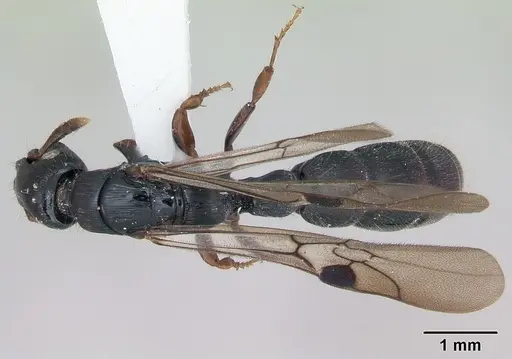
Literatur
Memuat peta distribusi...Memuat produk...