
Carebara bengalensis
- Nama Ilmiah
- Carebara bengalensis
- Tribe
- Crematogastrini
- Subfamili
- Myrmicinae
- Penulis
- Forel, 1902
- Distribusi
- Ditemukan di 0 negara
Pendahuluan
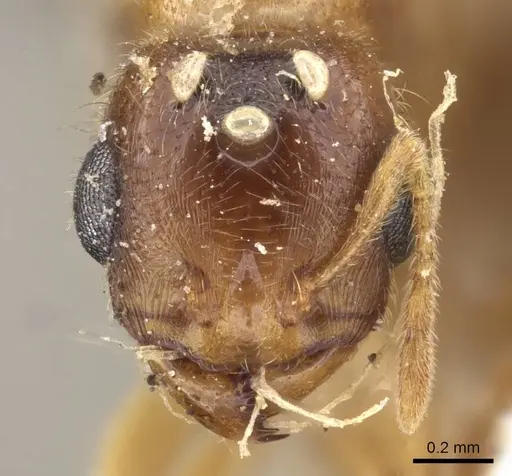
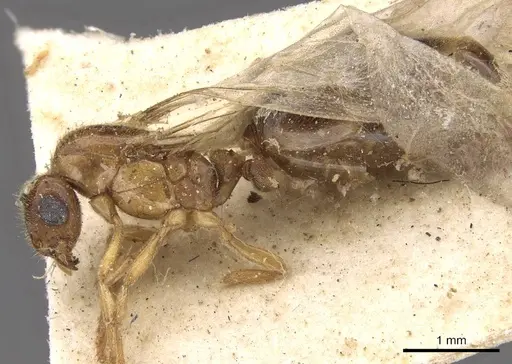
Carebara bengalensis is a tiny myrmicine ant from the Indomalaya region, originally described from Barrackpore in West Bengal, India. The species is exceptionally rare - only the queen and male castes have ever been documented, with no worker caste known to science . Queens have 9-segmented antennae and possess a distinctly bicarinate clypeus (two ridges running down the center of the face) . This species has been recorded across the Himalayan foothills in India (Sikkim, West Bengal), Nepal, and Bangladesh . Previous records from China's Yunnan province were misidentifications - Liu et al. (2024) confirmed this ant does not occur in China [AntWiki]. What makes C. bengalensis particularly intriguing is how little we know about it. The complete absence of described workers in over 120 years of study makes this one of the most poorly known ant species in the region. This represents both a scientific mystery and a significant challenge for antkeepers - captive breeding would require understanding a complete colony lifecycle that has never been documented.
Quick Summary
- Difficulty: Expert
- Origin & Habitat: Indian subcontinent (India, Nepal, Bangladesh), tropical to subtropical Himalayan foothills. Originally described from Barrackpore, West Bengal. Found in Sikkim and West Bengal states of India, and Bhaktapur, Nepal [4][5]. Likely inhabits forest floor microhabitats typical of Carebara species.
- Colony Type: Unknown, only queen and male castes documented, workers never described. Colony structure is unconfirmed.
- Size & Growth:
- Queen: size data unavailable
- Worker: Unknown, worker caste has never been described [2]
- Colony: Unknown
- Growth: Unknown
- Development: Unknown, worker caste undescribed (This is one of the most poorly known ant species globally. No development data exists because workers have never been documented.)
- Antkeeping:
- Temperature: Inferred from related Indian Carebara species: aim for 24-28°C (warm tropical conditions). No direct thermal data exists for this species.
- Humidity: Inferred: likely requires moderate to high humidity (60-80%) similar to other litter-dwelling Carebara species. Keep substrate consistently moist.
- Diapause: Unknown, likely enters dormancy during cooler months given Himalayan distribution, but specific requirements unstudied.
- Nesting: Inferred: likely nests in soil or rotting wood in forest floor microhabitats. A naturalistic setup with moist substrate or a Y-tong/plaster nest would be appropriate starting points.
- Behavior: Behavior is completely unstudied. Based on genus patterns, likely nocturnal or crepuscular foragers. Escape risk cannot be assessed without worker size data. Temperament unknown, related Carebara species are generally non-aggressive but this is speculative. As a Myrmicinae species, they possess a modified stinger capable of smearing venom onto enemies rather than piercing flesh.
- Common Issues: No worker caste exists in scientific literature, you cannot establish a functional colony without workers, The species is exceptionally rare, wild-queen collection in its native range would be extremely difficult, Complete lack of captive breeding records means no established protocols exist, Temperature and humidity requirements are inferred, not confirmed, No documented diet preferences, must be determined through trial and error
The Worker Mystery
Carebara bengalensis represents one of the most significant gaps in ant taxonomy. Despite being described in 1902 and having been recorded multiple times since, only the queen and male castes have ever been documented [2]. This is extraordinarily unusual, in over 120 years of study, no researcher has collected or described worker specimens. This could mean several things: the workers may be extremely small and easily overlooked, they may have distinctive behavior that makes them hard to collect, or simply that this species has been rarely encountered by myrmecologists. For antkeepers, this presents an insurmountable challenge, you cannot establish a colony without workers, and no one knows what the workers look like or how to find them. This makes C. bengalensis essentially impossible to keep in captivity through normal means.
Distribution and Identification
The distribution of Carebara bengalensis spans the Himalayan foothills of the Indomalaya region. It has been confirmed in Sikkim and West Bengal in India, Bhaktapur in Nepal, and Bangladesh [4][5]. The species was originally described from Barrackpore, a town in West Bengal, which explains both the species name and the type locality. There was historical confusion about its presence in China (Yunnan province), but Liu et al. (2024) resolved this by confirming C. bengalensis does not occur in China, previous records were misidentifications [6]. Identification relies on queen characters: 9-segmented antennae and a distinctly bicarinate clypeus (two ridges running lengthwise on the face) [3][2]. Males have 13-segmented antennae.
Related Species and Inferences
Since direct biological data for C. bengalensis is nonexistent, we must make inferences from related species and genus patterns. The genus Carebara contains over 200 species worldwide, with many in South and Southeast Asia. Related species in India are typically small, ground-nesting ants that forage in leaf litter and upper soil layers. They are generalist foragers, collecting small insects, honeydew, and plant matter. Most Carebara species form moderate colonies of a few hundred to a few thousand workers. However, these are general genus patterns, this specific species may deviate significantly in any of these characteristics. Any captive attempt would essentially be experimental and would require documenting findings that could contribute to scientific knowledge.
Why This Species Cannot Be Kept
It must be stated clearly: Carebara bengalensis cannot be maintained in captivity with current knowledge. The fundamental problem is not difficulty, it is impossibility. Without described workers, no one knows what to look for when collecting colonies, what size enclosure to provide, what temperatures they require, or what they eat. Even if a mated queen were somehow obtained, no protocol exists for raising her brood because we do not know what the larvae need to develop. The scientific community has had over 120 years to document this species and has failed to do so. This is not a challenge for even expert antkeepers, it is a species that simply cannot be kept until basic biological research documents the worker caste. [1][2]
Frequently Asked Questions
Can I keep Carebara bengalensis ants?
No. Carebara bengalensis cannot be kept in captivity. The worker caste has never been described in over 120 years of scientific study, meaning no one knows what workers look like, how they behave, or what they eat. Without workers, a colony cannot function.
Why are there no workers documented for this species?
The worker caste of Carebara bengalensis remains unknown to science. This is exceptionally rare but not unique among ants. Workers may be extremely tiny, have unusual behavior that makes them hard to collect, or the species has simply been rarely encountered. The original description in 1902 only included queen and male [2].
Where does Carebara bengalensis live?
This species is found in the Himalayan foothills of the Indomalaya region: Sikkim and West Bengal in India, Bhaktapur in Nepal, and Bangladesh. It was originally described from Barrackpore in West Bengal, India [4][5].
Is Carebara bengalensis found in China?
No. Previous records of this species in China's Yunnan province were based on misidentifications. Liu et al. (2024) confirmed C. bengalensis does not occur in China [6].
What do Carebara bengalensis queens look like?
Queens have 9-segmented antennae and a distinctly bicarinate clypeus (two ridges running down the center of the face). They were originally described by Forel in 1902 from specimens collected in Barrackpore, West Bengal [3][2].
How rare is Carebara bengalensis?
Extremely rare. The 1903 paper by Rothney described it as rare and the species has rarely been encountered since [1]. Over 120 years since description, only queen and male specimens exist in scientific collections.
What should I keep instead of Carebara bengalensis?
Consider other Carebara species that are better documented, or other small Myrmicinae from the Indian subcontinent like Pheidole, Tetramorium, or Monomorium. Many well-documented species exist with established care protocols. Focus on species where workers are known and colony behavior is understood.
Could I collect a wild colony of Carebara bengalensis?
Even if you live in its range (India, Nepal, Bangladesh), finding this species would be extraordinarily difficult. It has been rarely encountered by professional ant researchers using specialized collection methods. Without knowing what the workers look like, successful collection would be nearly impossible.
Report an Issue
The current care sheet is based fully on literature. See inconsistencies, or something that's incorrect? Please , it will be resolved after review from an admin. Contributing to the blogs tab also helps providing information, to make us be able to further improve the caresheets. Thank you for your support!
References

Lembar perawatan ini dilisensikan di bawah CC BY-SA 4.0 .
Blog Komunitas
CASENT0908900
Lihat di AntWeb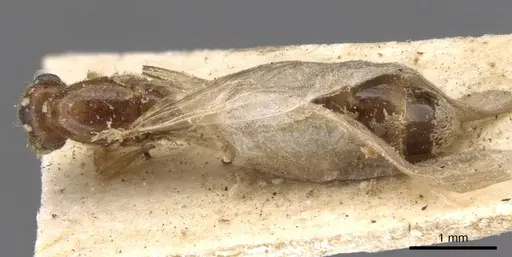
Literatur
Memuat peta distribusi...Memuat produk...