
Aenictus wilsoni
- Nama Ilmiah
- Aenictus wilsoni
- Subfamili
- Dorylinae
- Penulis
- Bharti <i>et al.</i>, 2012
- Distribusi
- Ditemukan di 1 negara
Pendahuluan
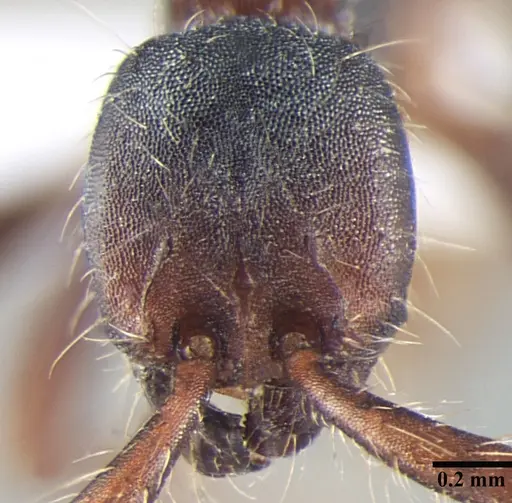
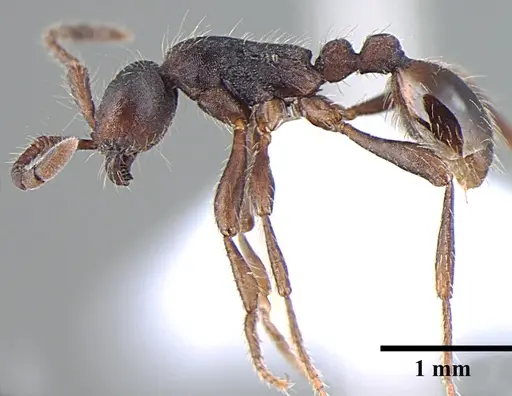
Aenictus wilsoni is a small army ant species endemic to the Himalayan foothills of northern India. Workers measure 4.0-4.3 mm in total length and are blackish in color with brown gena, gaster, and appendages, featuring distinctive microreticulate sculpturing across their heads and bodies . They were discovered in 2010 at Andretta, a hill station in Himachal Pradesh surrounded by tea gardens and pine forests at 940 meters elevation, where they were observed raiding across the soil surface . This species belongs to the Aenictus philippinensis species group and was named to honor the renowned ant biologist E.O. Wilson . Researchers have only ever collected 15 workers total - no queens, males, or brood have ever been documented, making this one of the rarest and least-known ant species in the world . As an army ant, they likely exhibit the nomadic lifestyle typical of the genus, but their specific biology remains completely undocumented. The complete absence of any known reproductive caste makes captive keeping currently impossible.
Quick Summary
- Difficulty: Expert
- Origin & Habitat: Andretta, Himachal Pradesh, India, specifically the Shivalik range of the northwest Himalayas at 940m elevation, in hill station habitat surrounded by tea gardens and pine forests merging with the Dhauladhar mountain range [1][2]
- Colony Type: Unknown, no queens or reproductive castes have ever been documented [1]
- Size & Growth:
- Antkeeping:
- Temperature: Temperature needs unclear, based on Himalayan foothill location at 940m elevation, likely temperate conditions around 20-25°C [1]
- Humidity: Humidity needs unclear, hill station habitat suggests moderately damp conditions [1]
- Diapause: Diapause requirements unclear, Himalayan location suggests possible winter diapause [1]
- Nesting: Soil surface raiding species, does not construct permanent nests [1]
- Behavior: Active surface raiders observed foraging on the ground [1]. Likely specialized predators of other ants and small invertebrates like other Aenictus species [3]. Workers possess a visible sting but at 4mm long pose minimal threat to humans [1].
- Common Issues: no queens have ever been collected, making captive colony establishment impossible., known only from 15 specimens collected in 2010,so acquisition is impossible., specialized army ant biology requires enormous space and constant food sources impractical for home keeping., identification requires microscopic examination of thorax ridges and fossae, making verification difficult without lab access [1].
Why This Species Cannot Be Kept in Captivity
You cannot currently keep Aenictus wilsoni as a pet ant. Scientists have only ever found 15 workers of this species, collected on a single day in June 2010 [1]. No queen ants have ever been discovered, which means there is no way to start a colony. Without a queen, workers will eventually die and cannot be replaced.
Even if queens were available, Aenictus wilsoni is an army ant. Army ants have specialized biology that makes them extremely difficult to house. They typically form massive colonies with thousands of workers that move constantly between temporary nesting sites [3]. They require huge amounts of living prey and space to conduct their raiding behavior. Standard ant farms, test tubes, and formicariums cannot accommodate these needs.
Natural History and Habitat
Aenictus wilsoni comes from Andretta, a green hill station in the Shivalik range of the northwest Himalayas at 940 meters elevation [1]. The area sits among tea gardens and pine forests before merging into the Dhauladhar mountain range. Workers were collected raiding on the soil surface in this habitat [1].
The climate at this elevation is likely temperate, warm in summer but cool in winter. The June collection date suggests warm-season activity, but the Himalayan location means winters could bring cold conditions. The habitat lacks heavy leaf litter, suggesting these ants forage in open soil areas rather than deep forest floor [1].
Army Ant Biology
Aenictus wilsoni belongs to the army ant genus Aenictus, specifically the philippinensis species group. These ants are specialized predators that hunt in organized groups. While specific behavior for A. wilsoni is unconfirmed, related species show a distinctive lifestyle: colonies alternate between nomadic phases, where they move daily and raid for food, and stationary phases, where they stay in one place to raise brood [3].
Army ants do not build permanent nests. Instead, they form temporary bivouacs, living structures made from the bodies of the workers themselves. They require massive amounts of prey, primarily other ants and small invertebrates, to sustain the colony. This combination of huge space requirements, constant food needs, and nomadic behavior makes army ants unsuitable for standard captive keeping setups.
Identification and Similar Species
Workers of Aenictus wilsoni are small (4.0-4.3 mm total length), blackish in color with brown appendages, and have 10-segmented antennae [1]. They can be distinguished from the similar Aenictus philippinensis by several features: they are darker in color (blackish versus medium reddish brown), have longer antennae relative to head size (scape index 93-100 versus 78), and show a straight rather than convex propodeum face [1][4].
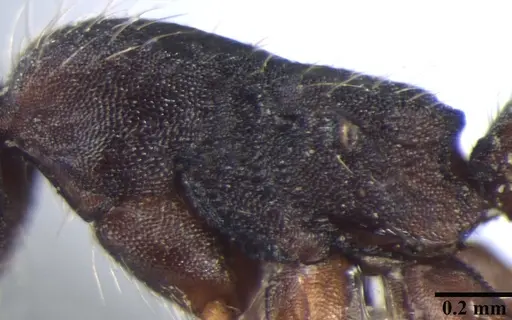
Key identifying features visible under magnification include a distinct ridge on the thorax immediately followed by three small pits (fossae), and an oblique excavation between the lower third of the middle and rear thorax segments [1]. The petiole appears rectangular from above with a transverse ridge on the front margin [1].
Frequently Asked Questions
Can I keep Aenictus wilsoni in a test tube?
No. This species is not available to antkeepers. No queens have ever been collected, and only 15 workers exist in museum collections worldwide [1]. Even if found, army ants require specialized setups, not test tubes.
How long until Aenictus wilsoni gets their first workers?
Unknown. Scientists have never observed a queen, eggs, or brood of this species [1].
What do Aenictus wilsoni eat?
Likely other ants and small invertebrates like other army ants in the genus, but specific diet is unconfirmed [3].
How big do Aenictus wilsoni colonies get?
Unknown. Other Aenictus species can have colonies of thousands of workers, but this is unconfirmed for A. wilsoni [3].
Do Aenictus wilsoni need hibernation?
Unknown. They live in the Himalayan foothills where winters are cool, but no seasonal activity data exists [1].
Can I buy Aenictus wilsoni?
No. This species is known only from its original discovery in 2010 and has never entered the antkeeping trade [1][2].
Are Aenictus wilsoni dangerous?
They possess a visible sting [1], but at 4mm long they pose little threat to humans. However, army ants can be aggressive defenders [3].
Why is it called Aenictus wilsoni?
The species was named in 2012 to honor E.O. Wilson, the renowned ant biologist and conservationist [1].
Report an Issue
The current care sheet is based fully on literature. See inconsistencies, or something that's incorrect? Please , it will be resolved after review from an admin. Contributing to the blogs tab also helps providing information, to make us be able to further improve the caresheets. Thank you for your support!
References

Lembar perawatan ini dilisensikan di bawah CC BY-SA 4.0 .
Blog Komunitas
ANTWEB1008020
Lihat di AntWeb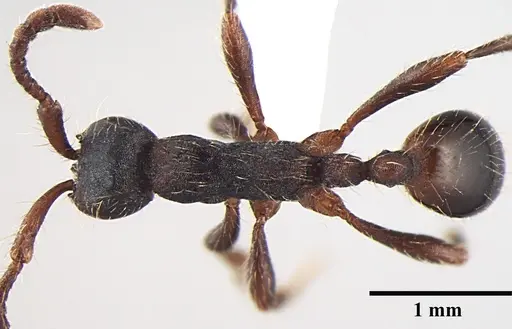
Literatur
Memuat peta distribusi...Memuat produk...