
Aenictus jarujini
- Nama Ilmiah
- Aenictus jarujini
- Subfamili
- Dorylinae
- Penulis
- Jaitrong & Yamane, 2010
- Distribusi
- Ditemukan di 0 negara
Pendahuluan
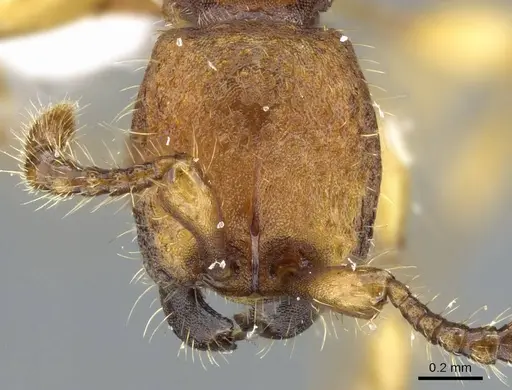
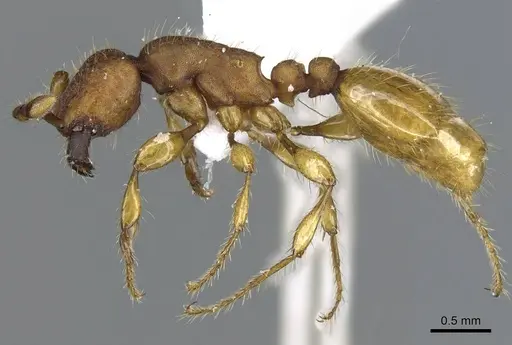
Aenictus jarujini is a tiny army ant found only in northern Thailand. Workers measure 3.4-3.8 mm in total length and show pale brown bodies with yellow gasters and legs . You can recognize them by their 9-segmented antennae ending in a very large terminal segment, and their densely pitted heads . The species remains one of the rarest ants known to science - only 65 workers were collected once in 2008 from a temporary camp (bivouac) under a stone in a disturbed forest area at 1000 meters elevation . As a true army ant in the subfamily Dorylinae, this species forms temporary living nests using their own bodies rather than digging permanent chambers . They were discovered during the dry season in a disturbed area near hill-evergreen forest, suggesting they prefer shaded, moderately cool conditions with access to cover objects . No queens have ever been documented for this species - only worker caste specimens exist in collections .
Quick Summary
- Difficulty: Expert
- Origin & Habitat: Northern Thailand (Mae Hong Son Province), hill-evergreen forest at 1000m elevation [1]
- Colony Type: Unknown, only workers documented, army ant reproductive biology suggests colony fission [3]
- Size & Growth:
- Antkeeping:
- Temperature: Likely 22-26°C based on collection at 1000m elevation in northern Thailand [1]
- Humidity: Moderate to high, matching forest floor conditions at the type locality [1]
- Diapause: Unknown, tropical location suggests probably not required
- Nesting: Forms temporary bivouacs under stones, permanent nests are not used [1]
- Behavior: Army ant, nomadic, predatory, forms temporary bivouacs. Workers are small and fast-moving but not particularly aggressive toward humans [3].
- Common Issues: this species cannot be obtained for captivity, only 65 specimens exist in museums., no established care methods exist for this species., army ants require massive foraging space unavailable in standard setups., continuous prey supply would be necessary for survival., no queens are available for colony founding.
Why This Species Cannot Be Kept in Captivity
Aenictus jarujini has never been kept in captivity and likely cannot be maintained with current antkeeping methods. Only 65 workers exist in scientific collections, collected from a single location in 2008 [2]. No queens have ever been found, meaning you cannot start a colony from a single queen [3].
As true army ants, they require massive foraging territories and constant supplies of live prey that cannot be provided in standard ant farms. They also lack permanent nests, instead forming temporary bivouacs that shift location regularly [1]. Attempting to house them would result in the death of the colony.
What the Type Collection Tells Us
On March 7,2008,researcher W. Jaitrong collected the only known specimens from Haui Nam Dang National Park in Mae Hong Son Province, northern Thailand [2]. The ants occupied a bivouac under a stone in a disturbed area near hill-evergreen forest at approximately 1000 meters altitude during the dry season [1].
This single collection represents our entire knowledge of the species' biology. The habitat suggests they prefer shaded, moderately cool forest conditions with access to cover stones. The pale brown and yellow coloration may help them blend with forest floor litter [1].
How to Identify Aenictus jarujini
Workers have 9-segmented antennae where the final segment is very large, almost as long as the two previous segments combined [1]. Their heads are subrectangular with dense macro-punctures on the back half and weaker punctures on the front [2].
You can separate them from the similar Aenictus latifemoratus by counting antennal segments: Aenictus jarujini has 9 while Aenictus latifemoratus has only 8 [1]. The petiole node is subrectangular with a rim on the back edge, and the subpetiolar process is very low compared to related species [2]. The mandibles have a large curved apical tooth followed by 10-15 smaller denticles [1].
Army Ant Biology Context
Aenictus jarujini belongs to the army ant subfamily Dorylinae. These ants are nomadic predators that do not build permanent nests. Instead, they form temporary living structures called bivouacs using their own bodies [3].
Colonies reproduce by fission, splitting into two groups, rather than through nuptial flights with winged queens [3]. This biology makes them impossible to house in standard formicariums designed for stationary colonies. They require continuous movement and massive amounts of prey that home keepers cannot provide.
Frequently Asked Questions
Can I keep Aenictus jarujini in a test tube setup?
No. This species has never been kept in captivity and cannot be housed in standard test tubes or formicariums. They are army ants that require massive space and constant food supplies unavailable in home setups [1][3].
Where can I buy Aenictus jarujini?
You cannot purchase this species. Only 65 specimens exist in museum collections from a single 2008 collection, and no commercial sources are available [2].
How do I start a colony of Aenictus jarujini?
You cannot start a colony because no queens have ever been collected or documented for this species. Army ants reproduce by colony fission rather than traditional queen founding [3].
What do Aenictus jarujini eat?
While specific diet is unstudied, related Aenictus species prey on other ants and small arthropods. They are specialized predators requiring live prey [3].
How big do Aenictus jarujini colonies get?
Unknown. Only 65 workers were ever collected, but this likely represents a tiny fragment of a much larger colony typical of army ants [2].
What temperature do Aenictus jarujini need?
Specific requirements are unknown. Based on their collection site at 1000m elevation in northern Thailand, they likely prefer moderate temperatures around 22-26°C [1].
Do Aenictus jarujini need hibernation?
Unknown, but unlikely. As a tropical species from Thailand, they likely remain active year-round without winter rest periods [1].
Report an Issue
The current care sheet is based fully on literature. See inconsistencies, or something that's incorrect? Please , it will be resolved after review from an admin. Contributing to the blogs tab also helps providing information, to make us be able to further improve the caresheets. Thank you for your support!
References

Lembar perawatan ini dilisensikan di bawah CC BY-SA 4.0 .
Blog Komunitas
CASENT0905889
Lihat di AntWeb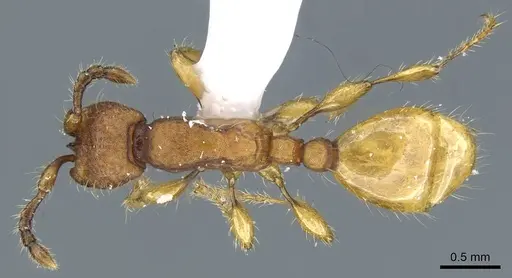
Literatur
Memuat peta distribusi...Memuat produk...