
Vombisidris xylochos
- Tud. név
- Vombisidris xylochos
- Nemzetség
- Crematogastrini
- Alcsalád
- Myrmicinae
- Szerző
- Bolton, 1991
- Elterjedés
- 0 országban megtalálható
Bevezetés
Vombisidris xylochos is a tiny yellow myrmicine ant native to the forests of Borneo, Brunei, Malaysia, and Indonesia . Workers measure just 3.4 mm in total length, making them one of the smaller ants you'll encounter in the hobby . They belong to the *Vombisidris dryas* species group and were first described by Bolton in 1991 from specimens collected via pyrethrum fogging of forest trees in Brunei . As members of the tribe Crematogastrini (Myrmicinae), they possess a modified, spatulate stinger used to smear venom onto enemies rather than piercing flesh. These ants are poorly studied in captivity, with most information coming from limited field collections. They appear to be forest dwellers that likely nest in elevated microhabitats like tree bark or rotting wood, given the canopy-fogging collection method . Their uniformly yellow color and distinctive morphological features, deeply impressed metanotal groove and long propodeal spines, make them relatively easy to identify among small yellow Myrmicinae .
Quick Summary
- Difficulty: Unknown, likely Expert due to limited data
- Origin & Habitat: Borneo, Brunei, Malaysia, and Indonesia (Indomalaya Region). Found in forest habitats, collected from forest tree canopy via pyrethrum fogging [1][2][3].
- Colony Type: Colony structure is unconfirmed. No data on queen morphology or colony size from wild colonies [1][2].
- Size & Growth:
- Queen: Unknown, no queen caste has been described [1]
- Worker: 3.4 mm total length [1]
- Colony: Unknown, no colony size data available [1]
- Growth: Unknown, no development data exists [1]
- Development: Unconfirmed, no development data exists for this species [1] (No data available, any timeline is speculative [1])
- Antkeeping:
- Temperature: Likely requires warm, stable conditions similar to other Southeast Asian forest ants. Based on their tropical origin, aim for 24-28 °C with a gentle gradient. No direct thermal data exists [1].
- Humidity: Likely requires high humidity given their forest canopy origin. Keep the nest substrate consistently moist but not waterlogged. Provide a humidity gradient so ants can self-regulate. No direct humidity data exists [1].
- Diapause: Unlikely, as a tropical Southeast Asian species, they probably do not require hibernation. However, this has not been studied [1].
- Nesting: Based on collection method (fogging of forest trees), they likely nest in elevated microhabitats like rotting wood, under bark, or in tree cavities. In captivity, a small Y‑tong (AAC) nest or plaster nest with tight chambers scaled to their tiny size would likely work well. Avoid large, open spaces [1].
- Behavior: Behavior is unstudied in captivity. Based on their small size and forest origin, they are likely shy and non‑aggressive. They probably forage in the canopy layer and may tend aphids or collect honeydew. Escape prevention is critical, use fine mesh and tight‑fitting barriers. As Myrmicinae in the tribe Crematogastrini, they have a functional stinger that smears venom rather than piercing.
- Common Issues: escape prevention is critical due to tiny 3.4 mm size, they can squeeze through standard barrier gaps, no captive husbandry data exists, keepers must experiment with conditions, growth rate unknown, potentially slow, humidity control is challenging, forest species need moist conditions without flooding, lack of established feeding protocols, their exact diet preferences are unknown
Origin and Distribution
Vombisidris xylochos is known from Brunei, Malaysia, and Indonesia in the Indomalaya Region [2][3]. The type specimen was collected in Brunei at Bukit Sulang near Lamunin through pyrethrum fogging of a forest tree, indicating these ants live in the forest canopy or tree hollows [1][3]. This collection method (fogging) involves spraying insecticide into tree foliage to knock down insects, which suggests V. xylochos is primarily a tree‑dwelling species rather than a ground‑nesting ant. The species was originally described by Bolton in 1991 and remains one of the less‑documented ants in the genus [3].
Identification and Morphology
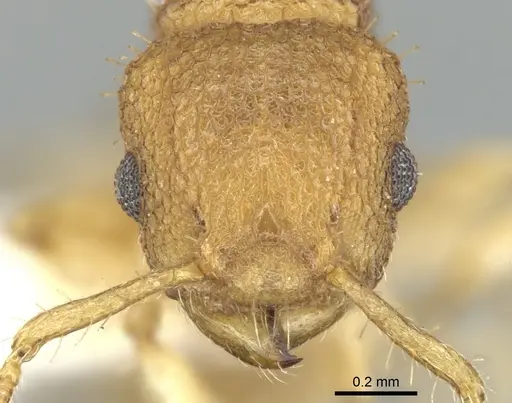
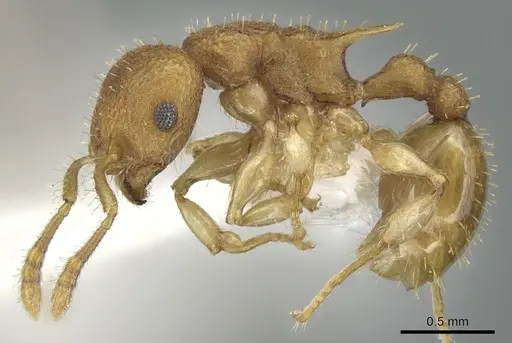
Workers of Vombisidris xylochos are tiny at just 3.4 mm total length, with a head width of 0.74 mm and head length of 0.78 mm [1]. They are uniformly yellow in color throughout, which helps distinguish them from some related species. Key identification features include a densely reticulate‑rugose (wrinkled) cephalic dorsum, a complete subocular groove, and a deeply impressed metanotal groove that appears trench‑like in profile view [1][2]. The propodeal spines are notably long, approximately twice the length of the propodeal dorsum. The promesonotum is nearly straight in profile with an angled anterodorsal corner, and the sides of the mesonotum are distinctly angular when viewed from above [1][2]. Their eyes are relatively small at 0.16 mm maximum diameter with about 10 ommatidia in the longest row [1].
Housing and Nesting
Based on their collection from forest tree foliage, Vombisidris xylochos likely nests in elevated microhabitats such as rotting wood, under bark, or in tree cavities [1]. In captivity, provide a small nest with tight chambers scaled to their tiny 3.4 mm size. A Y‑tong (AAC) nest or plaster nest works well for small Myrmicinae. Avoid large, open spaces that could stress these tiny ants. Ensure excellent escape prevention, their small size means they can squeeze through gaps that larger ants cannot. Use fine mesh on any ventilation holes and apply fluon or other barriers to container rims. Keep the nest humid but ensure adequate ventilation to prevent mold buildup [1].
Temperature and Humidity
As a tropical Southeast Asian species from Borneo and surrounding regions, Vombisidris xylochos likely requires warm and humid conditions [1][2]. Aim for temperatures in the range of 24-28 °C, which aligns with typical lowland tropical forest conditions. Provide a temperature gradient so the colony can self‑regulate, place a heating cable on one side of the nest if room temperature falls below this range. For humidity, replicate the damp forest floor environment, keep the nest substrate consistently moist but not waterlogged. Allow for some drier areas within the nest so ants can choose their preferred humidity zone. Good ventilation is essential to prevent stagnant air and mold while maintaining humidity [1].
Feeding and Diet
The exact diet of Vombisidris xylochos has not been documented in scientific literature [1]. As small Myrmicinae that inhabit forest canopy, they likely forage for small arthropods, honeydew from aphids or scale insects, and may tend mutualistic insects. In captivity, offer a varied diet including small live prey like fruit flies, springtails, or pinhead crickets. Sugar sources such as diluted honey water or sugar water should be available at all times. Given their tiny size, food items must be appropriately scaled, avoid offering large prey that could overwhelm or injure the workers. Observe feeding behavior to determine preferences and adjust offerings accordingly [1].
Colony Development and Growth
No data exists on colony development, founding behavior, or growth rates for Vombisidris xylochos [1]. The queen caste has never been described, so nothing is known about their founding biology, whether they are claustral (seal themselves in and live off stored fat) or semi‑claustral (must forage during founding) is unknown. Based on typical Myrmicinae patterns and related Vombisidris species, expect slow colony growth. Colonies may remain small (likely under 100 workers given their tiny worker size) even at maturity. Be patient with founding colonies, it may take many months to see the first workers (nanitics), and many more to reach significant numbers. Document your observations carefully, as any captive breeding data would contribute significantly to what is currently known about this species [1].
Frequently Asked Questions
How long does it take for Vombisidris xylochos to develop from egg to worker?
This is unknown, no development data exists. Based on typical Myrmicinae patterns and their tropical origin, one might expect 6-10 weeks at optimal temperatures (24-28 °C), but this is entirely speculative [1].
What do Vombisidris xylochos ants eat?
Their exact diet is unconfirmed, but as small forest‑dwelling Myrmicinae, they likely accept small live prey (fruit flies, springtails) and sugar sources (honey water, sugar water). Offer varied options and observe preferences [1].
Can I keep Vombisidris xylochos in a test tube setup?
A test tube setup can work for founding colonies, if you ever obtain a queen, but due to their tiny 3.4 mm size, ensure excellent escape prevention with tight‑fitting cotton and barrier coatings. Monitor humidity carefully, as test tubes can flood or dry out [1].
Do Vombisidris xylochos ants sting?
Yes, as Myrmicinae in the tribe Crematogastrini, they have a functional stinger that smears venom. Given their tiny size, any sting would be very mild.
Are Vombisidris xylochos good for beginners?
No, this species is not recommended for beginners due to complete lack of captive husbandry data. Their tiny size, unknown humidity requirements, and undocumented behavior make them challenging. They are best suited for experienced antkeepers who can experiment with conditions [1].
Do Vombisidris xylochos need hibernation?
Unlikely, as a tropical Southeast Asian species, they probably do not require hibernation. However, this has not been studied. Maintain warm temperatures year‑round (24-28 °C) [1].
How big do Vombisidris xylochos colonies get?
Unknown, no colony size data exists. Based on their tiny worker size (3.4 mm), colonies likely remain relatively small, possibly under 100 workers at maturity [1].
What is the best nest type for Vombisidris xylochos?
Based on their likely tree‑nesting habitat, a small Y‑tong (AAC) nest or plaster nest with tight chambers scaled to their tiny size works best. Avoid large, open spaces [1].
Can I keep multiple Vombisidris xylochos queens together?
Unknown, no data exists on colony structure or queen behavior for this species. Do not attempt combining unrelated queens until more is known about their social biology [1].
Why are my Vombisidris xylochos dying?
Without captive data, colony failures are difficult to diagnose. Common issues likely include: escape through tiny gaps, improper humidity (too dry or waterlogged), temperatures outside their tolerance range, or inadequate food for their tiny workers. Document conditions carefully and adjust incrementally [1].
When should I move Vombisidris xylochos to a formicarium?
Wait until the colony outgrows the test tube and shows consistent activity. For this tiny species, numbers may be small, a formicarium should have very small chambers and passages. Monitor for stress and be ready to revert to a test tube setup if needed [1].
What temperature should I keep Vombisidris xylochos at?
Aim for 24-28 °C based on their tropical Southeast Asian origin. Use a heating cable on one side of the nest to create a gentle gradient if room temperature is lower. Avoid temperature fluctuations [1].
Report an Issue
The current care sheet is based fully on literature. See inconsistencies, or something that's incorrect? Please , it will be resolved after review from an admin. Contributing to the blogs tab also helps providing information, to make us be able to further improve the caresheets. Thank you for your support!
References

Ez a tartási útmutató a következő licenc alatt áll: CC BY-SA 4.0 .
Közösségi blogok
CASENT0901986
Megtekintés az AntWeb-en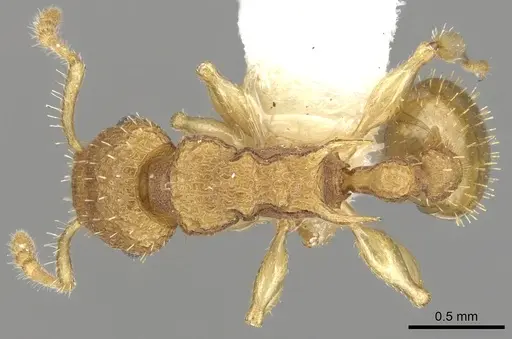
Irodalom
Elterjedési térkép betöltése...Termékek betöltése...