
Vombisidris philax
- Tud. név
- Vombisidris philax
- Nemzetség
- Crematogastrini
- Alcsalád
- Myrmicinae
- Szerző
- Bolton, 1991
- Elterjedés
- 0 országban megtalálható
Bevezetés
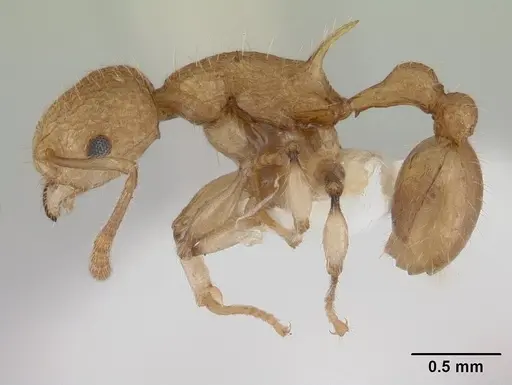
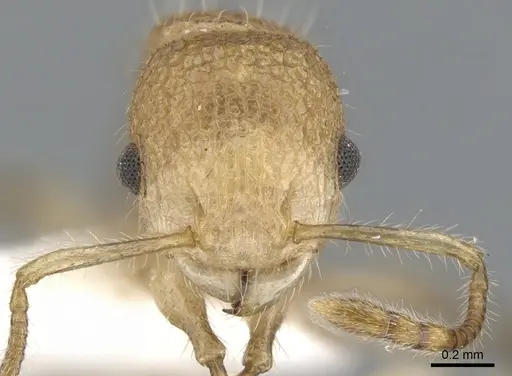
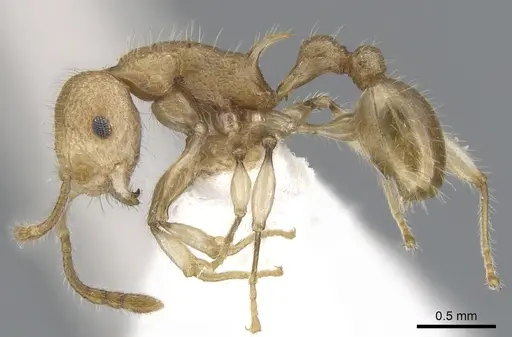
Vombisidris philax is a tiny myrmicine ant known only from the island of Sulawesi, Indonesia. Workers measure 3.4–3.6 mm in total length and are uniformly yellow, with very long, strongly arched propodeal spines and a pair of short vertical teeth on each side of the mesonotum . The front two-thirds of the first gastral tergite are covered in fine longitudinal grooves . The species lives in the canopy of tropical rainforest – the type specimens were collected by fogging a forest tree with pyrethrum . It is extremely rare, with no captive records or known colonies outside the original 1985 collection.
Quick Summary
- Difficulty: Unknown, no captive care literature exists
- Origin & Habitat: Tropical rainforest canopy in North Sulawesi, Indonesia, at 400 m elevation in Dumoga Bone National Park [1]. Collected by fogging a forest tree, confirming arboreal nesting [1].
- Colony Type: Colony structure is unconfirmed – no data on queen number or colony size in the wild
- Size & Growth:
- Queen: Unknown – only workers have been described [1]
- Worker: 3.4–3.6 mm [1]
- Colony: Unknown – no colony data available
- Growth: Unknown
- Development: Unconfirmed – no development data exists for this species (Related Vombisidris species from Thailand and China suggest similar tropical development timelines of several months)
- Antkeeping:
- Temperature: Likely needs warm conditions – aim for 24–28 °C based on its tropical rainforest origin. No direct data available.
- Humidity: High humidity required – as an arboreal tropical species, keep nest substrate consistently moist but not waterlogged. Target 70–85 % relative humidity.
- Diapause: Unlikely – being a tropical species from Sulawesi, it probably does not require hibernation. No data on seasonal behavior.
- Nesting: Arboreal – provide elevated nest options like horizontal acrylic nests, cork bark setups, or naturalistic terrariums with branches. Avoid deep soil nests.
- Behavior: Behavior is unstudied in captivity. Based on genus and morphology, these are likely docile forest ants that forage in the canopy. Their small size (under 4 mm) means escape prevention is critical – use fine mesh barriers. This species belongs to Myrmicinae, tribe Crematogastrini, which uses a smear defense – a modified spatulate stinger that wipes venom onto attackers rather than piercing.
- Common Issues: no captive husbandry information exists – this is an extremely rare species in the antkeeping hobby, escape prevention is critical due to tiny 3–4 mm worker size, arboreal nature means standard test tube setups may not be appropriate, no information on queen founding behavior or colony structure, tropical origin means temperature and humidity control are essential
Distribution and Origin
Vombisidris philax is known only from the island of Sulawesi in Indonesia, specifically North Sulawesi (Sulawesi Utara) in Dumoga Bone National Park at about 400 m elevation [1]. The original type series was collected in February 1985 by fogging a forest tree with pyrethrum, a method used to sample arboreal ants [1]. This confirms the species lives in the rainforest canopy. The genus Vombisidris has since been found in Thailand, Tibet, and other parts of China, but V. philax remains known only from Sulawesi [2][3]. The tropical rainforest provides warm, humid conditions year-round, which should be replicated in any captive setup.
Identification and Morphology
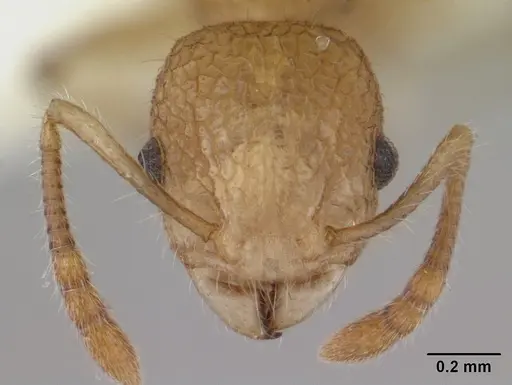
Workers of Vombisidris philax are tiny, measuring 3.4–3.6 mm in total length, with a uniform yellow colour [1]. The head has a fine dense network of wrinkles, and there is a complete groove under the eye. The most distinctive features are the very long, strongly arched propodeal spines and a pair of short vertical triangular teeth on each side of the mesonotum [1]. The front two-thirds of the first gastral tergite are covered in longitudinal grooves [2][3]. The eyes are relatively large. All upper body surfaces have dense, fine hairs [1]. These traits help separate V. philax from other Vombisidris species and are typical of an arboreal, canopy-dwelling lifestyle.
Housing and Nesting
Because Vombisidris philax was collected from forest trees, it is clearly arboreal. In captivity, avoid deep soil nests or standard test tubes meant for ground-nesting species. Instead, provide elevated nest options like small horizontal acrylic nests, cork bark setups, or naturalistic terrariums with branches and moss. Keep the nest humid but well-ventilated to prevent mold. Given the tiny 3.4–3.6 mm worker size, escape prevention is critical – use tight‑fitting lids and fine mesh over ventilation holes. Connect a foraging area (outworld) where you can offer food. Since this species is poorly studied, watch your colony and adjust the setup as needed.
Care Requirements
No captive care literature exists for Vombisidris philax, but we can make informed guesses from its origin. Being from a tropical rainforest, it likely needs warm temperatures (24–28 °C) and high humidity (70–85 %). Use a heating cable on one side of the nest to create a gradient if room temperature is lower. Keep the nest substrate consistently moist but not waterlogged – mist periodically and check condensation. Feed a varied diet including small live prey (fruit flies, springtails, and other micro‑arthropods) and sugar sources (honey water, sugar water). Because it’s arboreal, make sure the setup allows climbing and vertical movement. This species is extremely rare in the hobby, so there is no established care protocol.
Colony Structure and Reproduction
Nothing is known about the colony structure or reproductive biology of Vombisidris philax. The queen has never been described, and there is no data on colony size, number of queens, or founding behaviour. Related Vombisidris species from other regions might give clues, but specific information for V. philax is lacking. If you ever keep a colony, documenting your observations would be valuable for science. The genus Vombisidris is still poorly studied, with only a handful of papers since its description in 1991.
Frequently Asked Questions
How big are Vombisidris philax ants?
Workers measure just 3.4–3.6 mm in total length, making them among the smaller ant species [1]. They are uniformly yellow with very long curved propodeal spines.
Where does Vombisidris philax come from?
This species is native to the island of Sulawesi in Indonesia, specifically North Sulawesi at about 400 m elevation in Dumoga Bone National Park [1]. It is an arboreal ant that lives in the tropical rainforest canopy.
What do Vombisidris philax ants eat?
No specific dietary studies exist for this species. Based on related myrmicine ants, they likely accept small live prey (micro‑arthropods like springtails and fruit flies) and sugar sources (honey water, sugar water). Offer a varied diet and observe what they take.
What temperature do Vombisidris philax ants need?
No captive data exists, but being from tropical Sulawesi, they likely require warm conditions around 24–28 °C. Use a heating cable on one side of the nest to create a gradient if needed.
What kind of nest do Vombisidris philax ants need?
Because they are tree‑dwelling (arboreal), avoid standard test tube setups. Provide elevated nest options like small acrylic nests, cork bark setups, or naturalistic terrariums with branches. Keep the nest humid with good ventilation.
Are Vombisidris philax ants good for beginners?
No – this is an extremely rare species with no captive husbandry information available. There are no care guides, established protocols, or community experience to draw from. It is not recommended for any keeper until more information becomes available.
Do Vombisidris philax ants sting?
As a member of the subfamily Myrmicinae and tribe Crematogastrini, they have a modified spatulate stinger used to smear venom rather than inject it. Given their tiny size, any reaction would likely be mild.
How long does it take for Vombisidris philax to develop from egg to worker?
No development data exists for this species. Being tropical, development probably takes several months, but specific timelines are unconfirmed. Any observations from captive colonies would be scientifically valuable.
Can I keep multiple Vombisidris philax queens together?
No data exists on colony structure. The queen has never been described, and nothing is known about whether this species is monogyne or polygyne. Do not attempt combining unrelated queens without any guidance.
Why is Vombisidris philax so rare in the antkeeping hobby?
This species has only been described from a few specimens collected in 1985 in Sulawesi, Indonesia. No additional field collections or captive colonies have ever been documented. The species remains known only from the original type series, making it essentially unavailable to hobbyists.
Report an Issue
The current care sheet is based fully on literature. See inconsistencies, or something that's incorrect? Please , it will be resolved after review from an admin. Contributing to the blogs tab also helps providing information, to make us be able to further improve the caresheets. Thank you for your support!
References

Ez a tartási útmutató a következő licenc alatt áll: CC BY-SA 4.0 .
Közösségi blogok
CASENT0178736
Megtekintés az AntWeb-en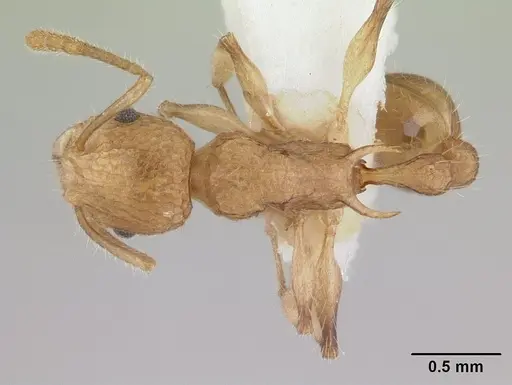
CASENT0901991
Megtekintés az AntWeb-en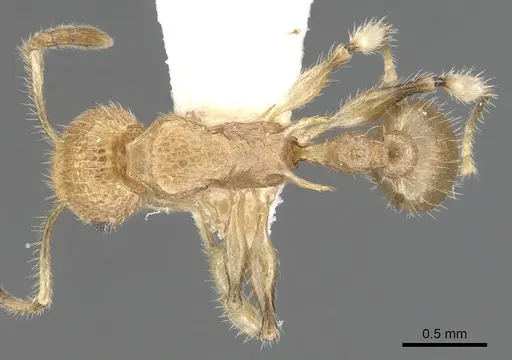
Irodalom
Elterjedési térkép betöltése...Termékek betöltése...