
Vollenhovia mwereka
- Tud. név
- Vollenhovia mwereka
- Nemzetség
- Crematogastrini
- Alcsalád
- Myrmicinae
- Szerző
- Clouse, 2007
- Elterjedés
- 0 országban megtalálható
Bevezetés
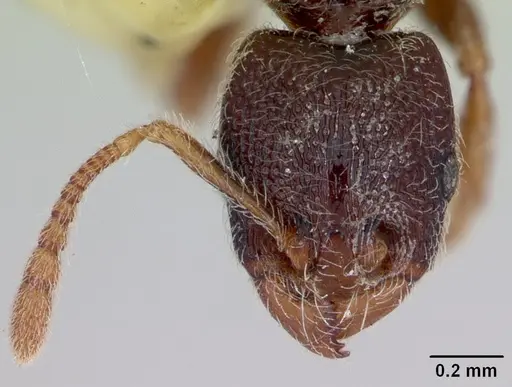
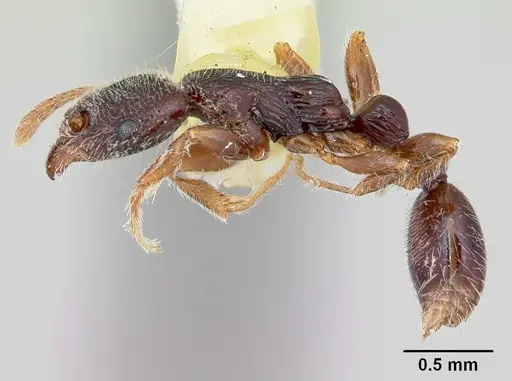
Vollenhovia mwereka is a tiny ant species, measuring just 2.5-2.6mm in total length . Workers have a distinctive heart-shaped head with a deeply concave vertex, and their entire body is covered in thick, wavy, striate sculpture that gives them a wrinkled appearance - exactly what their name means, since 'mwerek' is Pohnpeian for 'wrinkled' . They are deep reddish brown with orange mandibles, antennae, and legs, and have a dense covering of curved standing light-colored hairs across their head, body, and legs . This species appears to be endemic to Pohnpei Island in the Federated States of Micronesia, where it has only been found on Mt. Nahnalaud . Nothing is known about their biology in the wild - this is one of the least-studied ant species, making them a true mystery for antkeepers.
Quick Summary
- Difficulty: Expert
- Origin & Habitat: Endemic to Pohnpei Island, Federated States of Micronesia, specifically found only on Mt. Nahnalaud [2]. The island has a tropical climate with high year-round humidity and temperatures.
- Colony Type: Unknown, colony structure has not been documented. Being a Myrmicinae species, they likely form small colonies typical of the genus, but no data exists on queen number or colony size.
- Size & Growth:
- Queen: Unknown, queens have not been described or measured.
- Worker: 2.50-2.60mm total length [1]
- Colony: Unknown, no colony size data exists
- Growth: Unknown
- Development: Unknown, no development data exists for this species (Development timeline has not been studied. Related Vollenhovia species in tropical regions typically develop from egg to worker in 4-8 weeks at warm temperatures, but this is a rough estimate.)
- Antkeeping:
- Temperature: Keep at 24-28°C, this matches their tropical island origin. Use a heating cable on one side of the nest to create a gentle gradient. Monitor colony activity to fine-tune.
- Humidity: Keep substrate consistently moist. Pohnpei Island is humid tropical forest, so aim for damp substrate conditions with some drier areas available. Mist occasionally and use a water reservoir.
- Diapause: Unlikely, being a tropical species from near the equator, they probably do not require a diapause period. However, some reduced activity during cooler months may occur.
- Nesting: No specific nesting data exists. Based on their small size and the humid forest environment, a test tube or Y-tong block with moist substrate would be appropriate. They likely prefer tight, humid chambers.
- Behavior: Completely unstudied, no behavioral observations have been documented in scientific literature. Based on genus patterns, they are likely docile and non-aggressive. Their tiny size (2.5mm) makes them excellent escape artists, so fine mesh barriers and tight-fitting lids are essential. Do not assume any specific behaviors regarding foraging, aggression, or colony structure.
- Common Issues: no biological data exists, everything about their care is speculative and based on genus patterns, escape prevention is critical due to their extremely small size, cannot verify dietary needs, no feeding observations have been documented, colony structure unknown, do not assume monogyne or polygyne, no data on founding behavior, claustral vs semi-claustral is unknown, risk of colony failure due to unknown specific requirements, potential stress from captive conditions if requirements differ from assumptions
Species Discovery and Taxonomy
Vollenhovia mwereka was first described in 2007 by Ronald M. Clouse from specimens collected on Pohnpei Island in the Federated States of Micronesia [1]. The species name comes from the Pohnpeian word 'mwerek, ' meaning 'wrinkled', a perfect description of their distinctive appearance caused by the thick, wavy, striate sculpture covering their head and mesosoma [1]. The type specimens were collected from Mt. Nahnalaud, the highest point on Pohnpei Island, between 1994 and 2002 [1]. This species appears to be endemic to Pohnpei, meaning it is found nowhere else on Earth [1]. The genus Vollenhovia belongs to the tribe Crematogastrini within the Myrmicinae subfamily. As a member of this tribe, they likely have a modified, flattened spatulate stinger used to wipe or smear venom onto enemies rather than piercing flesh.
Appearance and Identification
Workers of Vollenhovia mwereka are among the smallest ants you could keep, measuring just 2.5-2.6mm in total length [1]. Their most striking feature is their heart-shaped head with a distinctly concave vertex, you can actually see the indentation when viewing them from above [1]. The entire body is covered in deep, rounded rugae (wrinkles) that create their characteristic wrinkled look, with the head sculptured finer than the rest of the body [1]. They are deep reddish brown overall, with contrasting orange mandibles, antennae, and legs [1]. A dense covering of curved standing light-colored hairs covers their head, mandibles, antennae, legs, and anterior pronotum, with hairs becoming longer but sparser toward the rear of the body [1].
Habitat and Distribution
This species is known only from a single location: Mt. Nahnalaud on Pohnpei Island in the Federated States of Micronesia [2]. Pohnpei is a tropical island in the western Pacific with year-round warm temperatures and high humidity. The mountain likely provides a humid forest environment where these tiny ants live. Being endemic to a single island means any captive population of this species would be extremely valuable for conservation, they cannot be found anywhere else in the world [1].
Housing and Setup
Due to their extremely small size of just 2.5mm, excellent escape prevention is absolutely critical. Use test tubes with cotton plugs, and apply fluon to any container edges. A small Y-tong block or test tube setup works best, they need tight chambers scaled to their tiny body size. Keep the nest substrate consistently moist but not waterlogged, mimicking the humid forest floor of their native Pohnpei habitat. A small water reservoir connected to the nest helps maintain humidity. Since nothing is known about their nesting preferences, provide options like moist cotton, small chambers with soil, or plaster nests and observe what the colony prefers.
Feeding and Diet
Dietary requirements are completely unstudied for this species. Being a Myrmicinae ant, they likely accept both sugar sources and protein, but this is speculative. Start by offering a drop of sugar water or honey diluted with water, along with small live prey like fruit flies, springtails, or tiny crickets. Remove uneaten food after 24-48 hours to prevent mold. Do not assume they will accept any specific food, monitor carefully and adjust based on what the colony actually consumes. The complete lack of biological data means you are essentially pioneering their care in captivity.
Temperature and Seasonal Care
Keep the nest at 24-28°C, which approximates the tropical conditions of their Pohnpei Island home. A heating cable on one side of the nest creates a gradient allowing the ants to choose their preferred temperature. As a tropical species from near the equator, they likely do not require a diapause or hibernation period. However, they may show reduced activity during cooler months in your location. Monitor the colony for signs of stress, if workers cluster together excessively or become inactive, consider whether temperature adjustments are needed. No specific research exists on their temperature tolerance, so observe and adjust based on colony behavior.
Frequently Asked Questions
How long does it take for Vollenhovia mwereka to go from egg to worker?
The development timeline is completely unknown, no scientific research has studied their brood development. Based on typical Myrmicinae patterns in tropical regions, expect roughly 4-8 weeks from egg to first worker at optimal warm temperatures, but this is only an estimate. [3]
What do Vollenhovia mwereka ants eat?
Diet is unstudied. Based on genus patterns, they likely accept sugar sources and small protein prey. Offer diluted honey or sugar water and small live prey like fruit flies or springtails. Monitor acceptance and adjust accordingly. This species has never been documented eating anything in scientific literature. [3]
Are Vollenhovia mwereka good for beginners?
No, this is an expert-level species due to the complete lack of biological data. Every aspect of their care is speculative. They require ideal conditions to even survive, and without knowing their specific needs, successful keeping is challenging. Consider starting with better-documented species before attempting this mystery ant. [3]
Do Vollenhovia mwereka ants sting?
As a Myrmicinae species in the tribe Crematogastrini, they likely have a functional stinger. However, their tiny 2.5mm size means any sting would be negligible to humans. No stings have been documented in scientific literature. [3]
How big do Vollenhovia mwereka colonies get?
Colony size is completely unknown, no colony has ever been documented in scientific literature. Related Vollenhovia species typically form small colonies, possibly under 100 workers, but this is speculative for this specific species. [3]
What temperature should I keep Vollenhovia mwereka at?
Aim for 24-28°C based on their tropical Pohnpei Island origin. Use a heating cable on one side of the nest to create a gradient. This is an estimate since no thermal studies exist for this species. [3]
Do Vollenhovia mwereka need hibernation?
Unlikely, being a tropical species from near the equator, they probably do not require a diapause period. However, some reduced activity during cooler seasons may occur. No research exists on their seasonal behavior. [3]
Can I keep multiple Vollenhovia mwereka queens together?
Colony structure is completely unknown. No research documents whether they are single-queen (monogyne) or multi-queen (polygyne). Do not attempt combining unrelated queens, the outcome is unpredictable and no data exists to guide you. [3]
Why are my Vollenhovia mwereka dying?
Without knowing their specific requirements, colony failure is common. Potential issues include: temperature too high or too low, humidity wrong, escape-related losses, stress from unknown dietary needs, or underlying parasites from wild collection. This species may simply not thrive in captive conditions since nothing is known about their biology. [3]
Where is Vollenhovia mwereka native to?
They are endemic to Pohnpei Island in the Federated States of Micronesia, specifically found only on Mt. Nahnalaud. This means they are found nowhere else on Earth. [1][2]
Report an Issue
The current care sheet is based fully on literature. See inconsistencies, or something that's incorrect? Please , it will be resolved after review from an admin. Contributing to the blogs tab also helps providing information, to make us be able to further improve the caresheets. Thank you for your support!
References

Ez a tartási útmutató a következő licenc alatt áll: CC BY-SA 4.0 .
Közösségi blogok
CASENT0173090
Megtekintés az AntWeb-en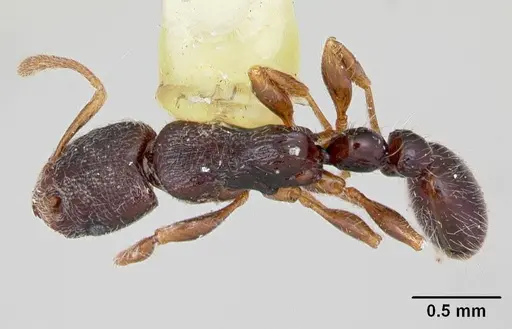
Irodalom
Elterjedési térkép betöltése...Termékek betöltése...