
Tetramorium judas
- Tud. név
- Tetramorium judas
- Nemzetség
- Crematogastrini
- Alcsalád
- Myrmicinae
- Szerző
- Wheeler & Mann, 1916
- Elterjedés
- 0 országban megtalálható
Bevezetés
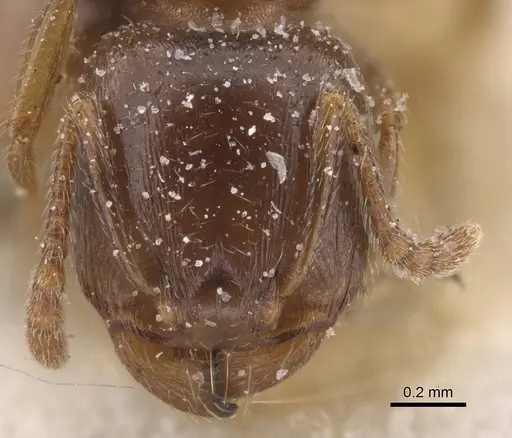
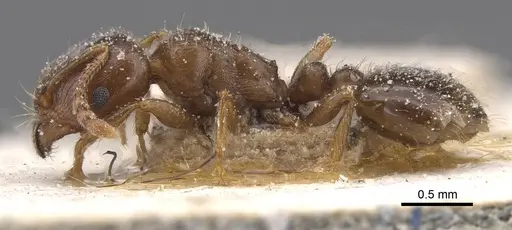
Tetramorium judas is a small ant from the Middle East, known only from the Dead Sea region of Israel and Jordan . Workers are about 3-4 mm long, with the compact, roughened body typical of Tetramorium. The species belongs to the Tetramorium caespitum group and the Tetramorium semilaeve complex, but its exact status is unclear - some researchers treat it as a valid species, others as a subspecies of Tetramorium semilaeve or Tetramorium caespitum . It lives in arid to semi-arid habitats, nesting in soil or under stones, and shows low habitat specificity, appearing in various landscapes without strong ecological preference .
Quick Summary
- Difficulty: Medium
- Origin & Habitat: Endemic to the Middle East (Israel, Jordan, possibly Lebanon, Syria, Saudi Arabia). Found in the Dead Sea area, nesting in soil and under stones in dry, rocky terrain [1][2].
- Colony Type: Likely monogyne (single-queen colonies) based on typical Tetramorium patterns. Colony size probably reaches several hundred workers at maturity, but exact numbers are unconfirmed.
- Size & Growth:
- Queen: Approximately 6-7 mm, inferred from related Tetramorium species [4]
- Worker: 3-4 mm, inferred from Tetramorium genus [4] (direct measurements unavailable)
- Colony: Likely up to several hundred workers at maturity, estimated from genus patterns
- Growth: Moderate
- Development: 6-10 weeks at optimal temperature, estimated from related Tetramorium species (Timing is unconfirmed for this species, based on genus-level data)
- Antkeeping:
- Temperature: Keep at 22-26 °C. This ant comes from a warm, dry region, so it tolerates heat but avoid extremes above 30 °C. Provide a gradient so workers can choose their spot [5].
- Humidity: Moderate humidity, keep the nest substrate slightly damp but not wet. This species prefers drier conditions than many ants, err on the dry side to prevent mold. Avoid waterlogging [4].
- Diapause: Likely a mild winter dormancy. The Dead Sea area has short, mild winters, reduce temperature to 15-18 °C for 2-3 months if you want to simulate natural conditions, but it's not strictly required [5].
- Nesting: Nests in soil with a stone or ceramic lid. A Y-tong (AAC) nest or plaster nest works. Keep the nest chamber slightly moist and the outworld dry. Avoid high-humidity setups [4].
- Behavior: Workers are active ground foragers, hunting small insects, collecting seeds, and tending for honeydew. They are not particularly aggressive but will defend the nest if disturbed. Their defense uses a modified, flattened stinger that smears venom onto enemies rather than piercing (common to the Crematogastrini tribe). Escape risk is moderate, they are not great climbers, but standard barriers (fluon, oil) are still recommended for smooth surfaces [4].
- Common Issues: limited availability, this species is rarely found in the hobby due to its restricted range, humidity management, too much moisture causes mold, keep drier than most ants, wild-caught colonies may carry parasites specific to Middle Eastern ants, taxonomic uncertainty means most care advice is based on inference from related Tetramorium species
Housing and Nest Setup
Tetramorium judas adapts well to standard ant nests. A Y-tong (AAC) or plaster nest works well because you can control humidity. Keep the nest moderately damp, the substrate should feel slightly moist, not wet. The outworld must be dry. Start founding colonies in a test tube with water at one end, then move to a formicarium once the colony reaches 20-30 workers. Provide a small outworld for foraging. This species needs less moisture than many ants, so avoid setups that trap condensation [4].
Feeding and Diet
Tetramorium judas is omnivorous. Give protein 2-3 times a week (small insects like fruit flies, pinhead crickets, or pieces of mealworm). Always keep a sugar source available (sugar water, honey, or commercial ant nectar). They may also collect small seeds. Remove uneaten food after 24 hours to prevent mold. Because they come from a dry area, they can handle short periods with less food better than many moisture-dependent ants [4].
Temperature and Seasonal Care
Keep the nest at 22-26 °C during the active season. This ant tolerates warm conditions but not extreme heat above 30 °C. In winter (November to February), you can reduce temperature to 15-18 °C to simulate a mild dormancy. This is not as critical as for cold-climate species, but it may help synchronize the colony's cycle. Do not cool them below 10 °C. The species' natural range has hot summers and mild winters, so a slight seasonal drop is enough [5].
Colony Founding
New queens likely seal themselves in a chamber and raise the first brood on stored body reserves (claustral founding), though this is unconfirmed for this species. Expect first workers (nanitics) within 6-10 weeks at 24 °C, typical for Tetramorium. Do not disturb the founding chamber for at least 4-6 weeks. Once workers appear, begin feeding small protein and sugar. Founding colonies are sensitive to fluctuations, so keep temperature and humidity stable [4].
Behavior and Temperament
Workers are active ground foragers. They are not especially aggressive toward humans but will defend the nest. The stinger is modified into a spatulate shape used to smear venom onto enemies rather than inject it, a defense mode typical of the Crematogastrini tribe. They do not climb smooth surfaces aggressively, but standard escape prevention is still needed. This species does not show slave-making or other unusual behaviors, it follows typical Tetramorium colony dynamics [4].
Frequently Asked Questions
Is Tetramorium judas a good species for beginners?
It's rated medium difficulty. The main challenges are finding this rare species and managing humidity correctly. If you have basic antkeeping experience, it is manageable, but beginners may struggle with the dry preference and limited availability.
How long does it take for Tetramorium judas to raise first workers?
Expect 6-10 weeks from egg to first worker at around 24 °C. This estimate is based on related Tetramorium species, exact timing for T. judas is unconfirmed.
Do Tetramorium judas ants sting?
They have a stinger, but it is modified to smear venom rather than inject. The sting is mild and not dangerous to humans, more of a nuisance. It is used mainly on prey.
Can I keep multiple Tetramorium judas queens together?
Not recommended. The species is thought to be monogyne (single queen per colony). Combining queens usually leads to fighting. If you find multiple queens, house them separately.
What humidity level do Tetramorium judas need?
Keep the nest substrate slightly moist but never wet, roughly 40-60 % relative humidity in the air is fine. This species prefers drier conditions than many ants. Too much moisture causes mold and can kill the colony.
Do Tetramorium judas need hibernation?
A mild winter dormancy is recommended but not strict. Reduce temperature to 15-18 °C for 2-3 months during winter. Do not go below 10 °C. This simulates the mild winters of their Middle Eastern range.
What do Tetramorium judas eat?
Omnivorous diet: protein (small insects) 2-3 times weekly and constant access to sugar (sugar water, honey, or ant nectar). They may also take small seeds. Remove uneaten food after 24 hours.
How big do Tetramorium judas colonies get?
Likely up to several hundred workers at maturity, an estimate from related Tetramorium. Exact maximum is unconfirmed. Expect moderate growth over 1-2 years.
When should I move Tetramorium judas to a formicarium?
Move from a test tube to a proper nest once the colony has 20-30 workers. Before that, the test tube provides stable founding conditions. Choose a nest that allows you to keep the nest chamber slightly dry.
Why is my Tetramorium judas colony declining?
Common causes: too much humidity (mold), temperature swings, poor diet, or parasites. Review your setup: ensure moderate humidity, stable 22-26 °C, and varied protein. Wild-caught colonies may have parasites, if decline continues, try isolating a small group in a clean setup.
Report an Issue
The current care sheet is based fully on literature. See inconsistencies, or something that's incorrect? Please , it will be resolved after review from an admin. Contributing to the blogs tab also helps providing information, to make us be able to further improve the caresheets. Thank you for your support!
References

Ez a tartási útmutató a következő licenc alatt áll: CC BY-SA 4.0 .
Közösségi blogok
CASENT0915022
Megtekintés az AntWeb-en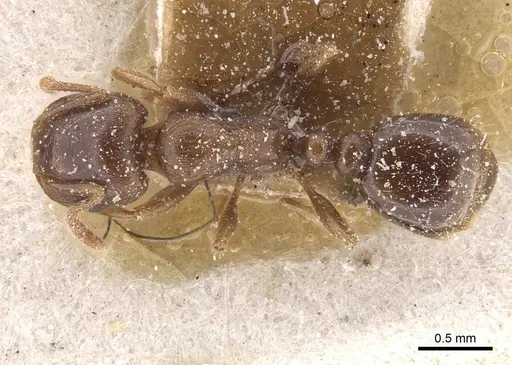
Irodalom
Elterjedési térkép betöltése...Termékek betöltése...