
Temnothorax coleenae
- Tud. név
- Temnothorax coleenae
- Nemzetség
- Crematogastrini
- Alcsalád
- Myrmicinae
- Szerző
- Mackay, 2000
- Elterjedés
- 0 országban megtalálható
Bevezetés
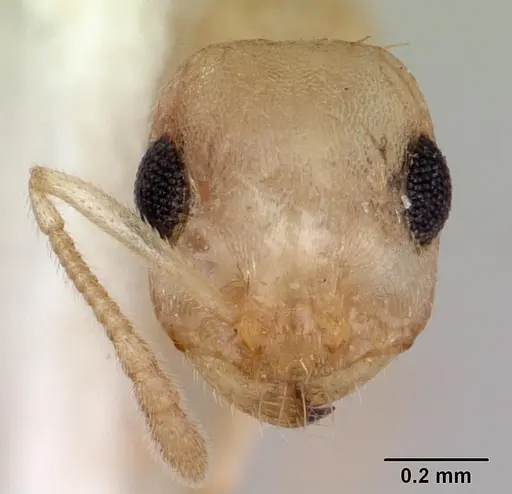
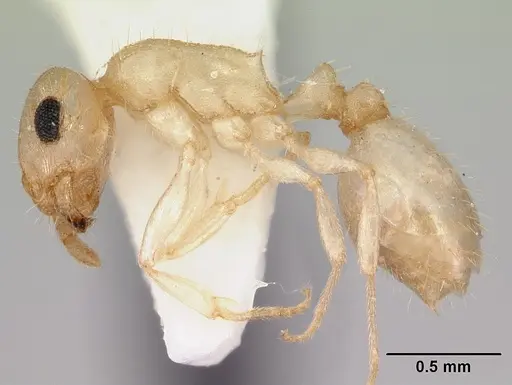
Temnothorax coleenae is a tiny, pale yellow ant species known only from the Chihuahuan Desert in south-central New Mexico. Workers are easily recognized by their light yellow body and large, strongly contrasting black eyes - a clear sign of nocturnal activity . This species belongs to the sallei‑clade and has only ever been collected once, making it one of the rarest North American ants. The head is almost completely covered in tiny punctures, and the petiole has a distinctive ventral flange . Because no colony has ever been found, almost nothing is known about its biology, but its pale color and enlarged eyes strongly suggest it is nocturnal, active during the cooler night hours .
Quick Summary
- Difficulty: Expert
- Origin & Habitat: South‑central New Mexico, USA, in creosote bush (Larrea tridentata) desert bajada habitat [1]. This is classic Chihuahuan Desert terrain, hot, dry, with sparse vegetation.
- Colony Type: Unknown. Only a single worker has ever been collected, so colony structure has not been documented. Based on typical Temnothorax patterns, likely single‑queen colonies [1].
- Size & Growth:
- Queen: Undescribed, no queen specimens have been found [1].
- Worker: Size data unavailable. The only known worker is very small (head length 0.66 mm), but total body length has not been reported [1].
- Colony: Unknown, only a single specimen has ever been collected [1].
- Growth: Unknown, no colony data exists.
- Development: Unconfirmed, no data exists for this species. (No direct development data exists.)
- Antkeeping:
- Temperature: Keep warm, around 22-26 °C. As a desert species it can tolerate higher temperatures, but avoid extremes. Provide a gentle gradient so workers can choose their preferred zone.
- Humidity: Low to moderate. Desert species prefer drier conditions, keep the nest substrate mostly dry with a small moist area. Avoid waterlogging.
- Diapause: Likely yes. Most temperate and desert Temnothorax require a winter rest period. Provide 3-4 months at 10-15 °C during winter.
- Nesting: Y‑tong (AAC) nests work well for these tiny ants, narrow chambers suit their size. Keep ventilation high to prevent mould.
- Behavior: Very little is known about their behavior in captivity. Based on morphology (large eyes, pale color), they are likely nocturnal or crepuscular, active during cooler hours. Workers are tiny and can escape through very small gaps, so escape prevention is critical. Expect them to be shy and non‑aggressive, typical of Temnothorax. They likely forage individually rather than in trails. This species belongs to the Crematogastrini tribe, which uses a smear defense, workers wipe venom onto attackers rather than stinging (general taxonomic knowledge).
- Common Issues: only one specimen ever collected, colonies have never been found or kept in captivity, no established care guidelines exist because the species is effectively unknown in the hobby, tiny size means escapes are likely without fine mesh or a well‑sealed setup, desert origin: may not tolerate high humidity, allow the nest to dry out between waterings, winter dormancy requirements are inferred, not confirmed, wrong temperature could kill the colony
Discovery and Rarity
Temnothorax coleenae is one of the rarest ant species in North America. The entire scientific knowledge of this species comes from a single worker collected in a pitfall trap on July 6,1984,in Doña Ana County, New Mexico [1]. Despite extensive trapping efforts by numerous researchers over several years, covering all seasons and both day and night, no additional specimens have been found [1]. This makes keeping T. coleenae almost impossible, no captive colonies have ever been established, and wild colonies have never been located. The species was originally described as Leptothorax (Myrafant) coleenae and later moved to Temnothorax by Bolton in 2003. The name honors Colleen 'Coco' Adelia Whitford [1].
Identification and Morphology
This species is unmistakable among North American Temnothorax. The combination of pale yellow body with large, jet‑black eyes is striking and unique [1]. Workers have a 12‑segmented antenna, and the head is almost entirely covered in small punctures (tiny depressions), unlike similar species which have smooth, shiny areas. The petiole has a well‑developed ventral flange on the anterior peduncle, ending in a blunt tooth. Propodeal spines are short and flattened laterally. The eyes are unusually large, occupying about one‑third of the head length with approximately 115 facets, clear evidence of nocturnal adaptation [2].
Natural Habitat
Temnothorax coleenae lives in the Chihuahuan Desert, one of the most arid desert regions in North America. The type locality features creosote bush (Larrea tridentata) vegetation on a bajada, a gently sloping fan of sediment at the base of mountains [1]. This habitat is characterised by extreme temperatures, very low rainfall, and sparse vegetation. T. coleenae is one of seven Temnothorax species that inhabit this desert region, along with T. andersoni, T. bestelmeyeri, T. cokendolpheri, T. neomexicanus, T. liebi, and T. bristoli [1]. Its large eyes and pale coloration suggest this species avoids daytime heat by being active at night, a common strategy among desert ants.
Keeping This Species
Since no one has ever kept T. coleenae in captivity, care must be based on inference from related species and its desert habitat. Provide a warm, relatively dry environment, aim for temperatures in the low‑to‑mid 20s Celsius with some variation. A Y‑tong (AAC) nest with narrow chambers suits their tiny size. Escape prevention is critical, these ants can squeeze through gaps that seem impossible. Use fluon on container edges and ensure any gaps in tubing are sealed. Foraging likely occurs at night, so offer small prey like fruit flies or springtails. Sugar water or honey can be offered occasionally. During winter, provide a cool period around 10-15 °C for 3-4 months, this follows patterns seen in other temperate Temnothorax. The biggest challenge is simply obtaining a colony: this species has never been found in sufficient numbers for study. It is not available in the hobby trade, and collecting from the wild is extremely unlikely to succeed. [1]
Frequently Asked Questions
How do I get a Temnothorax coleenae colony?
This is extremely difficult, only a single specimen has ever been collected, and no wild colonies have been documented. You likely cannot obtain this species through normal channels, it is not available in the antkeeping hobby trade and has never been kept in captivity.
What do Temnothorax coleenae ants look like?
They are tiny pale yellow ants with remarkably large black eyes that strongly contrast with their light body colour. Workers have a 12‑segmented antenna, and the head is almost entirely covered in small punctures. The petiole has a distinctive ventral flange [1].
Are Temnothorax coleenae good for beginners?
No, this species is not recommended for anyone. No established care guidelines exist because no one has ever kept a colony, and the species is so rare it cannot be legally obtained. It is effectively impossible to keep as a pet.
What temperature do Temnothorax coleenae need?
Based on their desert habitat, keep them warm at 22-26 °C. Avoid temperatures above 30 °C. Provide a temperature gradient so workers can choose their preferred heat level.
Do Temnothorax coleenae need hibernation?
Likely yes. Most temperate and desert Temnothorax species require a winter dormancy period. Provide 3-4 months at 10-15 °C during winter.
How big do Temnothorax coleenae colonies get?
Unknown, no colony data exists for this species, only a single worker has ever been collected. Based on related species, colonies likely reach a few hundred workers at most.
Are Temnothorax coleenae nocturnal?
Probably yes, their pale coloration and unusually large eyes (occupying about one‑third of head length with ~115 facets) are classic adaptations for night vision. Other desert ants with similar features are nocturnal to avoid daytime heat [2].
What do Temnothorax coleenae eat?
Not directly studied, but based on typical Temnothorax diet they likely eat small insects and arthropods (especially springtails and fruit flies) plus honeydew from aphids. Offer small live prey and occasional sugar water.
Where does Temnothorax coleenae live?
Only in south‑central New Mexico, USA. The type locality is in Doña Ana County, about 45 km northeast of Las Cruces, in the Chihuahuan Desert [1].
Can I keep multiple queens together?
Unknown, no queen specimens have ever been found, so colony structure is completely unconfirmed. Based on related species, most Temnothorax are monogyne (single‑queen).
Report an Issue
The current care sheet is based fully on literature. See inconsistencies, or something that's incorrect? Please , it will be resolved after review from an admin. Contributing to the blogs tab also helps providing information, to make us be able to further improve the caresheets. Thank you for your support!
References

Ez a tartási útmutató a következő licenc alatt áll: CC BY-SA 4.0 .
Közösségi blogok
CASENT0172988
Megtekintés az AntWeb-en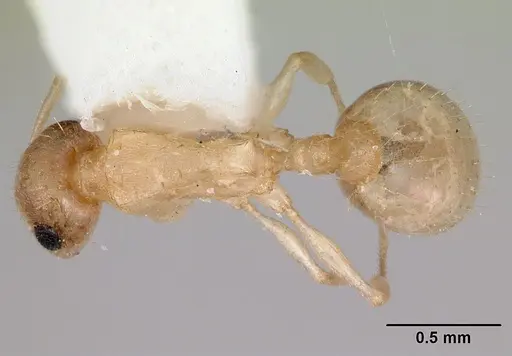
Irodalom
Elterjedési térkép betöltése...Termékek betöltése...