
Strumigenys laevipleura
- Tud. név
- Strumigenys laevipleura
- Nemzetség
- Attini
- Alcsalád
- Myrmicinae
- Szerző
- Kempf, 1958
- Elterjedés
- 0 országban megtalálható
Bevezetés
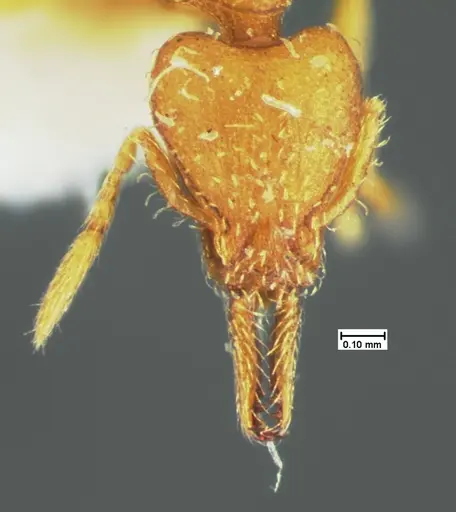
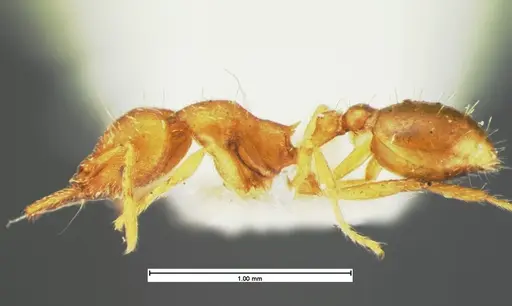
Strumigenys laevipleura is an extremely rare, tiny ant from Colombia, with workers measuring just 2.6-2.7mm in total length . Workers have distinctive long, narrow mandibles with three preapical denticles along the inner margin. Unlike many Strumigenys, they lack flagellate hairs. The postpetiole and first gastral segment are smooth and shining. This species belongs to the gundlachi group and is known only from a handful of specimens collected in Antioquia, Risaralda, and Tolima, Colombia . All known specimens were intercepted from orchid shipments (Miltonia sp.) at US quarantine stations, suggesting an arboreal lifestyle . As a member of the Dacetini tribe, it is almost certainly a specialist predator of springtails and other tiny arthropods.
Quick Summary
- Difficulty: Expert
- Origin & Habitat: Colombia (Antioquia, Risaralda, Tolima) – found in tropical arboreal habitats, intercepted on orchids [2][3][1].
- Colony Type: Unknown colony structure – only workers have ever been documented.
- Size & Growth:
- Antkeeping:
- Temperature: Unclear. Based on its tropical Colombian origin, aim for warm conditions around 24–28°C.
- Humidity: High humidity needed – keep the nest substrate consistently moist but not waterlogged. Avoid giving a specific percentage.
- Diapause: Unlikely – as a tropical species from Colombia it does not experience cold winters.
- Nesting: Likely prefers an arboreal setup. A naturalistic enclosure with moss, leaf litter, or small chambers works. Y‑tong (AAC) or plaster nests with fine chambers are recommended – do not use acrylic nests.
- Behavior: Extremely rare – no documented behavioral observations. As a Dacetini, it is expected to be predatory on springtails and other micro‑arthropods. Its tiny size (2.6mm) means escape prevention must be exceptional, standard mesh will not stop it. It has a functional stinger but is harmless to humans.
- Common Issues: no captive husbandry information exists – this species has never been kept in captivity., extreme rarity makes obtaining a colony nearly impossible., specialist predator requiring live micro‑prey – springtail cultures must be maintained., tiny size creates a high escape risk through standard barriers., unknown colony structure prevents any advice on queen management.
Species Overview and Identification
Strumigenys laevipleura is one of the rarest ants known. Workers are only 2.6–2.7mm long [1]. They belong to the gundlachi group within the Dacetini tribe, with relatively long mandibles (mandibular index 55–57) and three preapical denticles [3]. The median denticle is larger than the proximal one, and the basalmost denticle sits near the apical third of the mandible [3]. Key diagnostic features: no flagellate hairs, postpetiole smooth and shining without an anterior collar, and basigastral costulae absent [1]. The apicoscrobal hair is long and curved, the cephalic dorsum has two pairs of erect filiform hairs [3]. The species was originally described by Kempf in 1958 from specimens intercepted at San Francisco quarantine on an orchid (Miltonia sp.) [1]. Later records come from Antioquia, Risaralda, and Tolima [2][3].
Natural History and Habitat
Almost nothing is known about the natural history of Strumigenys laevipleura. All type material was taken from orchid shipments in quarantine, so the species is thought to be arboreal, living on epiphytic plants or in the canopy [1]. As a Dacetini, it is almost certainly a specialist predator, most likely feeding on springtails (Collembola) and other tiny arthropods. The long mandibles with multiple denticles are adaptations for capturing fast, small prey [1]. The species is only known from Colombia – Antioquia, Risaralda, and Tolima [2][3] – where the climate is tropical to subtropical with high humidity and little temperature variation.
Care Requirements
No captive colonies of Strumigenys laevipleura have ever been kept, so specific care is untested. Based on its likely arboreal origin, you should aim for warm temperatures (roughly 24–28°C) and high humidity – keep the nest substrate moist but not waterlogged. Use a naturalistic setup with live moss, leaf litter, or epiphyte material. Provide small chambers in Y‑tong or plaster (avoid acrylic). Feeding will require live micro‑prey: springtails are the natural prey of Dacetini, so maintain a continuous culture. Tiny sugar sources are unlikely to be accepted. Because workers are only 2.6mm, escape prevention must be extreme – use fine mesh and tightly sealed containers. A test tube may work for a founding queen but a more natural chambered nest might be better.
Challenges and Considerations
Strumigenys laevipleura is among the most challenging ants to keep. No colony has ever been documented in captivity, and wild colonies are extremely rare – only a handful of workers have ever been collected. Obtaining a colony would require locating a wild nest (very difficult given its arboreal habits and tiny size) or connecting with researchers in Colombia. The specialised predatory diet is another hurdle: you would need to maintain springtail cultures continuously, and success is uncertain. Since no husbandry data exists, any keeper would be pioneering all aspects of care. This species is best left as a research interest for advanced antkeepers with specialised setups, rather than a practical species for the hobby.
Frequently Asked Questions
Can I keep Strumigenys laevipleura in a test tube?
Possibly, but no one has ever documented keeping this species. Given its tiny size and likely arboreal habits, a naturalistic setup with small chambers and live moss may be more appropriate. No captive husbandry data confirms this.
What do Strumigenys laevipleura ants eat?
As a Dacetini, it is almost certainly a predator of springtails and other tiny arthropods. No feeding observations exist for this species, but related Strumigenys exclusively hunt live micro‑prey. You would need to maintain continuous springtail cultures. Sugar sources are unlikely to be accepted.
How long does it take for Strumigenys laevipleura to develop from egg to worker?
This has never been documented. No captive colonies exist, so no development timeline is available. Based on similar tiny Myrmicinae, development might take 4–8 weeks at warm temperatures, but this is speculative.
Are Strumigenys laevipleura ants good for beginners?
No. This is an expert‑level species, and realistically it is not suitable for the hobby at all, since no captive colonies have ever been documented. The species is extremely rare, requires specialised predatory feeding, and has no established husbandry protocols. Beginners should choose more documented species.
Where does Strumigenys laevipleura live in the wild?
Only known from Colombia (Antioquia, Risaralda, Tolima). All known specimens were intercepted from orchid shipments, suggesting an arboreal lifestyle on tropical plants. The species has never been documented in natural field collections [2][3][1].
How big do Strumigenys laevipleura colonies get?
Unknown. Only a handful of workers have ever been documented, and no colony size data exists. Related Strumigenys species may reach several hundred workers, but this is speculative.
Do Strumigenys laevipleura ants need hibernation?
No. As a tropical species from Colombia, it does not experience cold winters and would not benefit from hibernation. Keep it at warm, stable temperatures year‑round (roughly 24–28°C).
Can I keep multiple queens together?
Unknown. The colony structure of this species has never been documented. Only workers have been observed, and no queen specimens have been described. There is no data to support any recommendation.
Why is Strumigenys laevipleura so rare?
This species is known from only a handful of specimens collected over decades. The extreme rarity likely reflects both genuine biological scarcity and the difficulty of collecting arboreal ants in tropical forests. They may have very localised distributions or live primarily in forest canopies where they are rarely encountered [1].
Report an Issue
The current care sheet is based fully on literature. See inconsistencies, or something that's incorrect? Please , it will be resolved after review from an admin. Contributing to the blogs tab also helps providing information, to make us be able to further improve the caresheets. Thank you for your support!
References

Ez a tartási útmutató a következő licenc alatt áll: CC BY-SA 4.0 .
Közösségi blogok
CASENT0105567
Megtekintés az AntWeb-en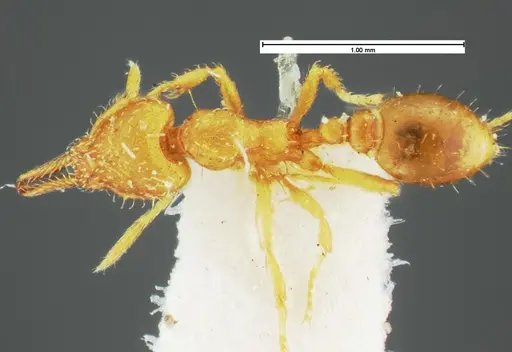
Irodalom
Elterjedési térkép betöltése...Termékek betöltése...