
Stenamma ailaoense
- Tud. név
- Stenamma ailaoense
- Nemzetség
- Stenammini
- Alcsalád
- Myrmicinae
- Szerző
- Liu & Xu, 2011
- Elterjedés
- 0 országban megtalálható
Bevezetés
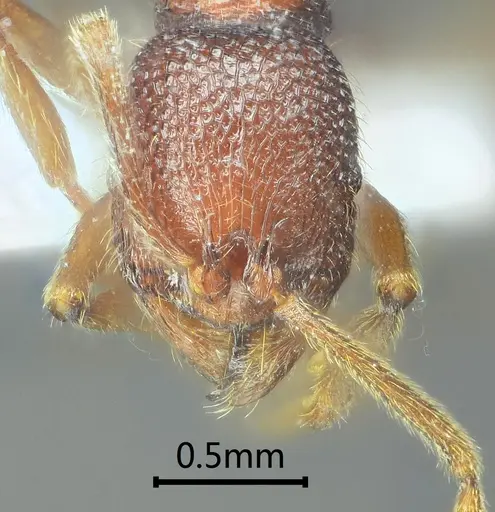
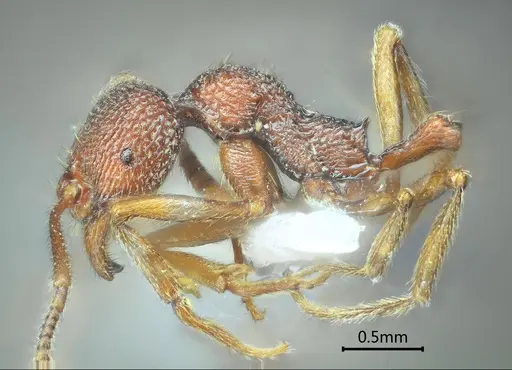
Stenamma ailaoense is a small ant known only from a single worker specimen collected in the high mountains of Yunnan Province, China. Workers are reddish-brown with yellowish-brown legs and black eyes . The species was discovered at 2500 m elevation on Mt. Ailao in a sub-alpine moist evergreen broadleaf forest, and it has also been recorded from conifer-broadleaf forest at 2056 m in Sichuan . It is closely related to Stenamma nipponense but differs in having a longer head and scapes, a shallower metanotal groove, broader trapezoidal propodeal plates, and a retirugose propodeal dorsum . Due to its very limited known distribution and the lack of colony observations, this species is poorly understood and rarely encountered.
Quick Summary
- Difficulty: Unknown, likely Medium to Hard
- Origin & Habitat: Mt. Ailao, Yunnan Province, China at 2500 m elevation. Found in sub-alpine moist evergreen broadleaf forest [1]. Also recorded from conifer-broadleaf forest in Wanglang Nature Reserve, Sichuan at 2056 m [2]. Palearctic region, extratropical [3].
- Colony Type: Unconfirmed. Colony structure is not documented.
- Size & Growth:
- Queen: Unknown, not described.
- Worker: Total length not recorded. The head length is 1.03 mm, which indicates a small species [1].
- Colony: Unknown. Likely small (under a few hundred workers) based on related Stenamma species.
- Growth: Unknown
- Development: Unknown, no data available. (Cool mountain habitat suggests development would be slower than in tropical species, but no direct observations exist.)
- Antkeeping:
- Temperature: Unknown. Based on its high-elevation forest habitat, it likely requires cool, stable conditions (16-20 °C). Avoid warm temperatures.
- Humidity: High humidity is likely essential. Keep the nest substrate consistently moist but not waterlogged, mimicking the damp soil of its natural forest floor.
- Diapause: Likely yes. Because it is an extratropical species from temperate China [3], it probably needs a winter dormancy period. Reduce temperature to 10-15 °C for 3-4 months.
- Nesting: Nests in soil [2]. Provide a deep, moist substrate such as natural soil or a test tube setup with a large water reservoir.
- Behavior: Behavior is poorly documented. Based on related Stenamma species, workers are likely slow-moving, cryptic, and non-aggressive. They probably forage mostly within soil and leaf litter. Escape risk is moderate due to small size.
- Common Issues: unknown founding requirements make colony establishment speculative, maintaining cool temperatures (16-20 °C) can be difficult in warm climates and may stress the ants, high humidity levels are critical, if the substrate dries out, the colony will likely die, very limited knowledge about diet, brood development, and colony structure increases the risk of mistakes, small worker size means standard escape barriers (e.g., fluon, oil) must be applied carefully
Discovery and Distribution
Stenamma ailaoense was described in 2011 from a single worker collected in Yunnan Province, China [1]. The type locality is Mt. Ailao at 2500 m elevation in a sub-alpine moist evergreen broadleaf forest. The species has also been recorded from Wanglang Nature Reserve in Sichuan at 2056 m [2]. These are the only two known sites, making this a very rare ant in the wild. The name 'ailaoense' refers to Mt. Ailao [1]. Biogeographic analyses classify it as a Palearctic, extratropical species [3].
Identification and Morphology
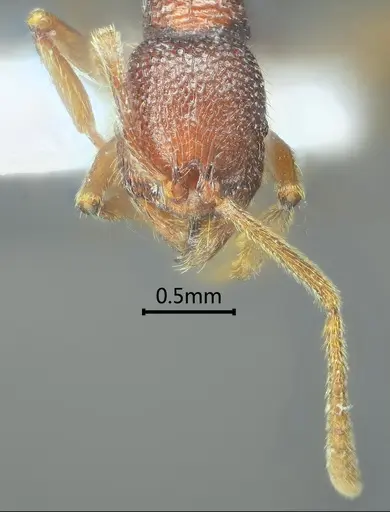
Only workers have been described. The head is roughly rectangular in full‑face view, longer than broad, with a straight occipital margin and roundly prominent occipital corners. The mandibles have three distinct apical teeth followed by eight small denticles. The antennae are 12‑segmented with a 5‑segmented club, the scapes are long, surpassing the occipital corners by about one‑sixth of their length. The body is reddish brown, the appendages yellowish brown, and the eyes and masticatory margins of the mandibles are black. The propodeal spines are slender, about half the length of the declivity, and the propodeal plates are broad and nearly trapezoidal [1][4].
Natural History
This species inhabits conifer‑broadleaf forests at elevations of 2056-2500 m [2]. It nests exclusively in soil and forages within soil layers [2]. The narrow elevational range and limited habitat (only moist, cool forests) suggest it is sensitive to environmental changes. The sub‑alpine moist evergreen broadleaf forest of Mt. Ailao provides stable cool temperatures and high humidity through leaf litter and soil moisture.
Housing and Nesting
Base the setup on its natural soil‑nesting habit [2]. Provide a deep layer of natural soil or a test tube with a large water reservoir. The substrate must be kept moist but not waterlogged. A gradient of moisture within the nest area is ideal. Because the species comes from a cool climate, keep the nest at room temperature (18-22 °C) at most, and avoid any direct heat. Use barrier methods (fluon or oil) to prevent escapes, as workers are small.
Feeding and Diet
The diet of Stenamma ailaoense has not been documented. Based on related Stenamma species, it may accept small arthropods (e.g., fruit flies, small crickets) and sweet liquids (honeydew or sugar water). Offer tiny portions and remove uneaten food to prevent mold, especially in a humid setup. The best approach is to experiment with small amounts of protein and sugar sources.
Seasonal Care and Overwintering
Because this species is extratropical and originates from temperate China [3], a winter dormancy period is probably necessary. From late autumn to early spring, gradually reduce the temperature to 10-15 °C for 3-4 months. During this time, reduce or stop feeding and minimize disturbance. Natural daylight cycles can be followed. After the diapause period, slowly warm the colony back to normal activity levels.
Frequently Asked Questions
How do I keep Stenamma ailaoense ants?
Provide a soil‑based nest with constantly moist substrate, cool temperatures (16-20 °C), and a winter diapause. This species is poorly studied, so success is uncertain. Use a test tube or naturalistic soil setup and avoid overheating.
What temperature do Stenamma ailaoense ants need?
Based on its high‑elevation habitat, keep the colony cool, around 16-20 °C [1][2]. Do not use heating cables or mats. Warm temperatures above 25 °C are likely harmful.
What do Stenamma ailaoense ants eat?
The diet is unknown. Try offering small insects (fruit flies, small mealworms) and sugar water or honey in tiny amounts. Remove leftovers to prevent mold.
How big do Stenamma ailaoense colonies get?
Colony size is unknown. Related Stenamma species form small colonies, typically under a few hundred workers. Do not expect a large, populous nest.
Do Stenamma ailaoense ants need hibernation?
Yes, likely. Because they come from a temperate region with cold winters [3], provide a 3‑4 month diapause at 10-15 °C.
How long does it take for Stenamma ailaoense to develop from egg to worker?
Development time is unknown. Based on related cool‑climate Stenamma, it may take 8-12 weeks at optimal temperatures, but this is a rough estimate.
Are Stenamma ailaoense ants good for beginners?
No. Very little is known about this species. It has specific cool‑temperature and high‑humidity requirements, and colony founding is not documented. Start with more common and forgiving species.
Where is Stenamma ailaoense found?
It is known only from Mt. Ailao in Yunnan Province (2500 m) and Wanglang Nature Reserve in Sichuan (2056 m) [1][2]. Both sites are sub‑alpine moist evergreen broadleaf forests.
Can I keep multiple Stenamma ailaoense queens together?
Colony structure is unknown. There is no evidence of polygyny or pleometrosis. Do not attempt to combine queens unless you have reliable data.
Why is my Stenamma ailaoense colony dying?
Likely causes: temperatures too warm, humidity too low, or unknown founding needs. Keep the nest cool (16-20 °C) and the substrate consistently moist. Avoid disturbing the queen during founding. If problems persist, check for mold or insufficient food.
Report an Issue
The current care sheet is based fully on literature. See inconsistencies, or something that's incorrect? Please , it will be resolved after review from an admin. Contributing to the blogs tab also helps providing information, to make us be able to further improve the caresheets. Thank you for your support!
References

Ez a tartási útmutató a következő licenc alatt áll: CC BY-SA 4.0 .
Közösségi blogok
ANTWEB1060575
Megtekintés az AntWeb-en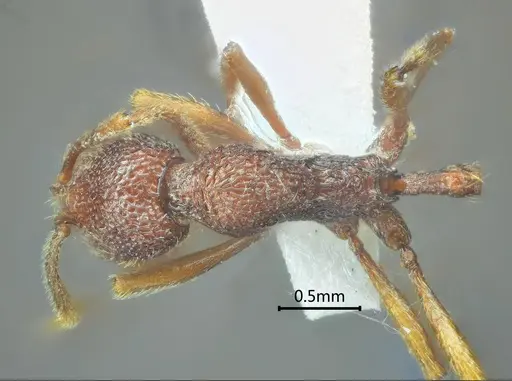
Irodalom
Elterjedési térkép betöltése...Termékek betöltése...